
The Lake Was Closed, But the Day Was Open
It’s been a slow couple of weeks in the diving department. Not for want of effort — I logged more miles driving up the shore than I did minutes underwater. The lake was frozen, slushed over, or simply hostile to the concept of human entry. And yet somehow, despite the repeated rejection, something worth showing up for kept appearing anyway.
Heather is currently hobbling around on a fractured foot — specifically a Jones fracture, which sounds less like an orthopedic injury and more like a small coastal town in Maine. The break sits in the fifth metatarsal on the outer edge of the foot, in a section of bone with notoriously poor blood supply. Other fractures knit together. Jones fractures take their time, and occasionally decline to reconnect at all — a condition orthopedic surgeons refer to as a nonunion.
In short: not the sort of fracture you want to annoy.
Which ruled out hauling forty pounds of scuba gear across icy rocks.
I made what I hoped was a tactful suggestion. “If that were my foot,” I said carefully, “I’d probably skip the dive.” She got the message.
Adam was to join us that day, but cancelled what was to be a dive at the Two Harbors Breakwall. A last-minute call, entirely reasonable, as he had assumed Heather was still diving and didn’t realize he was leaving me without a buddy.
Which is how I found myself heading up the shore with Heather riding along as surface support — which, given that she is currently only slightly more mobile than a folding lawn chair, was mostly moral support in the parking lot. Still, she said it was nice to get out of the house. She was already developing a slight case of cabin fever, and with a foot that treated every step like a formal complaint, even sitting by the lake watching someone else dive sounded like a proper outing.
The Breakwall was frozen solid for several hundred yards. The lake, apparently, had not gotten my memo about conditions improving. I stood there for a moment taking inventory of the morning: one dive buddy with a fractured foot, another who had cancelled at the last minute, and now a lake that had sealed itself off like a disgruntled landlord. At some point the universe stops sending hints and starts using a bullhorn. I suggested breakfast.
So we went to the Vanilla Bean, where I ordered a cinnamon roll that appeared to have been frosted by someone using a drywall trowel — two inches of cream cheese icing. It was magnificent. I managed the cinnamon roll and roughly half an omelette before conceding defeat.
There are worse consolation prizes.
By Monday I was restless. Weekly dives have quietly become something of a mental multivitamin, and without them I begin to feel slightly off — like a Golden Retriever that hasn’t been walked, growing incrementally more erratic with each passing day. So when my days off appeared on the schedule, I made a decision.
I was going to the Madeira. Solo. With a self-timer, a tripod, and a photograph I’d been trying to make for months — a slightly underexposed shot of the stern, Me holding a video light illuminating the deck hardware and looking trim and controlled.
Underwater self-portraits with off-camera lighting are, to put it charitably, fiddly. The setup involves a tripod, a timer, swimming back into frame, and hoping that the light is bright enough, and that I don’t look like someone who has accidentally wandered into the photograph. It’s what my photo buddy Sparky calls ‘low percentage shooting”.
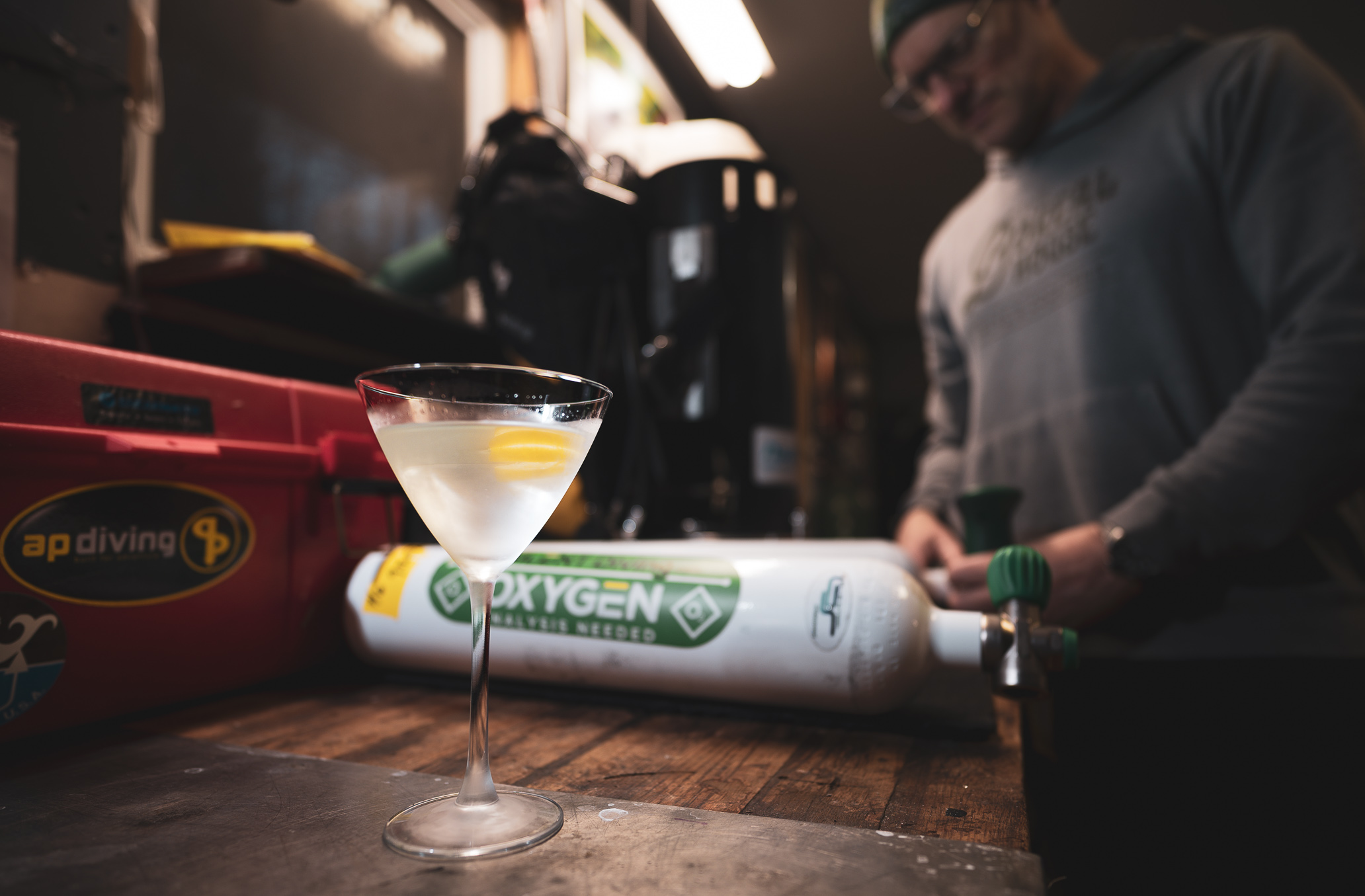
Sunday night, assembling the rebreather over a ritual martini, a small and reasonable voice in the back of my head began suggesting that solo diving in Lake Superior in February might warrant some reconsideration. Not necessarily abandonment. Just reconsideration.
Some people meal prep on Sundays. I mix martinis and assemble rebreathers. Same idea, higher stakes.
Solo diving already earns a raised eyebrow from most training agencies — remove your buddy and you remove the person most likely to notice when things go wrong. Add near-freezing water, a rebreather with more ways to fail than a Minnesota power grid in January, and ice sheets that drift with the wind and can quietly slide over your entry point while you’re below, leaving you beneath a lid you didn’t ask for — and the risk calculus shifts considerably. Solo diving is a yellow-zone decision. Solo diving Lake Superior in February is a different conversation entirely.
I responded by packing my topside camera gear — a backup plan for the backup plan — and went to bed.
By morning the car looked like a small expedition vehicle. Dive gear, tripods, camera equipment, a shovel, snowshoes, and a sled. The sun was out. Temperatures were pushing forty degrees.
Practically tropical.
The Breakwall in Two Harbors was still frozen solid.
I was about to accept the message and head back to the car when I noticed a thin strip of open water along the second leg — the section where the wall makes a slight turn about halfway out. I walked toward it.
The wind was cutting straight through my jacket and then, over the sound of it, I heard something else: ice crashing, grinding, stacking. I started walking faster. By the time I reached the end of the wall, sheets of ice were folding and shattering against it, pushed along the shoreline by the wind in slow, relentless procession.
I stood there and watched it for a while.
It’s the kind of thing you can’t plan for — a spectacle that only exists because you happened to show up on the right day at the right time for the wrong reason. I filmed it on my phone, then ran back to the car for the Nikon. By the time I returned it had calmed slightly, but the ice was still moving, still grinding, still doing something that felt important to witness.
I hadn’t even gotten underwater yet and the day had already delivered.
Still, the car was full of gear, and I continued north toward the Madeira to check conditions. Burlington Bay: frozen solid. Gooseberry: frozen. When I reached Split Rock Lighthouse State Park, I found the parking lot was buried behind a five-foot plow bank and a foot and a half of snow. Some areas nearby had apparently received more than forty inches in the recent storm. Minnesota winters like to make sure you haven’t forgotten who’s in charge.
The ranger let me park on the road despite the half a dozen signs suggesting otherwise. I strapped on the snowshoes — not commonly featured on the equipment list for a shore dive, but the snow was deep and completely untracked — and hiked down to scout conditions.
The water was open.
Technically.
For a hundred yards offshore the lake was filled with broken ice chunks and thick slush, shifting and grinding in slow motion. Open water in the same sense that a Dairy Queen Blizzard is technically liquid. Enterable, certainly. But solo, in February, it felt less like adventure and more like an excellent way to appear in a cautionary tale.
I filmed it, sent the video to Heather and Adam — “This would have been EPIC” — and hiked back up through the snow.
It was a strange day. No dive. No photograph. And yet the ice at the Breakwall, the snowshoe hike, the thick slush moving in the cove — there was something in all of it that felt like enough. The lake had said no, clearly and repeatedly, and the day had still found a way to be worth showing up for.
That week I had an aquarium dive. The duties are fairly standard: feed the sturgeon, scrub some rocks, make bubble rings for kids in the viewing window. The bubble rings are easily the best part of the job.
I was setting up in the dive room when I felt the faintest whisper of what might have been a leak near the tank valve. I leaned in close. Put my ear practically against the fitting.
Nothing.
A few minutes later my dive buddy Zack walked in from across the room and said, casually, “You’ve got a leak.”
A fairly energetic one, apparently. Audible from twenty feet.
I had been standing with my ear touching it and heard nothing. It was one of those small moments that makes you feel suddenly ten years older and strongly suggests another conversation with an audiologist.
Thursday brought freezing rain. By morning everything outside was encased in ice — branches, railings, the car, the bird feeder I had mostly neglected all winter.
I spent the morning indoors servicing the first-stage regulators on my rebreather — three years without attention, which in scuba terms is politely described as overdue. What followed was several hours of disassembly, oxygen cleaning, meticulous drying, and repeated consultation of service manuals. Working on oxygen-service regulators requires a specific kind of focused patience: everything must be spotless, reassembly order matters enormously, and there’s always the quiet awareness that oxygen systems respond to contamination with considerable enthusiasm for combustion.
Three years overdue for service and now spread across the bench like a mechanical autopsy. Fortunately, it all went back together with no mysterious “extra” parts.
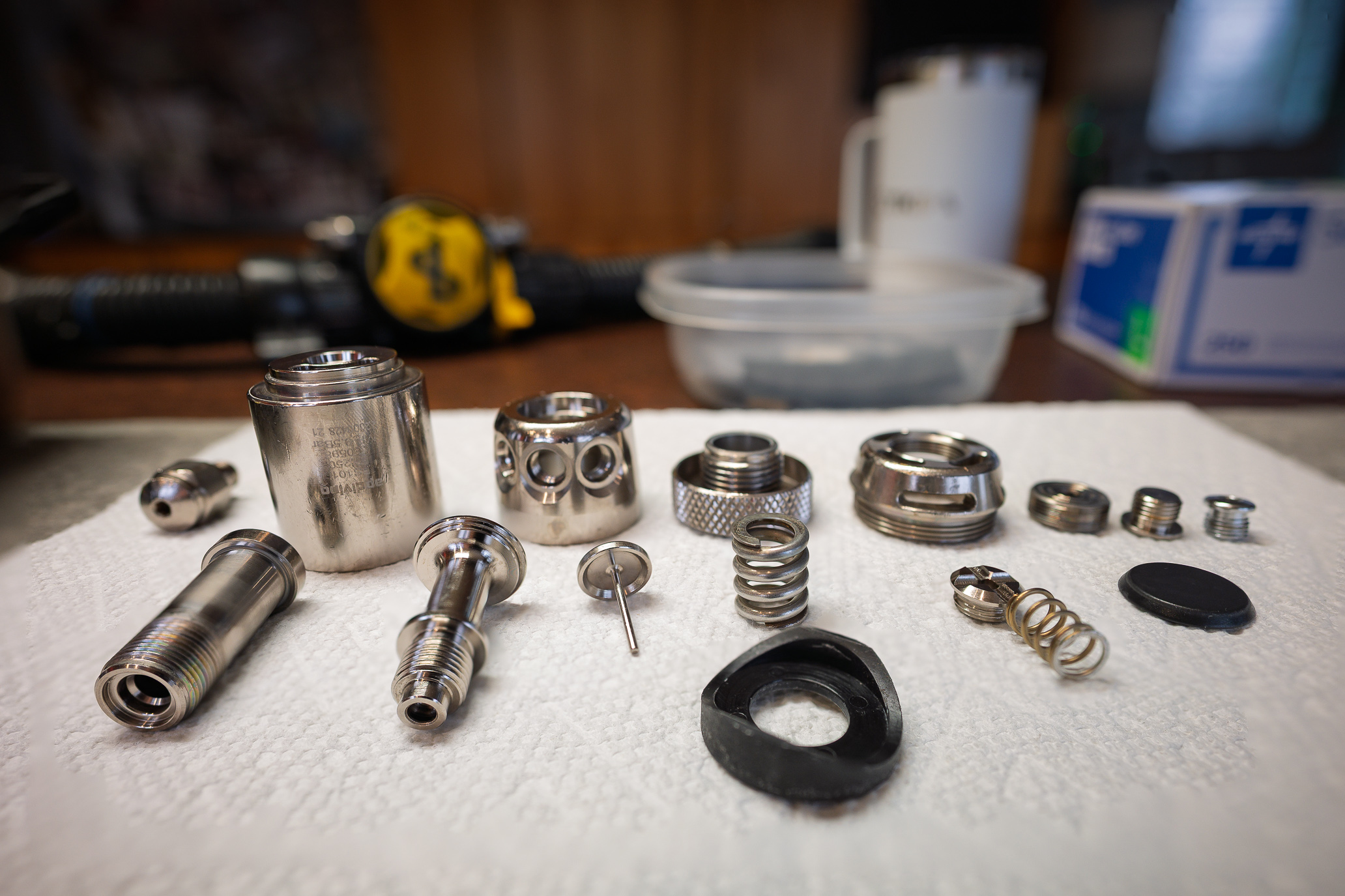
By early afternoon the intermediate pressures held steady and adjusted cleanly to factory spec. I left everything pressurized as a leak test and went outside.
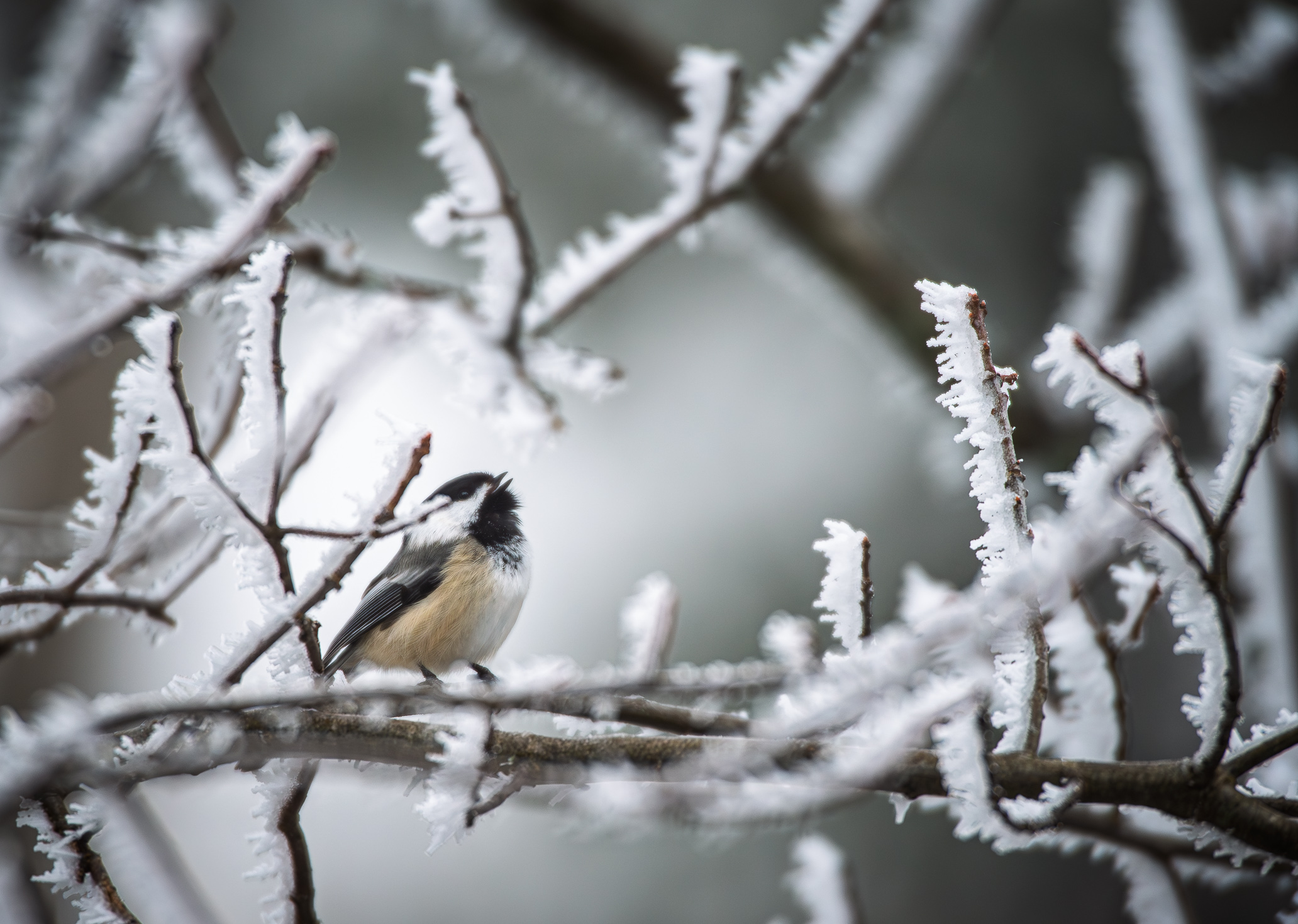
The trees were extraordinary — every branch glazed and catching the light. I grabbed sunflower seeds and my Merlin app and the birds, forgiving about the winter’s neglect, returned almost immediately. I cued up some bird calls on the app, and the Black-capped Chickadee arrived first, as they always do, conducting their own private audit of the branches.
I managed a photograph I rather like.
By evening the 1st stage intermediate pressures on my regulators was unchanged. For a first attempt, no spare parts mysteriously left on the bench, that felt like a genuine win.
It didn’t manage to dive. But somewhere between the ice at the Breakwall, the snowshoe hike through untracked snow, the rebuilt regulators that held pressure, and a chickadee in a frozen tree — the week had quietly assembled itself into something worth writing about.
Adam is back from Mexico next week. Heather has her ortho follow-up on Wednesday, and with a little luck she’ll be back in the water before the month is out. Things are trending in the right direction.
But honestly, the last couple of weeks were a reasonable reminder that the adventure doesn’t require a dive plan. A sheet of ice moving down a frozen Breakwall, an untracked snowshoe hike through forty inches of fresh snow, a chickadee in a frozen tree — Lake Superior has a way of being worth showing up for even when it won’t let you in. You just have to leave the house.