
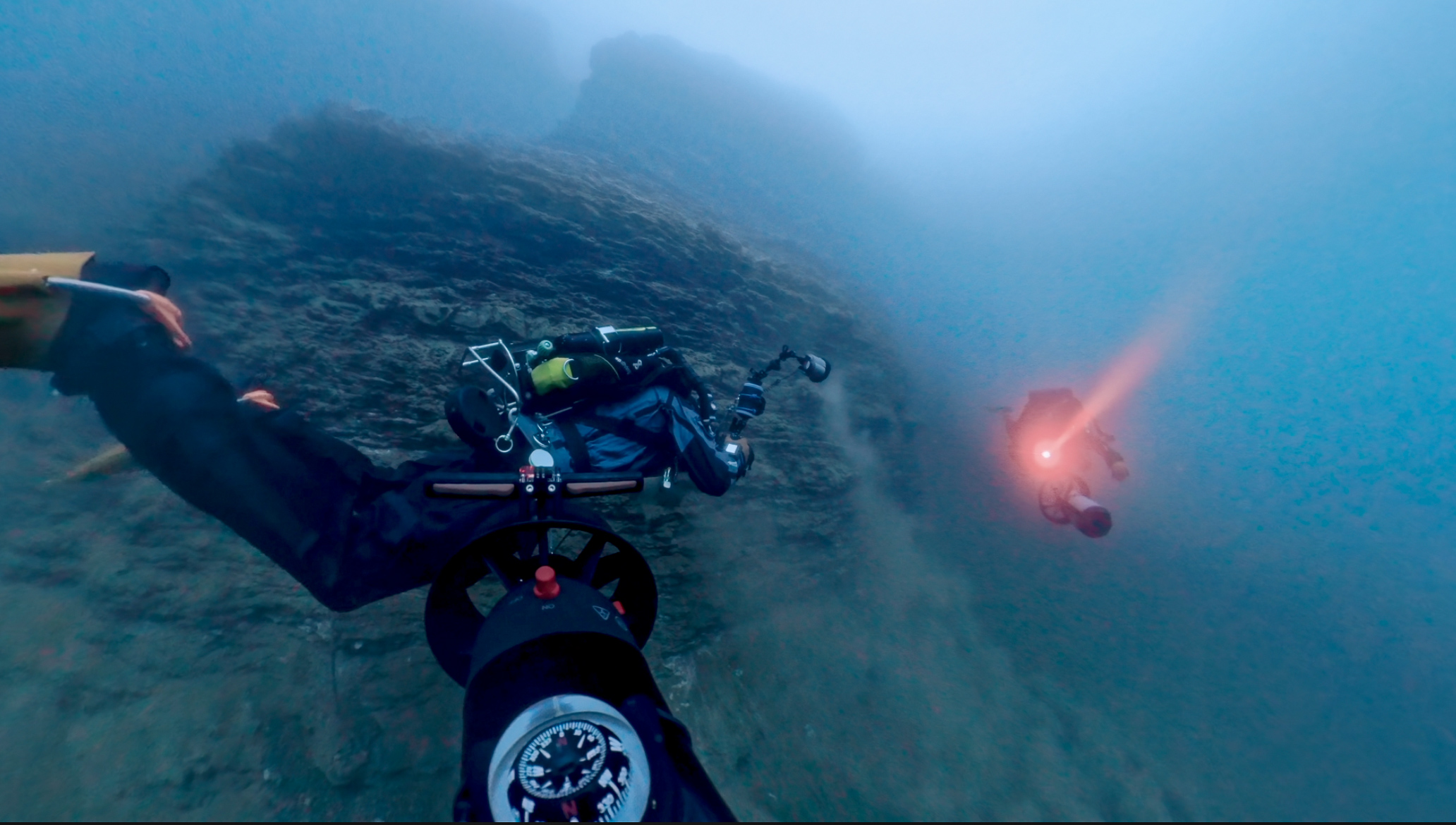
Blue Water and Quiet Competence
Last week’s entry documented, in some detail, my talent for compass confusion and general underwater fumbling. In the interest of balance, I should mention that occasionally the opposite happens.
This was one of those weeks.
Two dives. Two flooded iron mines on the Mesabi Range. Both deep, both cold, both near the edge of what my training permits, and both ~ almost suspiciously ~ smooth.
Which, as it turns out, is its own thing to pay attention to.
Tioga Pit rarely gets mentioned in Minnesota diving conversations, which is baffling, because the visibility is extraordinary. Standing on shore the water looks Caribbean-blue right up until you remember it’s thirty-eight degrees and only slightly warmer than my freezer door martini.
The main attraction is the wall. Around fifty feet it drops vertically toward 225 in that strange emerald-blue that abandoned mine pits develop over decades of clean groundwater seeping in ~ fading slowly to black in the depths below, somewhere between ethereal and quietly unsettling. Historically we’d swim sections of it for a couple hours but barely cover any distance. On scooters, you fly.
That’s the only word for it.
There’s a particular feeling that comes from moving effortlessly beside something massive. The wall rolls on beside you like the side of a submerged stadium while the bottom disappears into blue-black nothingness. Your own scale becomes briefly irrelevant. You stop thinking and just glide.
Tioga also contains an alarming number of underwater skeletons. Plastic ones, thankfully. Everything from small dogs to ten-foot humans scattered around the pit by someone who apparently decided the abandoned mine needed stronger haunted-house energy. There’s also a submerged cross marking a fiber optic cable ~ which means at various points the scenery consists of cold black water, sheer drop-offs, skeletons, and religious symbolism.
For most people this would qualify as a psychological evaluation.
For divers, it’s apparently décor.
What struck me most, though, was how calm I felt. A few years ago, spending thirty minutes between 100 and 130 feet meant monitoring every sound, every vibration, every slight change in breathing with the intensity of a bomb technician cutting wires. Useful, certainly. Also exhausting. Now the caution is still there ~ probably more than before, honestly ~ but it sits quieter. Less panic, more attention.
Enough attention, anyway, to notice how genuinely good the dive was.
We eventually circumnavigated the entire pit ~ something I’d never seriously considered before scooters. By rough geometry it’s just over a mile. I surfaced with seventy percent battery remaining, which felt deeply unfair in the way good technology sometimes does.
St. James Pit sits near Aurora ~ another flooded iron mine, another steep wall, another cold clear lake that once supplied ore and now supplies divers with a short route to serious depth. Also part of Aurora’s municipal water supply, which I try not to think about while diving it.
The ongoing project of hauling a DPV, an eighty cubic foot bailout cylinder, a 360 camera, and a full-sized camera housing to the water without looking like I’m moving my college kids out of their sorority house continues. Entry and exit still resemble a chaotic and expensive yard sale. A third arm would help. I’m looking into it.
St. James is considerably darker than Tioga ~ properly dark at depth, the kind of dark where a powerful light stops being optional at noon and arriving without one feels like poor planning of a kind that becomes immediately and completely obvious.
And then, somewhat accidentally, I found myself at 139 feet.
Nine feet past my certification limit, through no deliberate boundary-testing. The wall simply kept going. I was relaxed, enjoying the scenery. And the narcosis ~ that pleasantly dreamy nitrogen-fueled sense that everything is fine and also quite beautiful ~ was slowly increasing the dosage. My vision had settled into a comfortable two-martini blur when the depth alarm on my handset started rattling my forearm and my brain back to attention.
Which is, of course, exactly how it works.
Narcosis doesn’t announce itself. It doesn’t say “just so you know, your judgment is currently running about fifteen percent softer than usual.” It just makes the wall look particularly compelling and your own decisions feel particularly sound.
I was fine. But 139 feet is worth writing down ~ not as achievement, but as a reminder of how normalization of deviance works. The gradual process by which manageable risk becomes routine ~ each smooth dive expanding slightly what feels acceptable, until the next push feels less like a boundary and more like a baseline. It doesn’t feel like drift. It feels like competence. Which is precisely what makes it worth watching.
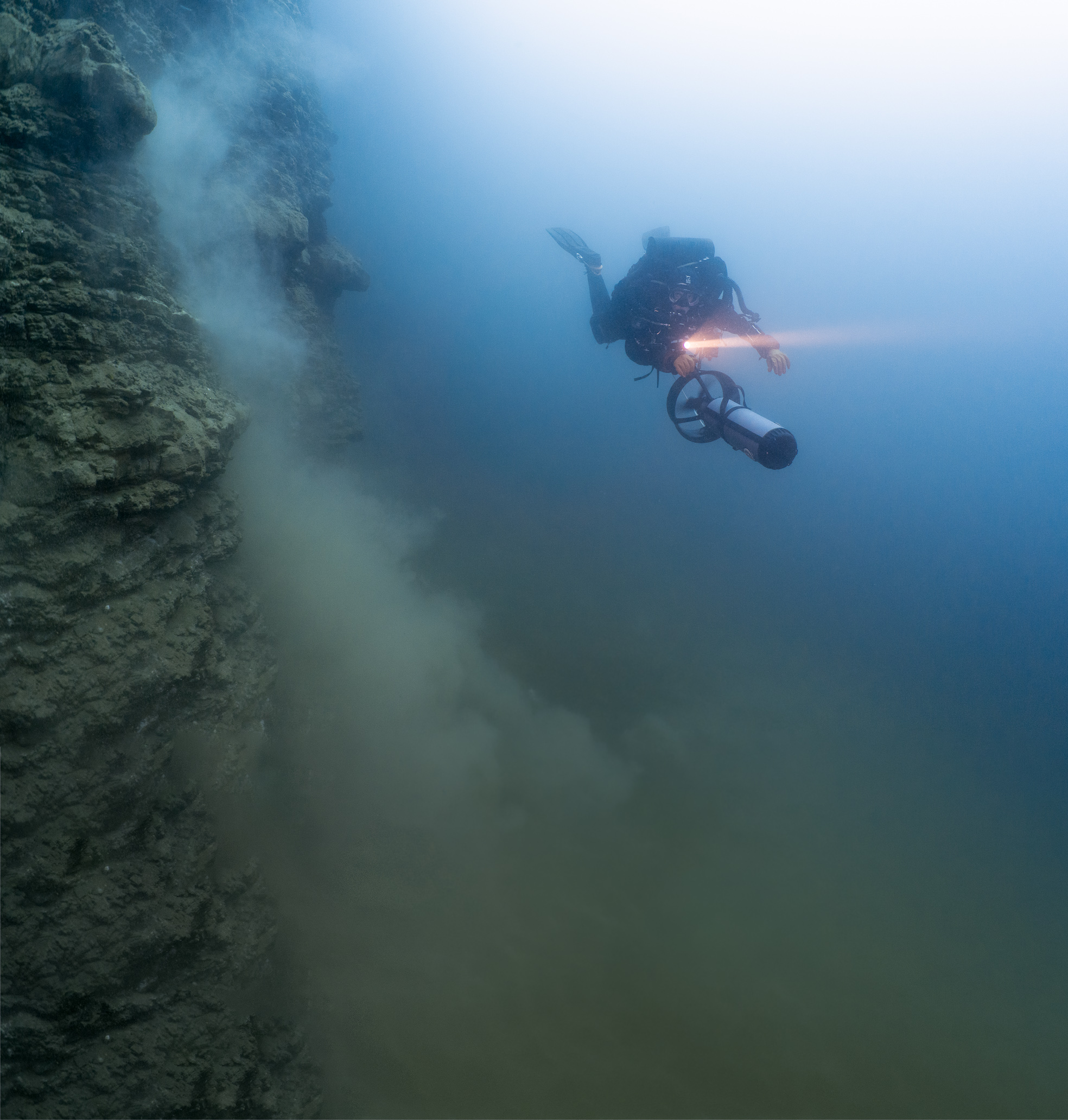
Flying the wall at Tioga. Somewhere around 100 feet, with considerably more wall below and enough visibility to make that feel like a reasonable idea.
I keep a journal partly for this reason. Not just for the dramatic entries ~ the gear failures, the navigation disasters, the episodes where I helpfully demonstrate what not to do ~ but for the smooth ones. To write it down while it still matters.
The best moment of either dive, though, happened at the surface.
I was reaching up to close my rebreather loop when I noticed two loons maybe twenty feet behind me. They slipped under as I eased forward with the scooter.
Loons, it turns out, spend spring establishing breeding territories and strengthening pair bonds. Their underwater courtship displays involve synchronized diving and circling movements that look impossibly graceful underwater. Which feels unfair considering they already own the soundtrack rights to northern Minnesota evenings.
The pair spiraled slowly around one another in long descending arcs ~ unhurried, precise, the kind of effortless choreography that only makes sense when you realize it’s been refined over thousands of years of spring courtship. I drifted within a few feet before they paddled off into the blue.
I stopped following and watched them go.
Best moment of the week month