
The Direction of Curiosity
I had a birthday this week. Fifty-five. Nothing about it felt like a milestone, which is exactly how I wanted it.
I spent the day diving for snails, then had a quiet dinner with Shari ~ an old-fashioned, a beer, and a good burger. My birthday present is apparently going to be a concert, but first I have to decide which one. She narrowed it down to four possibilities ~ LCD Soundsystem, Gary Clark Jr., Bahamas, or Alabama Shakes. So we sat on the deck listening to songs from each artist like judges on a very low-budget version of American Idol.
I still haven’t decided.
Maybe turning fifty-five has something to do with it, but I also decided this week to delete my Facebook account.
Well… sort of.
Facebook stretches this into a 30-day farewell tour. Nine separate “are you sure” screens, each more wounded than the last. I clicked yes on all of them. Three more weeks and it’s gone.
I never used Facebook much until the last couple of years, when I started posting photos and videos in the Minnesota scuba diving group. My hope was simply to convince a few people that remarkable diving exists right here at home.
The group, like most hobby groups, spends considerably more time discussing equipment than actually using it.
Someone recently posted a nice underwater video from a Minnesota dive site. Curious who they were, I clicked on their profile.
That was my mistake.
Mixed in with the diving were lengthy posts explaining the dangers of vaccines, why guns don’t kill people, and enough confidently stated opinions to suggest that gravity itself might still be under review.
Now, if I ever happen to meet this person at a dive site, I can’t unknow any of it. Instead of simply talking about diving, I’ll be standing there thinking, Ah yes… the Flat Earth fellow.
Ignorance, I decided, has a great deal going for it.
So I deleted Facebook.
Taking the high road, it would seem.
Logging into Facebook out of habit nearly every day since, I am.
Heather offered the cleanest fix. Since I send her photos and video from our dives anyway, she’ll post them under her own name. People still get inspired to dive. I never have to read a comment, and I never again have to fight the urge to check whether someone’s profile is going to ruin my opinion of them.
Deleting Facebook felt like a small gamble. So, in its own way, did driving back up to Embarrass.
I’d dove the Embarrass pit twice before. The first time, in 2022, the visibility was spectacular ~ some of the clearest water I’d dropped into anywhere. Last year was the opposite. A municipal construction project had stirred the place into soup. A little digging turned up the reason ~ Hoyt Lakes was tying into the pit for its drinking water, joining Aurora, Biwabik, and the Township of White, who already draw from it. Visibility was three feet on a good day. Heather and I swam out fifty yards as we descended, and lost each other any time we broke physical contact. We turned around and spent the dive doing trim drills in the murky shallows, salvaging something useful out of an hour’s drive.
This time the construction was finished, and the pit had returned to its old self ~ clear, quiet, unrecognizable from the summer before.
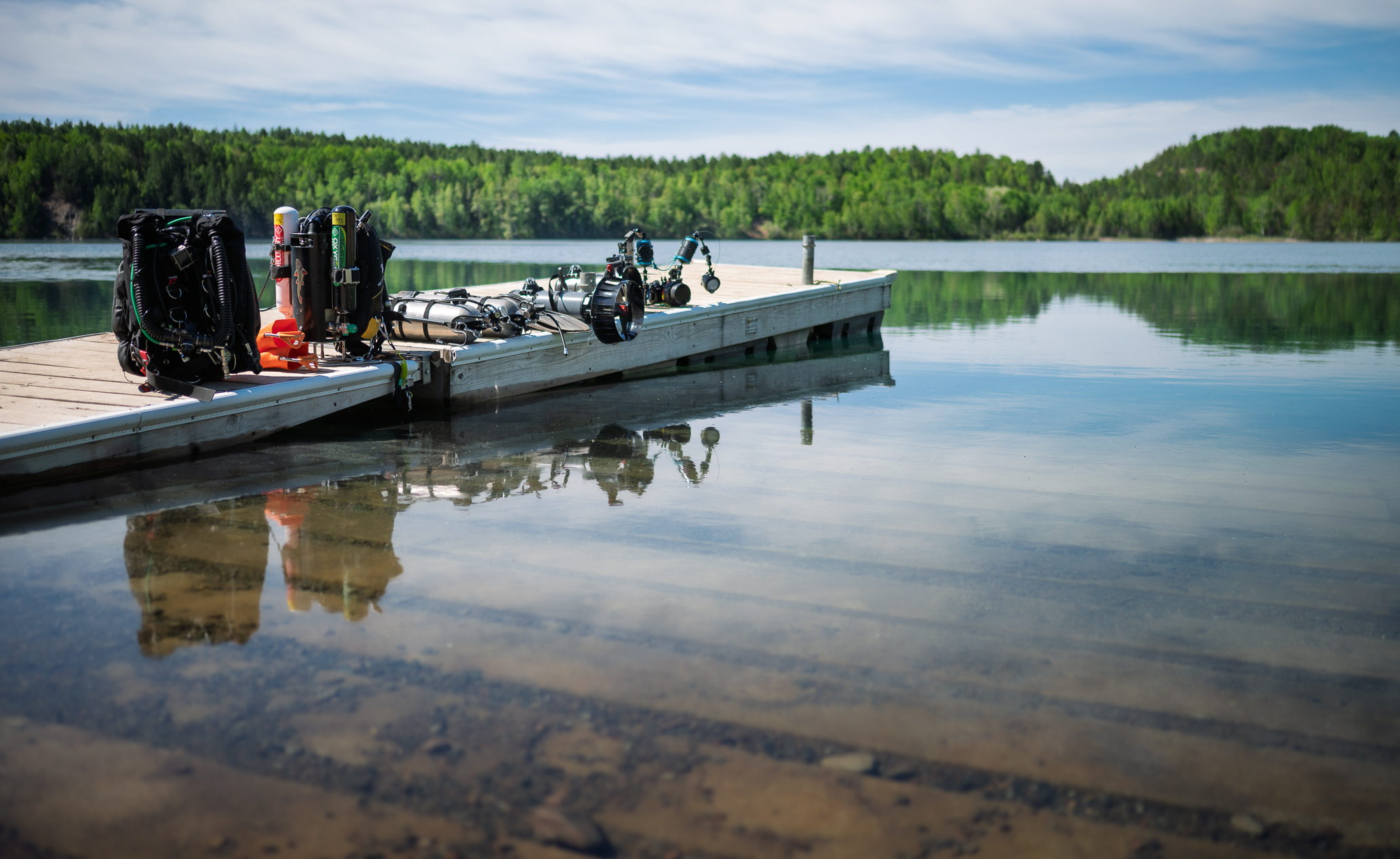
We backed the car right up to the dock and laid everything out along the edge in our usual SCUBA-yard-sale fashion ~ rebreathers, bailout bottles, scooters, camera housing, enough equipment that anyone wandering down to the lake would have been forgiven for assuming a National Geographic film crew was documenting something considerably more exotic than suckers in an abandoned mine pit.
The upside was that we didn’t have to carry any of it. We simply waded out waist-deep, shouldered the rebreathers, clipped on the bailout bottles, and left. Which is about as close as you get to valet diving in northern Minnesota.
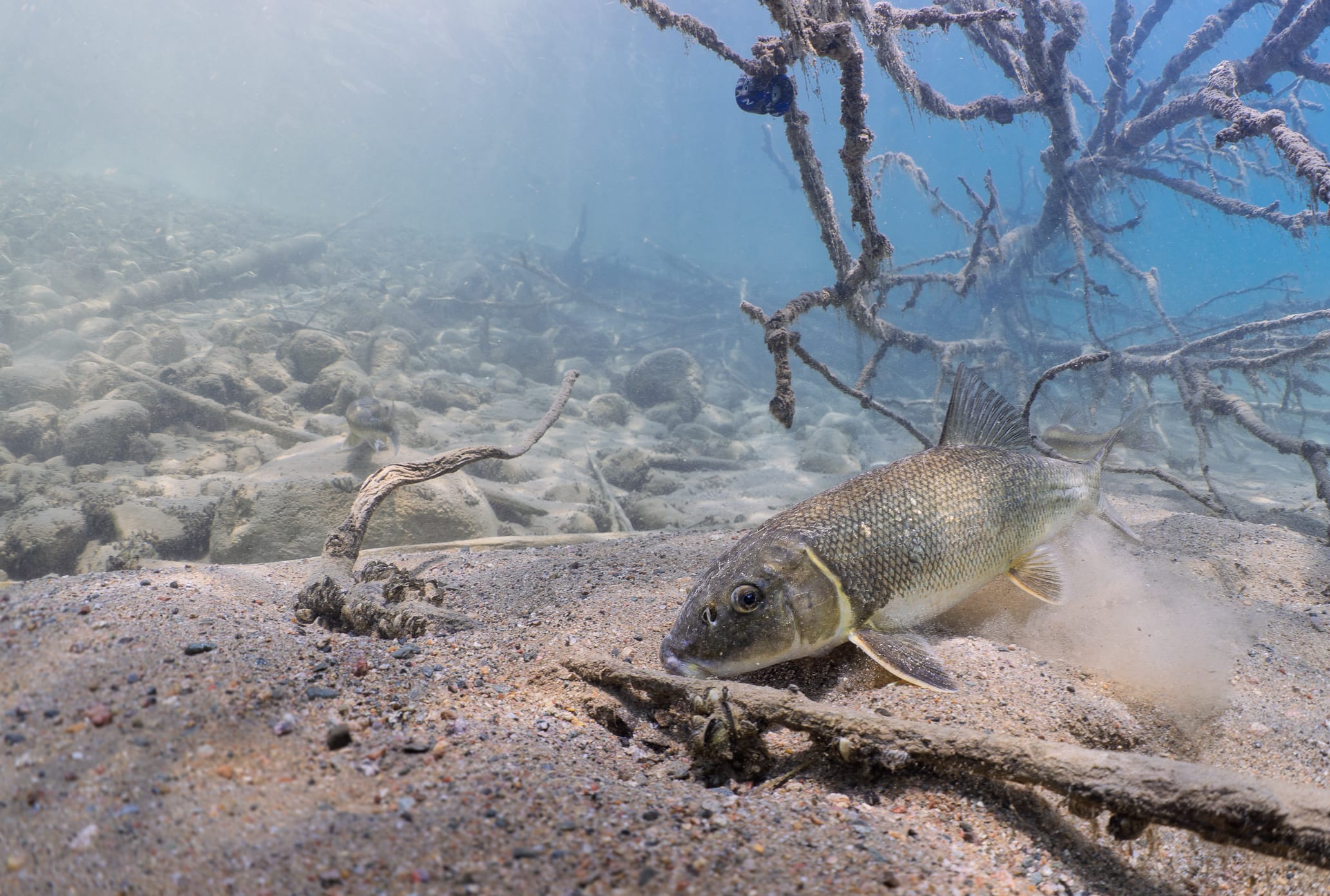
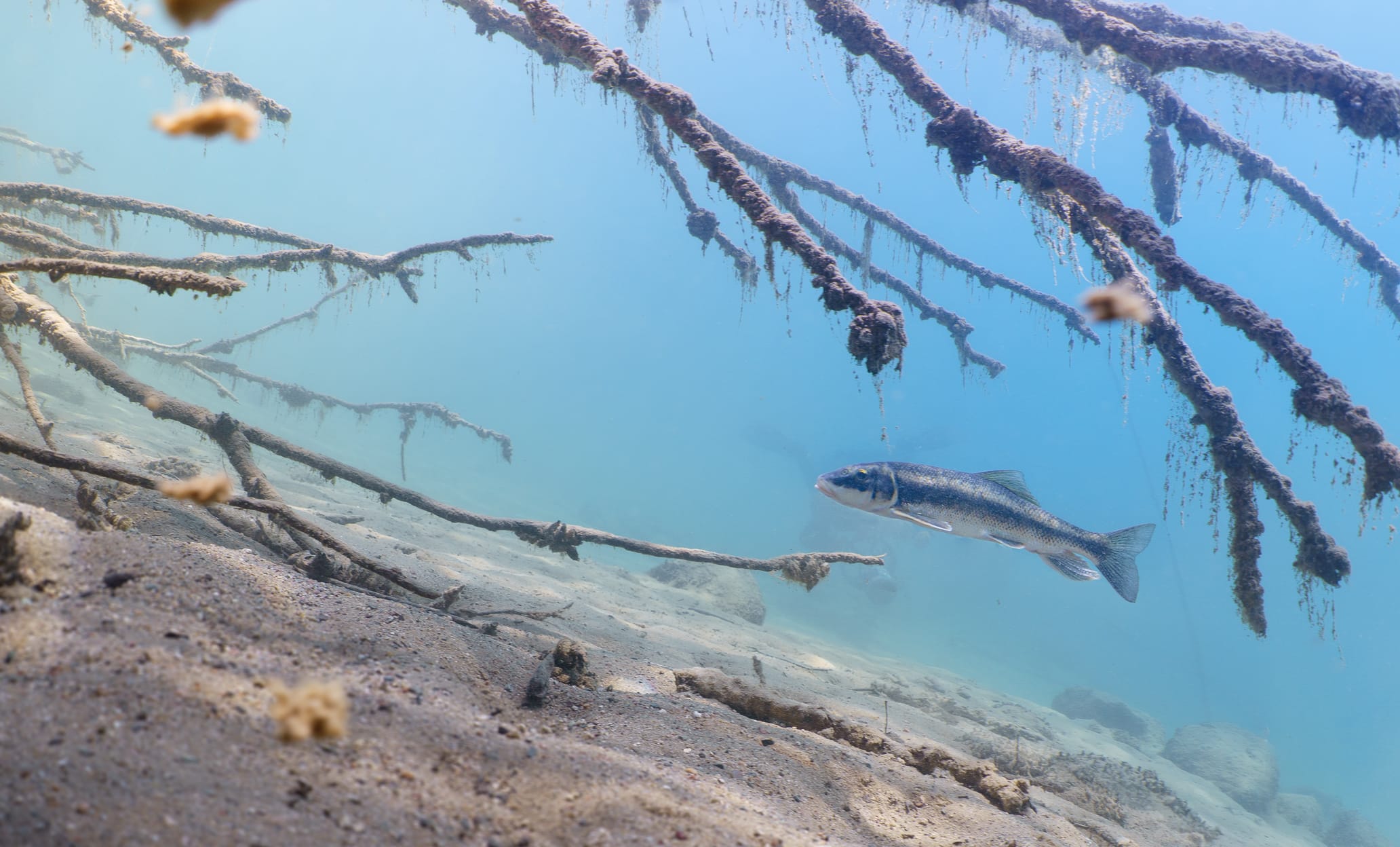
Underwater, the visibility held, and we were met almost immediately by a school of suckers. Not a glamorous fish by any definition. I spent fifteen minutes stalking the right angle anyway while Heather waited with more patience than the subject deserved.
Thousands of dollars in dive gear. Cameras, scooters, rebreathers… all in pursuit of the perfect portrait of a sucker.

We turned west toward some old mining structure rumored to be out there, dropping to 125 feet along a slope that was mildly interesting without being dramatic ~ more eroded hillside than the walls at Tioga or St. James.
That’s when I noticed a post in the distance with something round mounted on top. From a distance it was a shadow, odd enough to be worth a detour. Up close it was a full-sized alien head ~ the classic 1970s design, elliptical eyes, that flattened, faintly bored expression ~ sitting at exactly 100 feet, like it had been waiting for me specifically. I laughed out loud into my loop.
Most divers who plant something down here go with a skeleton. Whoever put an alien head at 100 feet has a sense of humor I’d enjoy. More interesting than the head itself was the line running from it up the slope toward shallower water, clearly placed by another diver, clearly leading somewhere. By then Heather had drifted to the edge of visibility. I hit the scooter’s catch-up mode, waved her over, and led her back to follow the line up.
The line climbed maybe fifty vertical feet, past a collapsed building and piles of twisted metal that looked like the aftermath of something violent rather than the end of an ordinary industrial process. None of it looked especially photographic on its own ~ more wreckage than subject ~ but it marked the path upward.
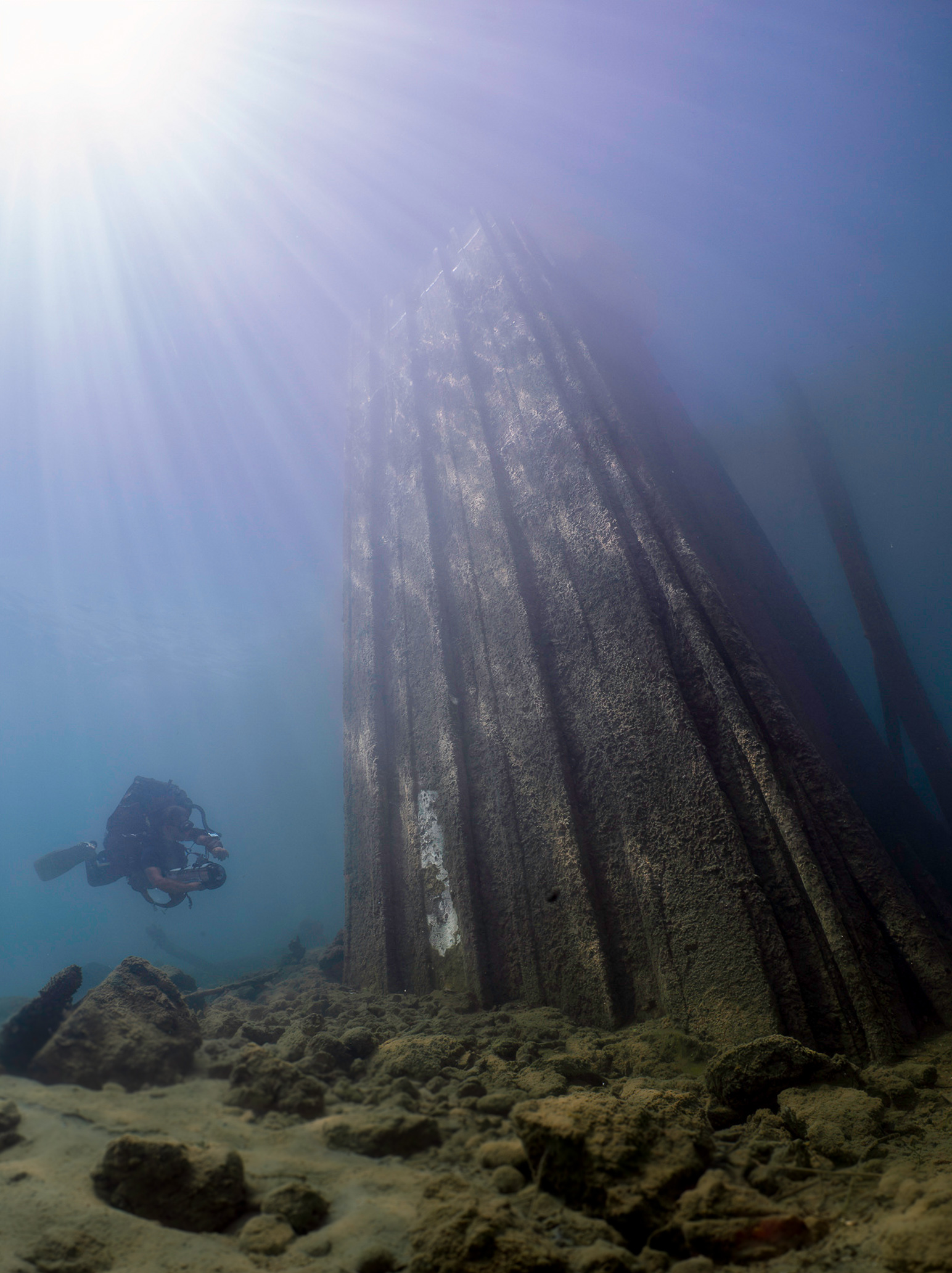
Past all that, rising from thirty or forty feet up through the surface, stood a square concrete structure, maybe twenty feet on a side. Something out of Lord of the Rings ~ a stone tower that refused to crumble under the weight of decades of neglect and flood. The photo of Heather gliding past it for scale gets the same enthusiastic question every time I share it: where is that?
Somewhere between Tolkien and industrial archaeology ~ a forgotten ore conveyor structure that quietly engages the imagination more than the engineers intended.
I wanted to know what it actually was.
A bit of research into the site eventually led me into the mining history of the area.
I found an aerial photo from the 1970s showing a ramp or elevator running from the pit floor up to a loading structure above the railroad tracks. What I’d photographed as a Tower of Sauron is the last surviving leg of the ore conveyor ~ once part of a system that hauled thousands of tons of iron ore up out of the pit to waiting railcars. Fifty years on, the machinery’s gone, the rails are gone, and the pit that swallowed them has become one of the clearer lakes in the state. All that’s left standing is this one stubborn piece of concrete, rising out of the water as if nobody told it the mine had closed.
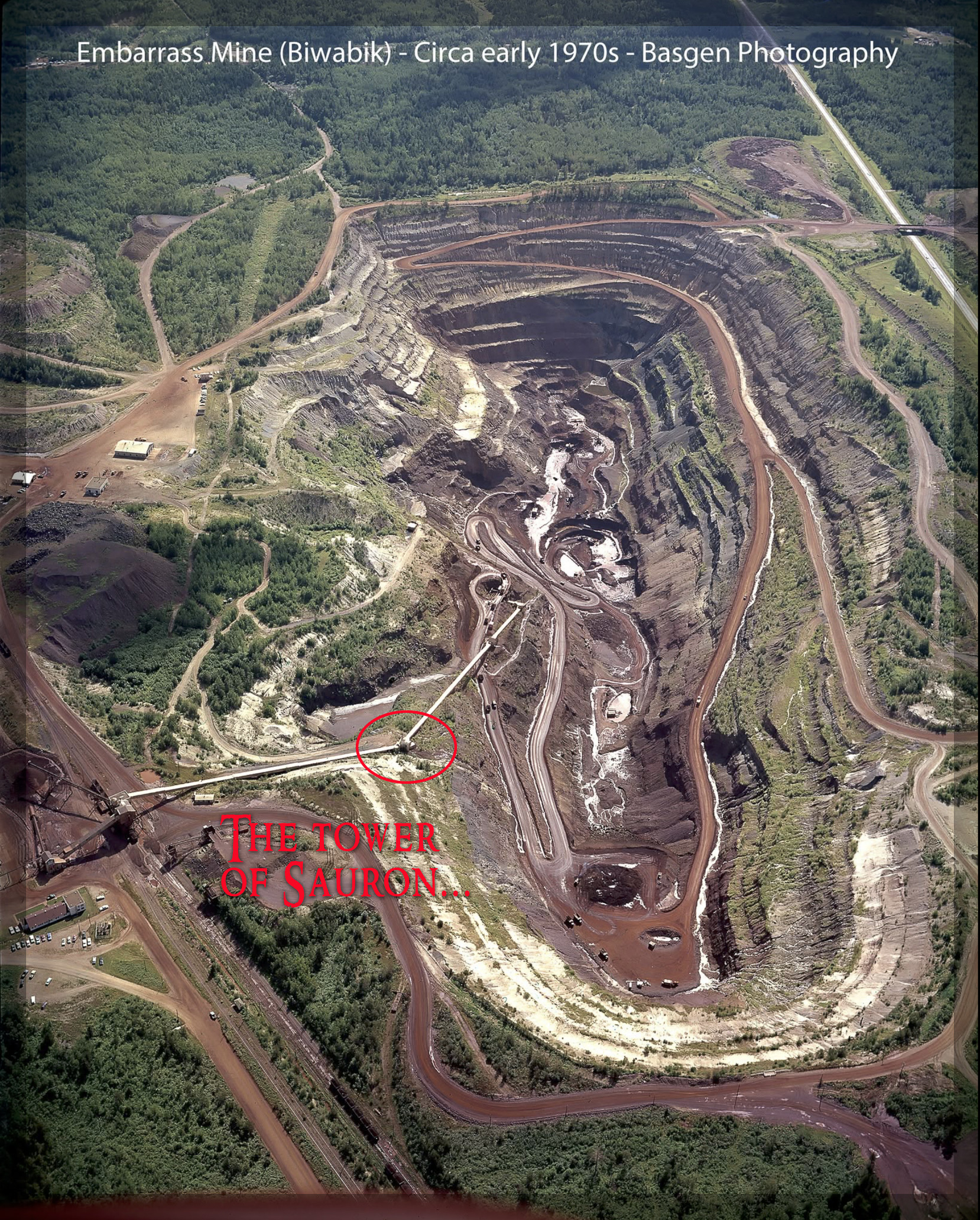
1970s aerial view of the same site ~ a working iron ore pit, where the “tower” was just part of a conveyor system and not remotely mysterious.
Mine pits do this kind of reinvention constantly, if you bother to look. They start as holes dug in search of iron ore, sit abandoned for a stretch, then spend decades quietly filling with groundwater until they end up as drinking water, trout water, or in my case, a place to chase photographs of suckers and alien heads.
That wasn’t the only rabbit hole I disappeared down that week.
I’d also been thinking about nitrogen narcosis.
I’ve felt narcosis on most dives past 110 or 120 feet ~ that half-second lag before my eyes catch up to where I’ve pointed them. I call it the two-martini effect.
What I’d never tested was whether it slowed me down the way two martinis would, or just felt that way. Some training agencies run simple cognitive tests on students at depth for exactly this reason, and narcosis hits people at wildly different intensities at the same depth. What makes it dangerous isn’t the impairment itself. It’s that confidence doesn’t drop along with performance. You don’t feel impaired. You just are.
So, in the interest of science and mild self-incrimination, I designed a cognitive test ~ a number sequence to recall, basic math, and a spatial task setting the hands on a clock face. The plan was simple: run it at 15 feet, run it again at 130, compare. Simple, until I tried to figure out how we’d time each other. A stopwatch seemed obvious enough. Except neither my primary nor backup computer had one, despite both being able to calculate decompression obligations and track partial pressures of oxygen in real time. Apparently a clock is too much to ask of a device that already knows how much nitrogen is dissolved in my blood. The fix was needlessly complicated and perfectly simple at once: film each other taking the test on the 360 camera, then sort out the elapsed time later from the footage.
I got every question right both times. That part didn’t surprise me. What surprised me was the time gap: 105 seconds at 130 feet versus 70 seconds at 15. Fifty percent slower, same accuracy, same confidence the whole way through. I didn’t feel slow. I felt entirely normal. Which is precisely the problem researchers keep flagging: the diver who feels fine at depth and the diver who is actually fine at depth are not reliably the same person.
It’s also the clearest argument yet for eventually doing MOD 2 training and adding helium to the mix, since helium cuts the narcotic load nitrogen brings on. I’m not sure I’m ready yet, and I now know Shari isn’t ready for me to take that step either ~ she responded to a text about MOD 2 with a single finger-wagging emoji, about as clear a verdict as I’ve received from my wife on a diving decision.
Looking back at the last couple of weeks, I’m wondering if there’s a pattern…
I quit Facebook because I’d started researching people, then spent the following two weeks researching mining history and nitrogen narcosis. Same impulse, pointed somewhere else.
Curiosity isn’t automatically a virtue. It has a direction.
Spend it on other people’s opinions and you mostly come away with a collection of opinions, most of them not yours and none of them useful. Spend it on an abandoned mine, a submerged tower, or what nitrogen does to a brain at five atmospheres, and you come away understanding something.
Maybe that’s the only adjustment fifty-five calls for. Not less curiosity. Better aim.
I’m still deciding on the concert. And I haven’t deleted my Facebook account, not really. Three weeks left on the countdown, and I expect I’ll check it most of those days.