Depth, Doubt, and a Flat Tire
This was the weekend I’d been quietly dreading for months—the one I’d trained for, studied for, and imagined with the same anxious anticipation most people reserve for root canals. My air-diluent decompression course on the rebreather. I had nearly cancelled the whole thing after a botched mask-clearing drill last week, a small disaster that left me questioning how a person who stumbled on a basic skill taught to twelve-year-olds could possibly pass a technical course involving complex gases, decompression schedules, and manage a machine that recycles every breath and seems to require a minor in engineering to operate.
By Monday, though, I was alive, certified, and back at the lake using my new skills to capture a photograph I’d been imagining for ages—a photo that, as it happened, lay about twenty feet deeper than I’d been allowed to go until now. But I’m getting ahead of myself. The story starts the previous Thursday, as so many of my bad ideas do.
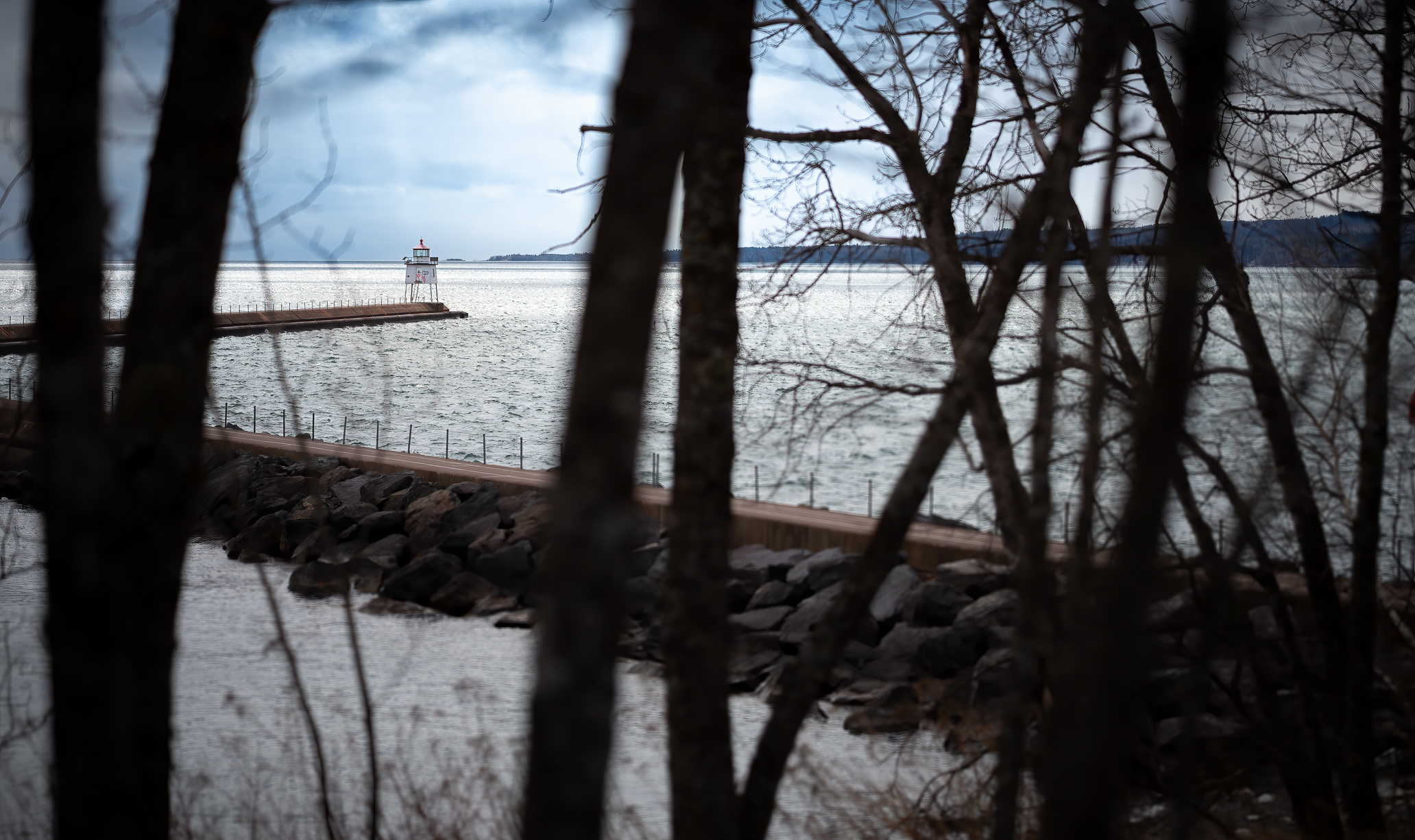
Heather and I had planned a dive at Two Harbors. She had to be back by 1:00, so time was short, and we decided to make things “interesting,” which in Lake Superior terms means finding a slightly different way to freeze. We lugged our gear all the way out to the end of the break wall—1,700 feet of concrete walkway that feels twice as long when you’re pushing a wagon full of steel cylinders, electronics, and the misplaced confidence in my middle-aged back. The plan was to jump off the very end and see exactly where the end of the break wall lay underwater. This may not sound thrilling, but when most of your diving landscape resembles a wind-swept lunar plain, you take your amusements where you can.
The breakwall stretched ahead, calm lake on both sides, the lighthouse a small promise at the end. Even grey days feel like adventures here.
Heather, ever the good sport, had agreed to play instructor, armed with waterproof flashcards listing CCR drills for me to perform. I’d imagined the lake floor would fall away sharply as we swam east, letting me stretch down toward the depths I’d be working in over the weekend—ninety, maybe a hundred feet. Instead, it sloped off so gently it was hard to tell we were descending at all. After ten minutes, we’d gained perhaps five feet and the bottom had the personality of a linoleum floor. We turned back.
Then Heather showed me the card I had hoped she’d misplaced: Mask remove and replace at depth.
It’s a simple exercise, one of the first you learn in open-water training. Remove mask, replace mask, exhale through the nose, carry on. I’ve done it hundreds of times. But in Superior’s 40-degree water, the act of removing one’s mask is like voluntarily dunking your face in a bowl of cocktail ice. There’s a reflex—the mammalian dive reflex—that occasionally decides to make an appearance at the worst possible moment, sealing your airway just as you’re trying to exhale through your nose. It’s a bit like trying to sneeze with your mouth glued shut.
That’s exactly what happened. My airway closed. I tried again. Closed. Each failed attempt brought a little more buoyancy, a few more bubbles of panic. Eyes shut, mask full of water, I flailed slightly, hoping I wasn’t drifting upward like an escaped balloon. I reached out for Heather, who, bless her, was right there. With that tactile feedback I knew I wasn’t drifting upwards and managed to calm myself, and clear my mask.
I floated for a few minutes afterward, trying to regain my composure and inwardly reciting a litany of self-criticism. The rest of the dive was fine, though I was thoroughly deflated—figuratively this time. By the time we surfaced, I was convinced I wasn’t ready for the weekend course.
On the drive home, I said little. Halfway back, Heather’s Subaru developed a flat tire. In any other circumstance that might have been annoying, but at that moment it was a godsend—a problem I could fix with a wrench instead of introspection. Unfortunately, the spare was under the rear hatch, beneath all our dive gear, so we unloaded everything onto the shoulder of Highway 61, creating what looked like the saddest scuba yard sale in history. We fixed the tire, laughed about it, and for the first time since surfacing, my mood improved.
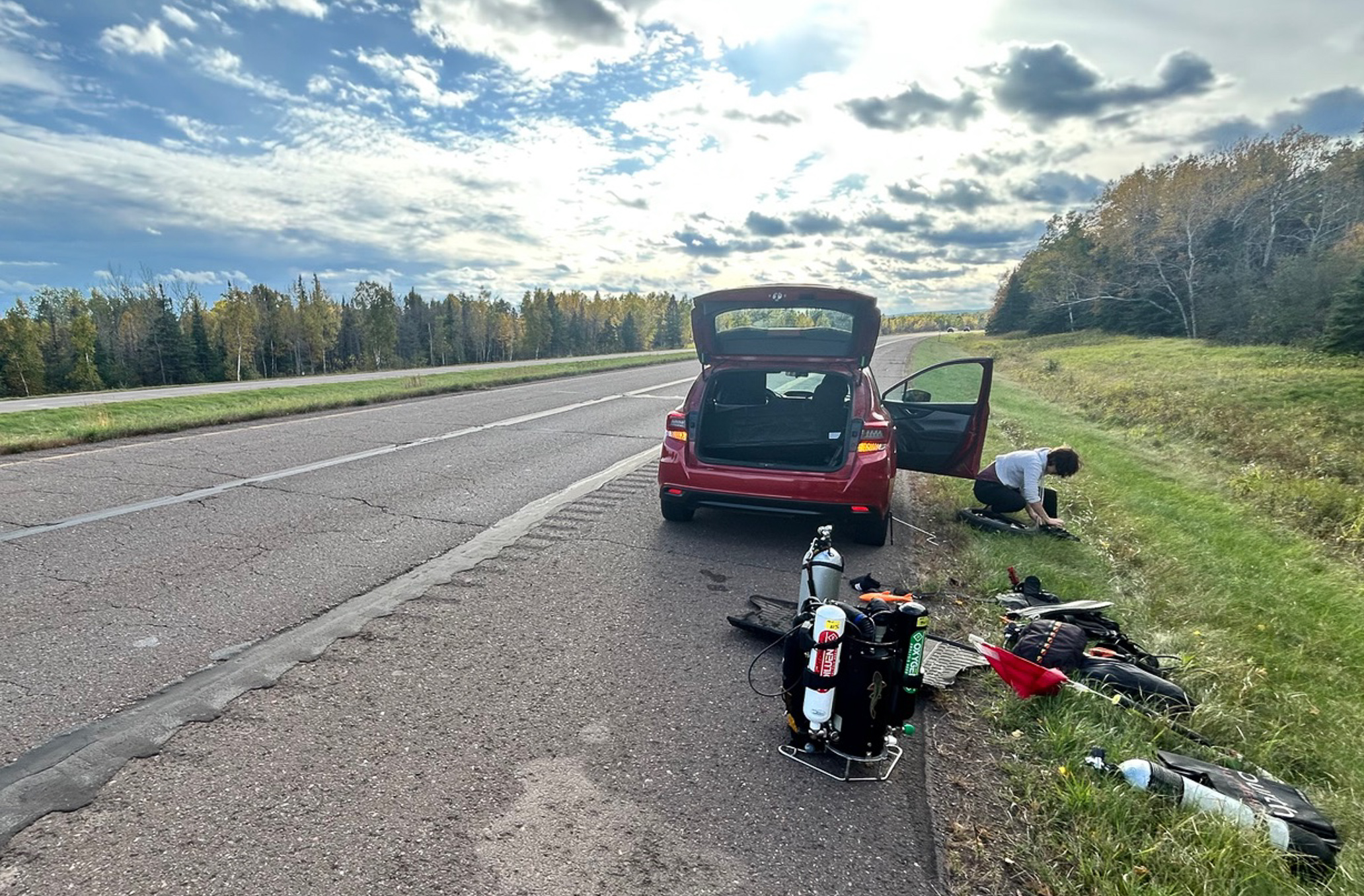
Highway 61 roadside dive exhibit: one flat tire, two divers, and enough gear to fill a DEMA trade show booth.
Still, the mask fiasco gnawed at me. Late that afternoon I refilled my tanks and drove back to the lake for a private reckoning—a kind of “mask-clearing therapy.” For nearly an hour I practiced flooding and clearing until the motions felt like breathing itself. Every attempt went easily, which was both gratifying and deeply annoying. Apparently, my nervous system prefers to malfunction only when witnesses are present.
Saturday showed up like an overdue bill—the start of the course I’d been losing sleep over. We met at the same break wall that had hosted my underwater meltdown. The lake was flat as glass, the kind of deceptive calm that makes you forget what could go wrong. There was another student, Adam, tall and initially intimidating until he revealed himself to be a stay-at-home dad with a quick smile and an endless supply of good humor. He’d been on his rebreather for all of three days, which instantly made me feel like the seasoned veteran.
Our instructor, Jorie, wasted no time. Boom drills, oxygen flushes, regulator shutdowns—each exercise meant to prepare us for the kind of improbable disaster chain that technical divers love to imagine. One scenario involved sharing a single regulator between two failed rebreathers while ascending, taking two breaths before passing it back. My first attempts were clumsy bordering on desperate; I inhaled like a freight train when it was my turn. But after a minute, I settled down, found the rhythm, and discovered it was, actually pretty easy.
That evening we debriefed over pints at Castle Danger Brewery, which seems like an ill-chosen name for a place where divers discuss gas management and emergency protocols, but somehow it worked. By the end of the night, I felt like a proper technical diver: tired, happy, and only mildly concerned for tomorrow activities.
St. James, once an iron mine, is now a cathedral of blue—deep, clear, and edged by a steep wall that falls away into an abyss nearly 300 feet deep. Divers prize it for visibility and the straightforward route to serious depth, the kind of place where a few fin kicks from shore gets you into the 100 foot zone without a lot of nonsense. It’s cold and startlingly transparent; you don’t so much descend as step off a ledge into a calmer, stranger place.
The plan was a 130-foot dive, my first real decompression exposure. We descended along a wall that dropped away like the edge of the world. At fifty feet, the slope vanished, and suddenly we were floating in blue space. At 130, light still filtered down, ghostly and thin, like the end of a long afternoon. Movement slowed, sound disappeared, and I felt that peculiar, dreamy sense that divers call narcosis—the two-martini effect. Pleasant, provided you remember which buttons you’re supposed to press.
I understood, in that moment, why so many divers chase depth. It’s the last wilderness—unreachable, quiet, demanding. And yet, the fascination with numbers—the “I hit 135 feet!” sort of boasting—has never made sense to me. Depth is not an achievement; it’s just a coordinate. What matters is what you do, what you see there, and how you behave when the world goes still.
By the end of Sunday, I was exhausted but elated. I’d passed the course, learned new skills, and survived both drills and beers without embarrassment. And, as it turned out, all that anxiety over my mask-clearing woes had been for absolutely nothing—Jorie never even asked us to do the drill. I’d spent a week dreading a task that never came, proof that most of our suffering is self-inflicted and usually unnecessary. Still, it was oddly comforting to know I’d worked myself into such a lather over an problem, worked thought it and lived to laugh about it.
Gold Rock looks peaceful now, draped in fall colors and sunshine, though it once made quite an impression on the Madeira—one the ship didn’t live to tell.
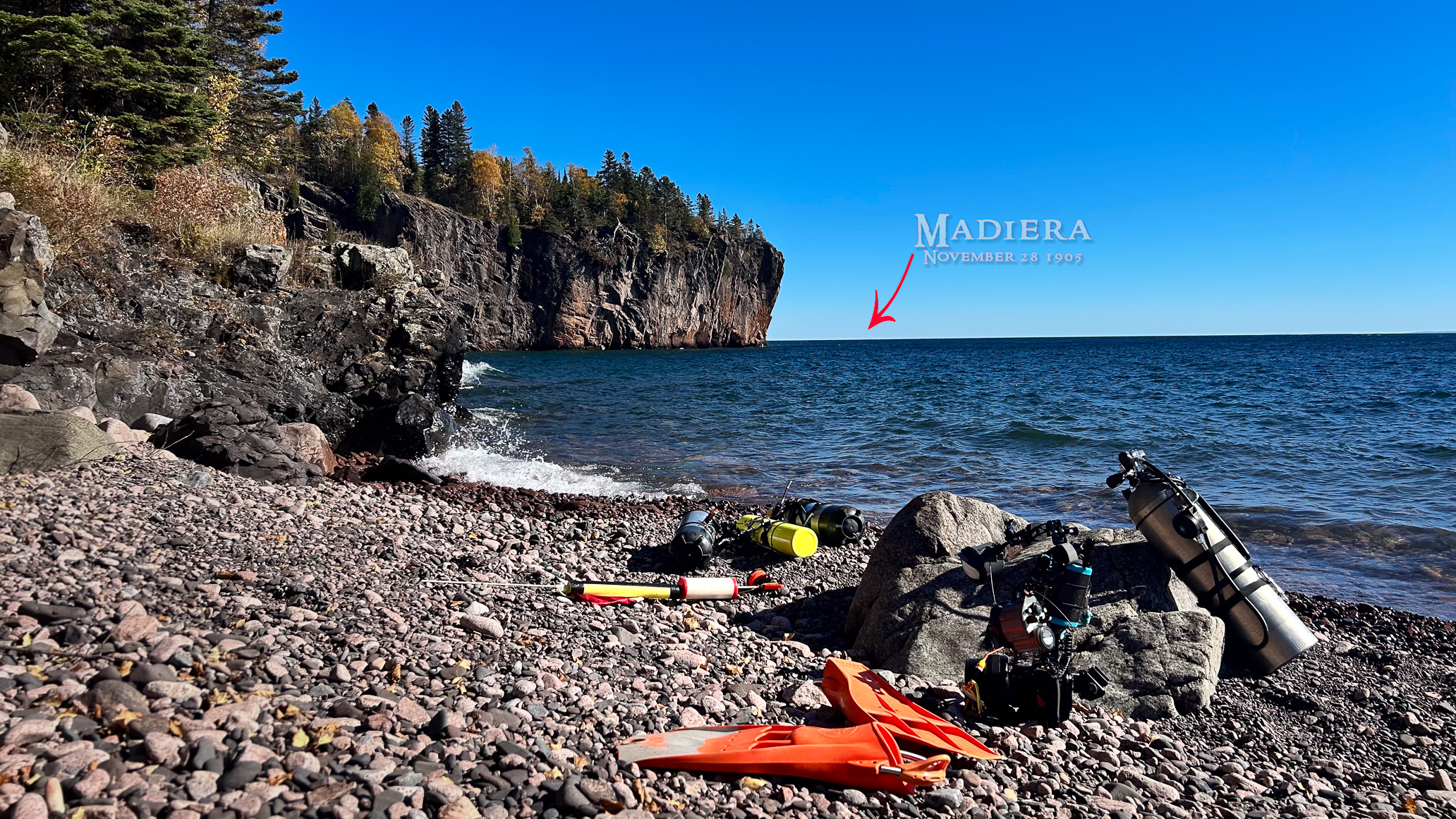
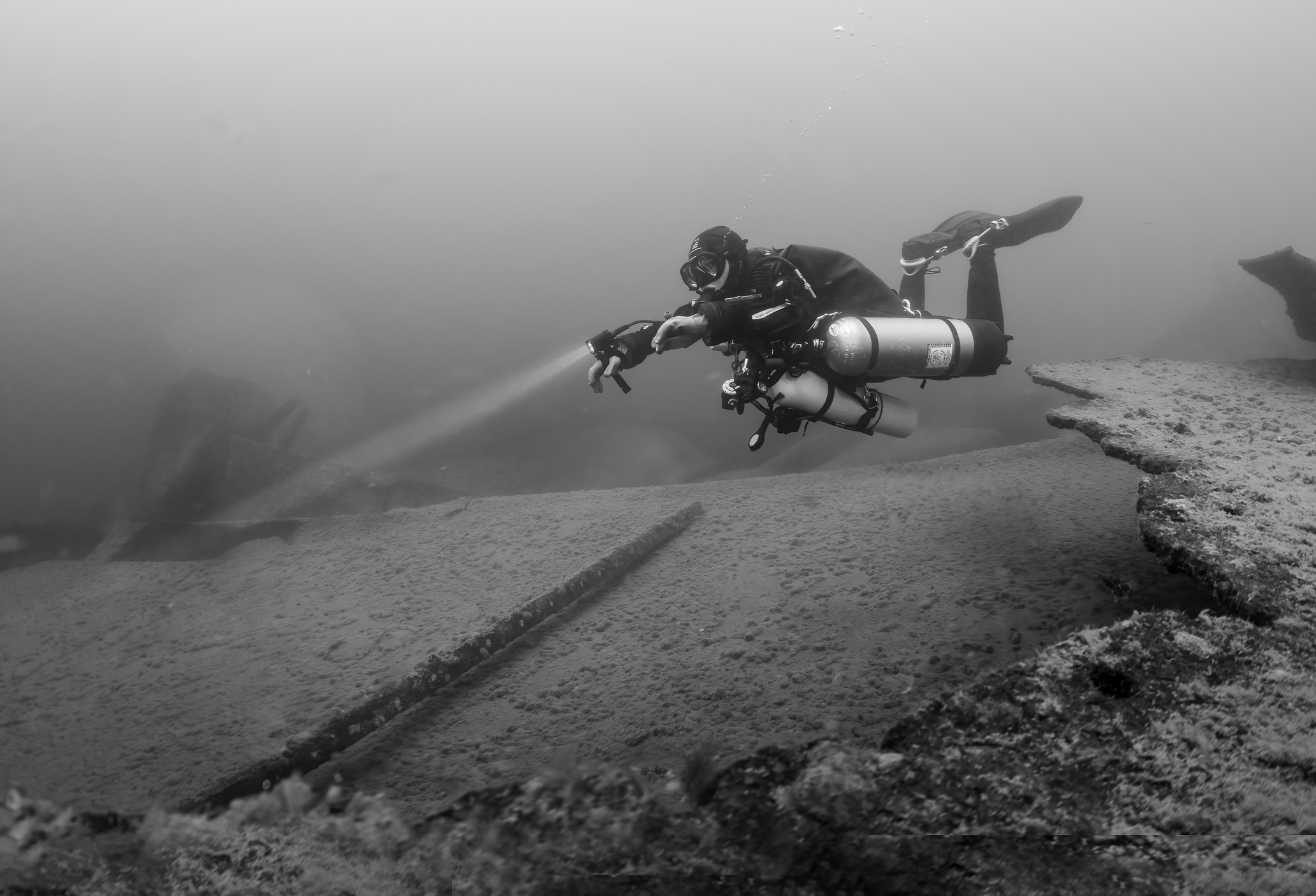
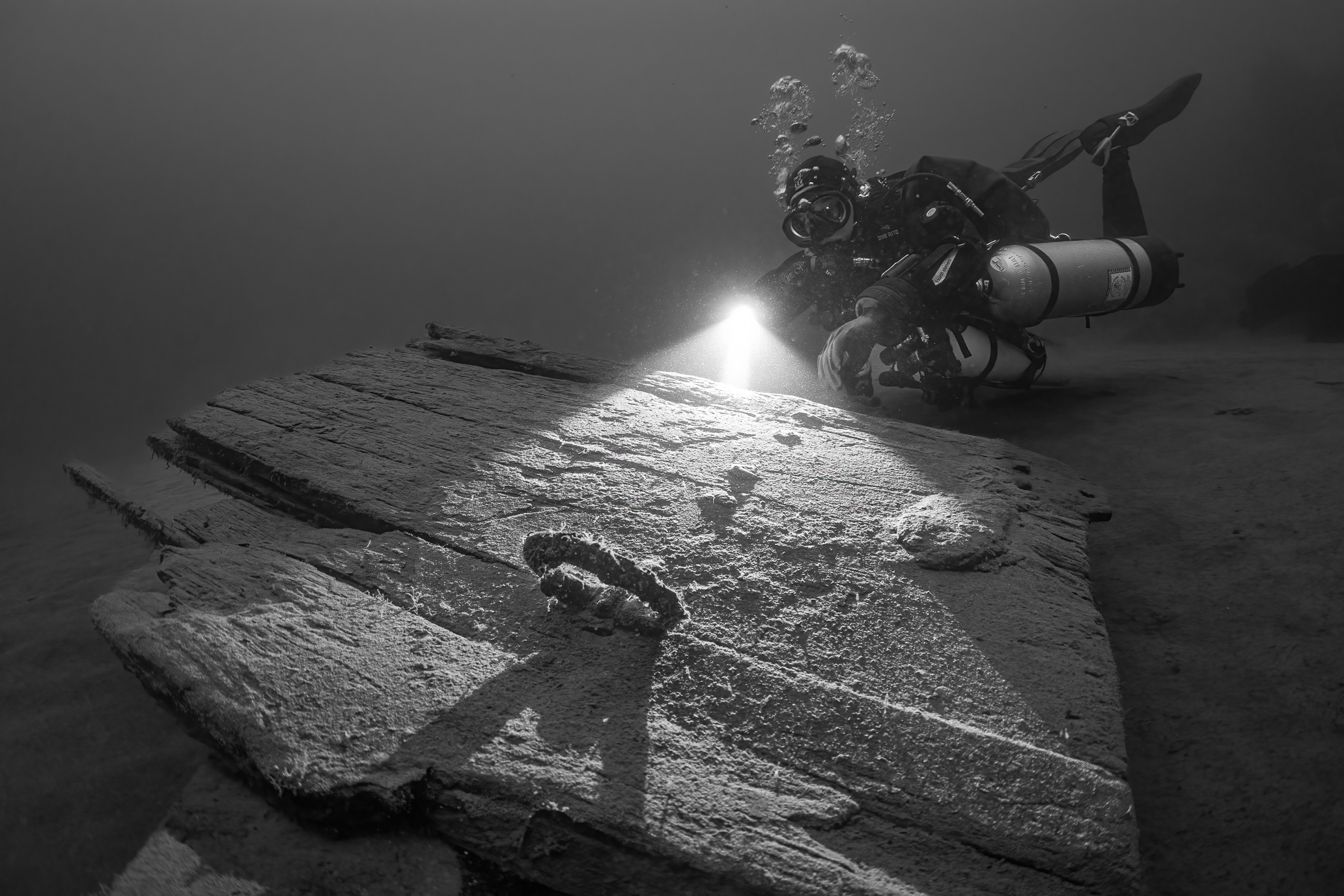
Monday, Heather and I celebrated with a dive on the Madeira wreck. She was still waiting on parts for her rebreather and diving open-circuit side-mount, and due to the planned depth and duration, she was carrying so many tanks she could have refueled a submarine. I, newly certified and a touch smug, planned to visit a spot at 120 feet that had previously been off-limits: a simple wooden hatch with a rusted metal ring, half-buried in sand. Hardly a treasure, but to me, it had become a goal.
The descent was stopped moments after it started by a stray dog hair on my first stage diluent o-ring. On closer examination, the leak was minor enough that I decided not to return to shore and deal with it, and continue the dive closely monitoring my diluent pressures. It took us maybe 20 minutes to descend to the hatch. I took a couple of photos with my strobes on, which looked “okay,” but then Heather illuminated it with her torch, and in the beam’s glow, it looked cinematic, almost holy. I switched off my strobes and took a few shots. The image that appeared on my viewfinder was exactly what I’d imagined—quiet, textured, and somehow complete. My deepest photo yet.
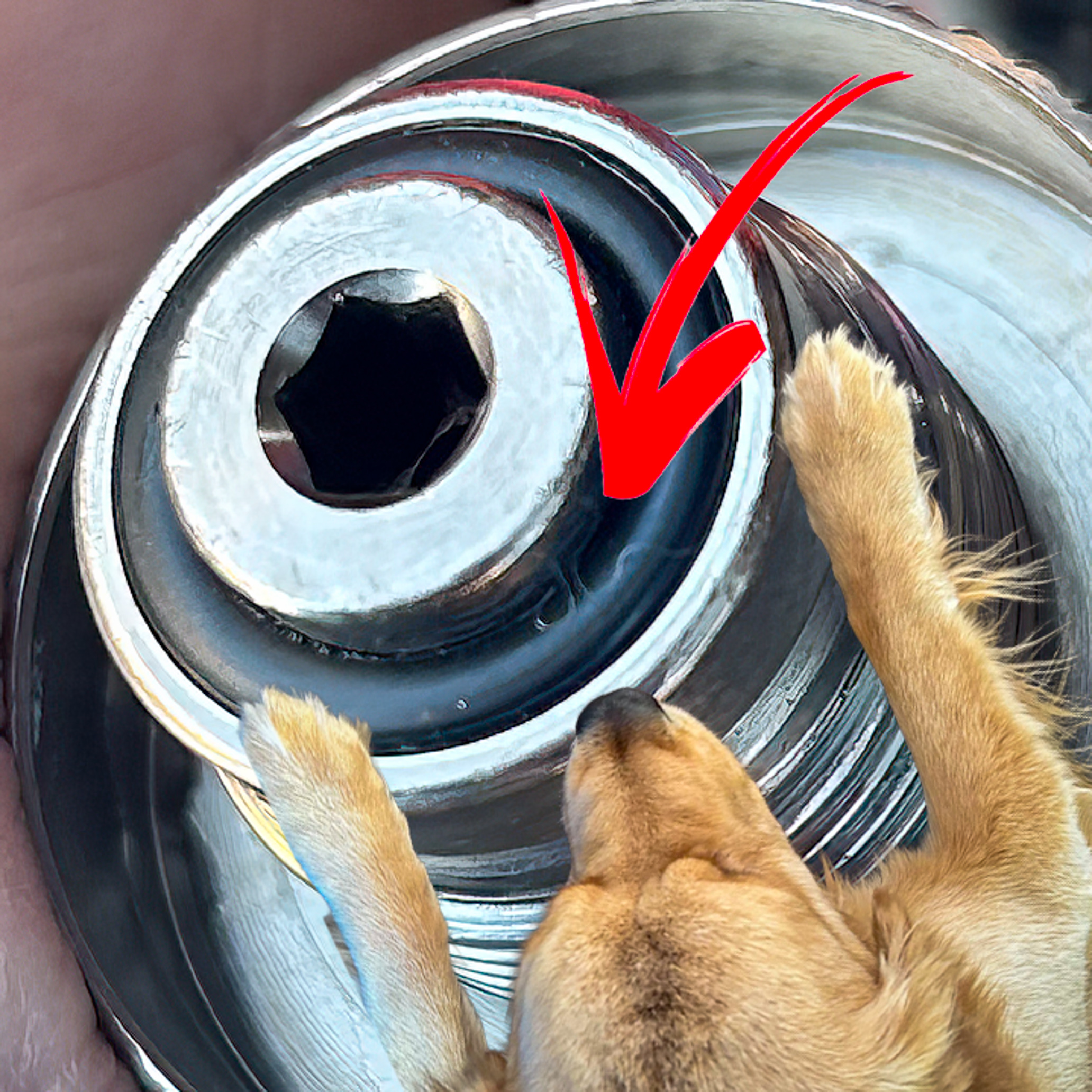
A golden retriever, a stray hair, and my first stage o‑ring conspired to interrupt the dive. All survived, only slightly delayed
We drifted a little deeper, toward the spot where dishes from the wreck are said to rest on the sand—relics that appear and vanish with the moods of the lake. This time, the lake was in a secretive mood; nothing but smooth sand greeted us. At 130 feet, I lingered just long enough to earn two minutes of decompression, which cleared itself well before I reached the shallows. Heather, diving air, had twenty-five minutes to burn, so I amused myself taking celebratory selfies—feeling, for the first time all weekend, perfectly at ease.
Three cylinders, one hatch, and the eternal optimism of cave divers convinced it just might fit.
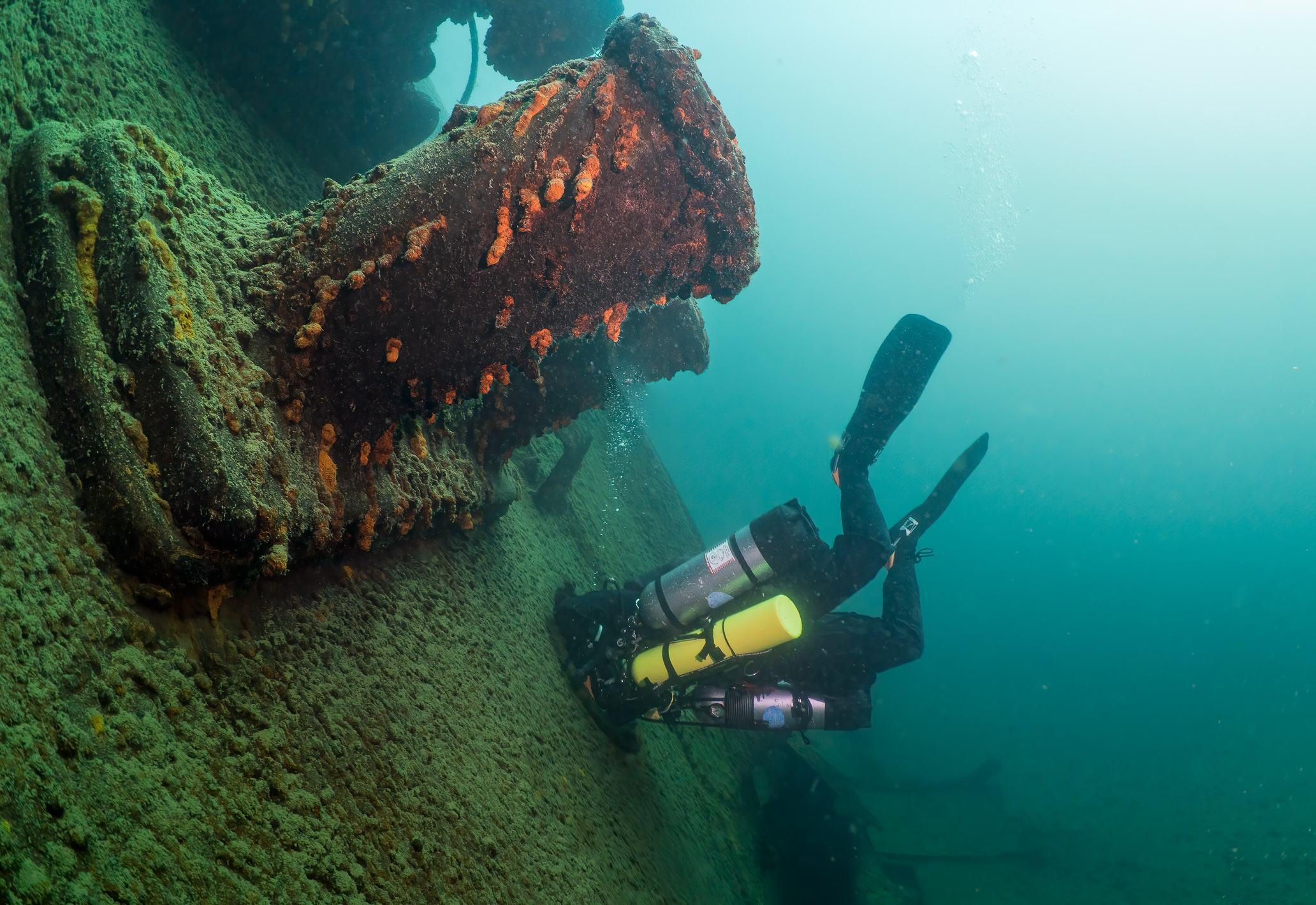
Divers, like runners, have a curious fondness for quantifying joy. A runner might say, “I did five miles today,” while a diver says, with equal pride, “We hit a hundred and thirty feet.” It’s the same impulse—the urge to turn a private experience into a tidy, measurable achievement. Non-divers, of course, always ask first about depth, as if that single number explains everything. For many, it becomes a badge of honor: the deeper, the better. Technical divers, myself included, have simply made the game more complicated, adding layers of gas mixes, decompression stops, and rebreathers that hum and hiss like small science projects. It’s all part of the fun, I suppose. But for me, the real magic isn’t in the number—it’s in the stillness, the light filtering through cold Superior water, the simple satisfaction of capturing an image that feels like the place itself. I’d rather talk about the mood of a dive than the measurement of it. Besides, some things are better left unspoken; my wife’s nerves are steadier not knowing just how deep these adventures sometimes go.
Lately, though, I’ve found a quiet confidence settling in at depth. The same places that once felt slightly forbidding now feel almost familiar—like old churches where you finally stop whispering. Working through my recent mask-clearing fiasco was humbling, but also oddly satisfying, a reminder that even simple skills deserve attention. Diving, like any craft, rewards repetition and patience more than bravado. You practice, you refine, and eventually you stop thinking about it altogether. I finished the weekend tired, grateful, and quietly proud—not for how deep I’d gone, but for the calm that came with it, and for remembering that mastery isn’t a finish line, just the steady pleasure of getting a little better each time you descend.