Fewer Images Than Planned, More Ideas Than I Started With
Officially, it is spring. Astronomers, calendars, and optimistic Minnesotans all agree on this point. Duluth, however, remains unconvinced.
Here, spring doesn’t so much arrive as it cautiously circles the premises. We’ve had a few encouraging days where the snow softens and retreats slightly, like a polite guest considering departure, but temperatures stubbornly refuse to climb past 40°F. Meanwhile, a mere 150 miles south in Minneapolis, people are mowing lawns—mowing lawns!—while we remain entrenched among snowbanks and optimism.
The culprit, as always, is the lake. Lake Superior currently resembles a misplaced polar ice cap, locked solid for nearly a mile beyond the harbor. The United States Coast Guard icebreaker has been grinding away at it for days, carving hopeful channels for the shipping season. It’s fascinating to watch—like a very determined butter knife attacking a frozen pie—but it does nothing to warm the air.
Speaking of cold things, I’ve been refining my Sunday night martini ritual, which has become less a drink and more a small act of devotion.
In the course of what can only be described as serious research, I stumbled upon the “freezer door martini.” The idea is deceptively simple: pre-mix gin, dry vermouth, and just enough water to mimic proper dilution, then store the whole affair in the freezer. The result, ideally, is a perfectly balanced, impeccably cold martini on demand—no shaking, no stirring, no last-minute negotiations with ice.
A freezer stocked with ready-to-pour martinis feels like excellent planning, in the way a nightstand cookie jar might.
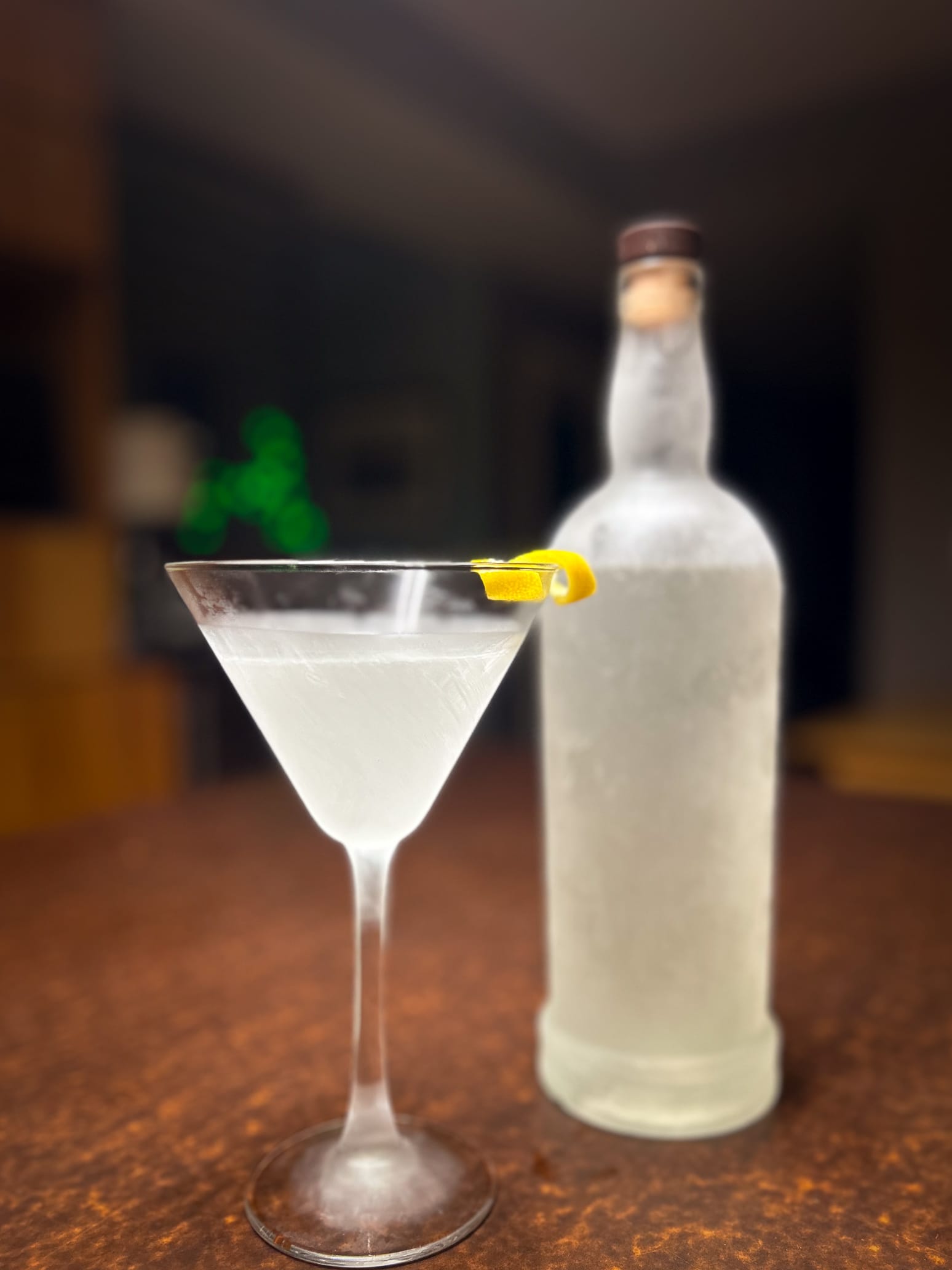
A proper martini, as it turns out, inspires more strong opinions than most international treaties. The classic ratio leans somewhere between 2:1 and 5:1 gin to vermouth, though modern sensibilities often drift toward a mere whisper of vermouth—more rumor than ingredient. I aim for something balanced enough to taste intentional, finished with a lemon twist, which adds just enough brightness to remind you this is, at heart, a very efficient delivery system for gin.
My first freezer attempt was… instructive.
I appear to have either added too much water or underestimated the capabilities of my chest freezer. After pouring the first glass, I returned the following day to find the bottle had achieved a state best described as “martini slush.” There’s no doubt a scientific explanation involving alcohol content and freezing points, but martinis seem to benefit from a less analytical approach.
The kitchen freezer, it turns out, has better manners. Sunday’s martini emerged bracing, clean, and a wisp away from frozen — which, in February, is more or less Lake Superior in a glass. The curious thing is that both warm me from the inside. The gin through biochemistry. The lake through something harder to explain — the specific, involuntary joy of climbing out of something that cold and discovering you’re still more or less intact.
Which, as it happens, had recently become possible again.
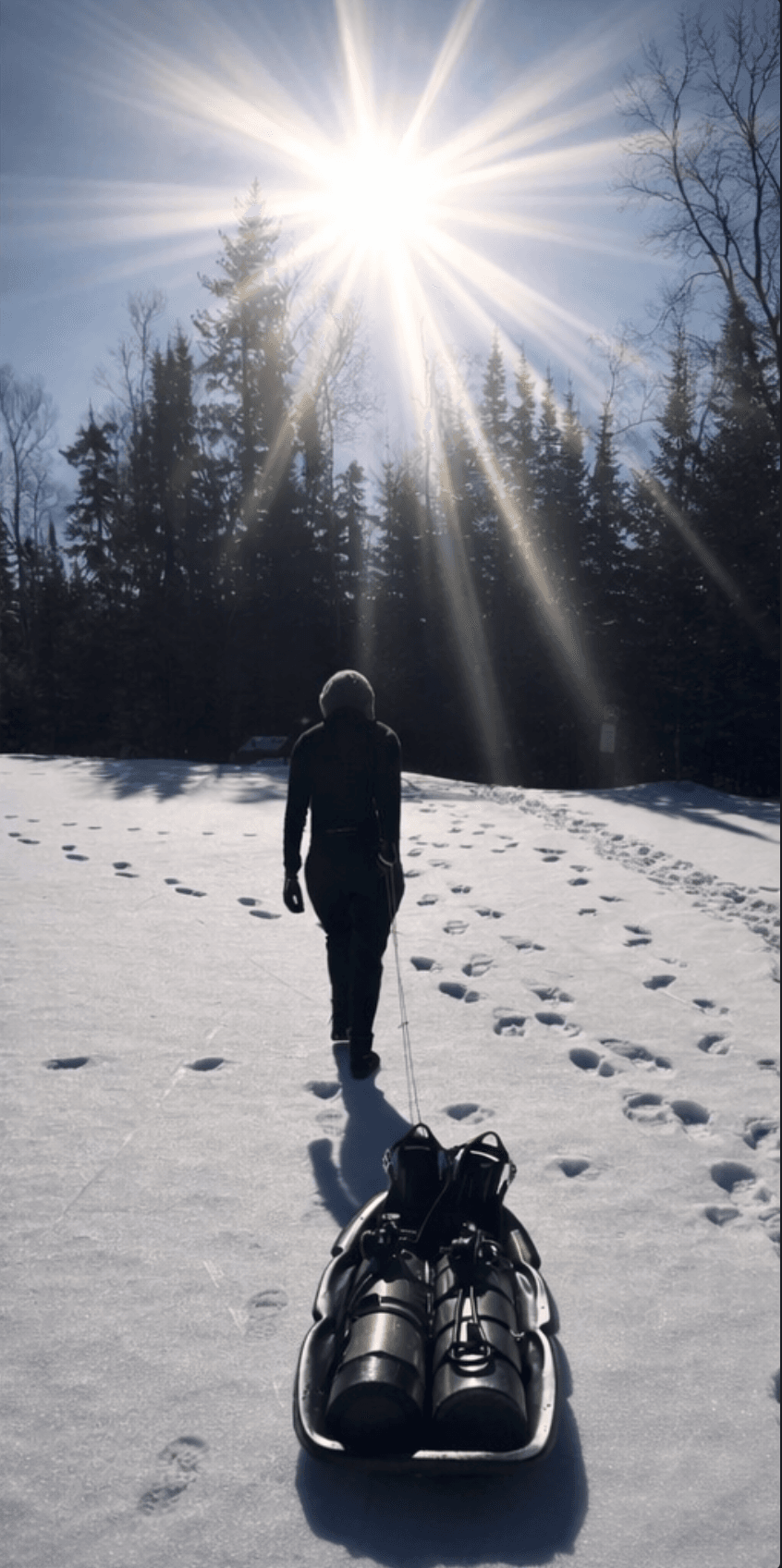
There’s likely a niche market for purpose-built scuba sleds. Admittedly small. Possibly three people. Until then, the children’s version continues to overachieve.
Heather was finally easing out of her foot fracture. The ice had loosened its grip on the lake. And Madeira Monday — quietly shelved through weeks of frozen shorelines and a walking boot — was back on the calendar.
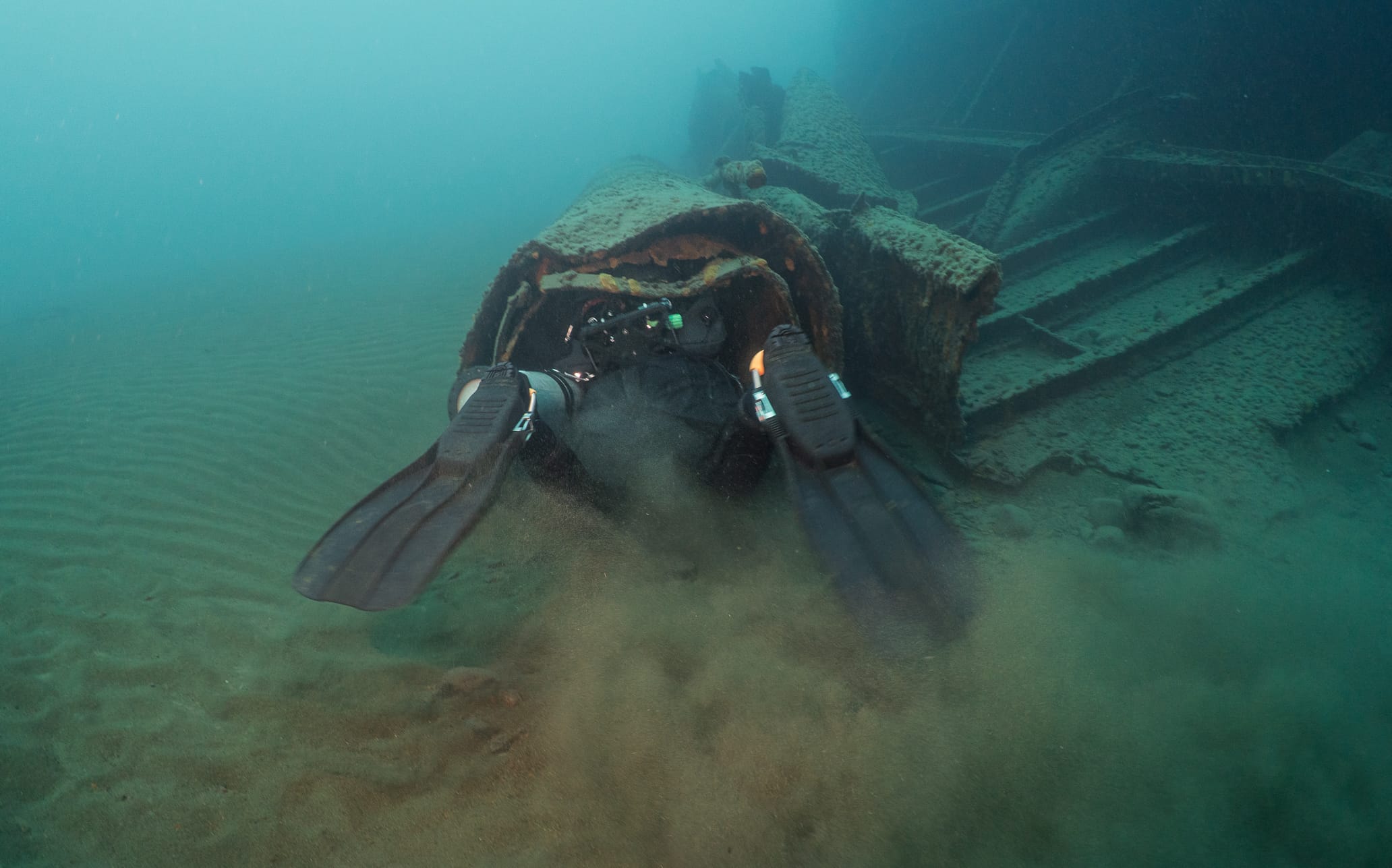
The Madeira Shipwreck, near Split Rock Lighthouse, is a place that defies tidy explanation. It’s not the wreck itself—though it has history enough. It’s the setting. A quiet stretch of shoreline, a private-feeling beach, and the peculiar luxury of solitude behind a locked, diver-only gate. It feels less like visiting a dive site and more like being let in on a secret.
Though, as it turns out, the secret may be getting out.
At the visitor center, where you sign in for access, there was a name—John Ryan, if I recall—neatly written beneath what can only be described as a commanding run of Heather Slane signatures stretching nearly half a page. I found this mildly unsettling. I had been under the impression we had exclusive rights to this particular corner of the world, and John had the audacity to challenge that assumption.
Madeira Monday delivered sun and nearly 40 degrees, which here qualifies as generosity. The lake was restless but not objectionable. The parking lot, still buried under a foot of snow, forced us to gear up roadside along Highway 61, where passing cars provided a steady reminder that we must look faintly ridiculous, and, I like to think, at least slightly heroic.
The sleds, those unsung heroes of winter diving, continue to earn their keep. The novelty of hauling life support equipment across snow has long since faded, but the practicality remains undeniable, especially when the walk stretches a few hundred yards.
I had plans for the dive. Elaborate ones.
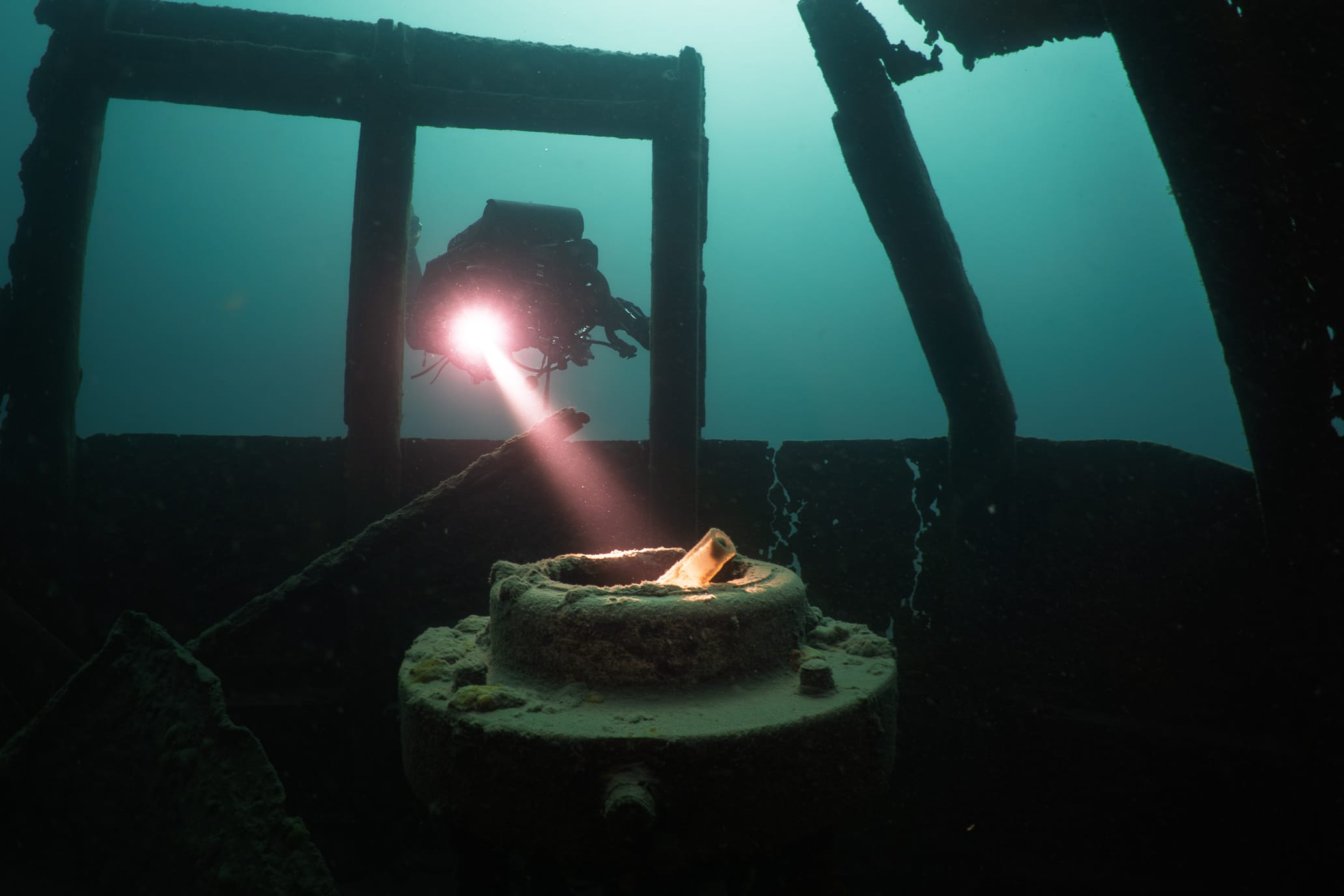
The goal was to light the stern section swim-through from below, illuminating Heather as she passed through, a departure from the usual silhouette shots. My plan involved staging video lights within the wreck, which seemed clever right up until I tried to execute it.
Mounting the lights on my strobe arms for transport felt like a reasonable idea. Removing them underwater, however, introduced a series of complications that can best be summarized as physics asserting itself. The lights are fairly heavy, and while the DIY flotation I added keeps them near neutral, once freed from the arms they insisted on standing upright and pointing directly downward, like disapproving periscopes.
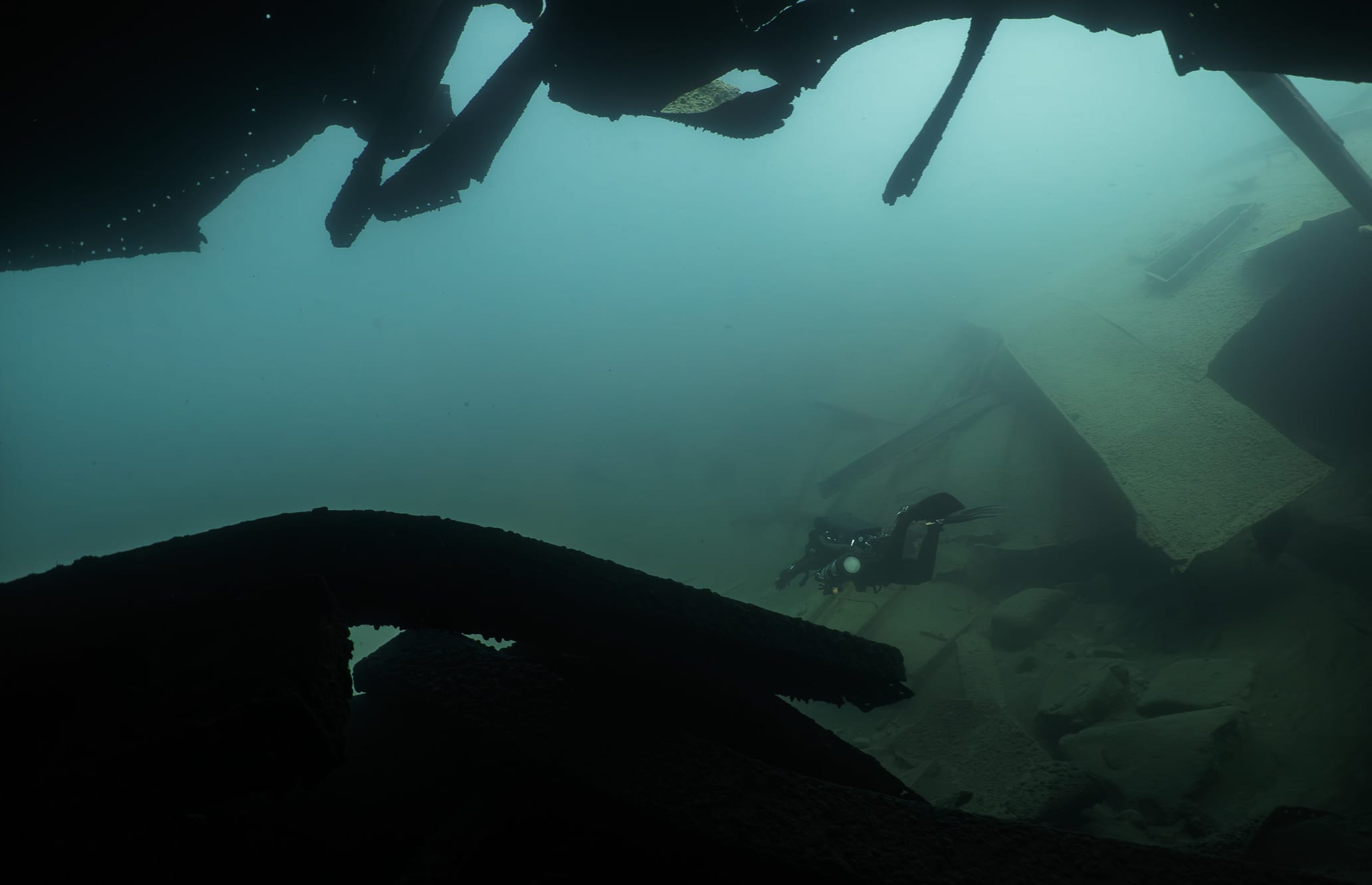
Plan B. Turns out silhouettes are pretty good when your lighting experiment sinks faster than the wreck did.
I briefly considered dismantling the floats at depth, but the mental image of small, expensive components drifting irretrievably toward the surface convinced me otherwise. The shot was abandoned with only mild resentment.
We moved on.
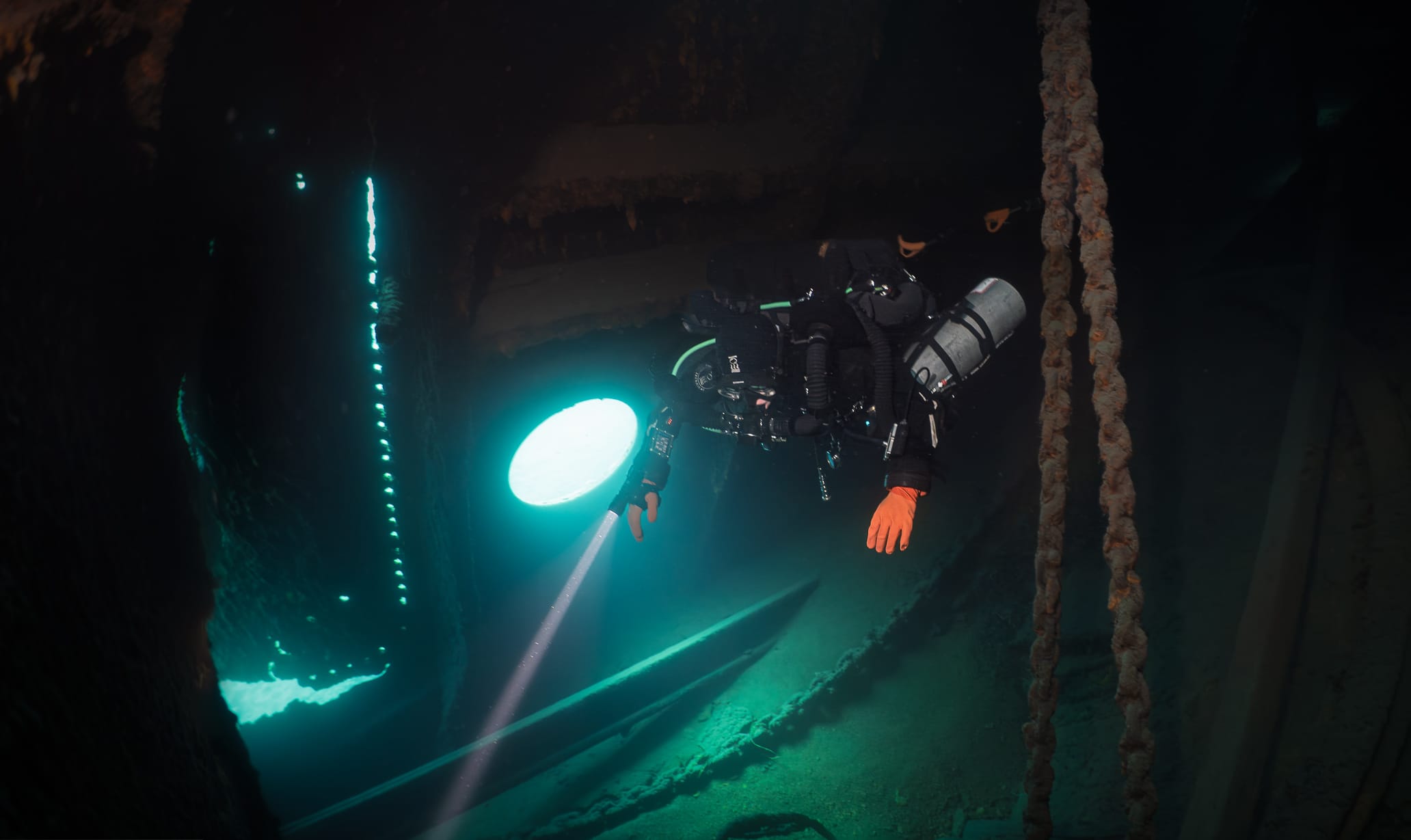
Heather slipped inside the Madeira’s chain locker with the practiced ease of someone who has done this many times, me hovering at the entrance just far enough to frame her, heavy chains suspended in pale, filtered light, a porthole casting a soft spherical glow into the space. I took several frames. Nothing definitive, but the kind of image that suggests something better is waiting in there, somewhere…
The chain locker has everything — chains, light, a century of atmosphere. What it's missing is a better photograph. Whether that's the room's fault or mine is a matter I intend to resolve on the next dive.
We continued on, eventually reaching the smokestack, that familiar waypoint. I considered pushing deeper to the wooden hatch at 130 feet, but after 40 minutes my hands had reached a temperature comparable to my martini, and I signaled to turn the dive.
On the ascent, the lake revealed subtle rearrangements. Sand had shifted, covering sections of wreckage that were previously exposed. And the white cross, a diver memorial resting in 40–50 feet of water had been displaced, lying awkwardly among the rocks. I cleared it and set it back in place, a small act of order and respect against the lake’s persistent reshuffling.
The exit was, in technical terms, sporty. Winds had shifted, waves had grown, and climbing out required just enough effort to be memorable. The return to the car—uphill, naturally—was its own quiet ordeal, particularly with rebreathers, bailouts, and a partner still favoring a healing foot.
Still, if it were easy, it would lose something essential.
After shedding gear, I headed back down. Heather was already at the water’s edge in that particular posture – arm out, perfectly still, barely breathing – that I have come to associate with either something truly remarkable, or a snapping turtle. I ran through the candidates as I approached: a wolf, a moose, a harbour seal who had taken several wrong turns somewhere south of Hudson Bay. It was none of these, and considerably better than most of them.
A river otter. Just… there. Moving through the shallows with the casual authority of something that never had to spend four thousand dollars to feel comfortable in cold water.
River otters are not uncommon in the region, though they generally prefer calmer water than Superior offers — which makes this one’s presence feel slightly pointed. Underwater they are, frankly, embarrassing: nostrils that seal shut on command, a transparent third eyelid that functions as built-in dive mask, eight minutes of breath-hold, and a cruising speed of eight miles per hour at depths of sixty feet. No certification required. No equipment. No financial suffering whatsoever.
This one ambled to within twenty feet of Heather, regarded us with the mild curiosity before slipping back into the lake.
We waited, briefly hopeful.
It had already moved on.
No photo. You’ll have to take my word for it.
In the end, I came home with fewer images than I’d planned, but more ideas than I started with—which, in diving as in most things, is usually the better outcome.
The Madeira will wait.
And I’ll be back.