
Frozen Valves, Sound Judgment, and Other Signs of Winter
Winter arrived the way it usually does in Minnesota: abruptly, without consultation, and with the subtlety of a falling piano. One week it was fifty degrees and sunny, Heather and I diving the Madeira and eating blueberry pie by the lake like sensible, well-adjusted people. The next, we were parked at St. James Pit in eight inches of snow, the air temperature in the low teens, staring out the windshield as if winter had personally followed us there out of spite.
We tried to dive anyway. It was the first true winter outing of the season, and those always come with a special flavor of nervous optimism. Heather had never taken her rebreather into freezing air, where low temperatures can slow CO₂ absorbent reaction rates, affect non-return valve performance, and make manual oxygen and diluent add valves vulnerable to icing before the unit ever reaches the water. She had also broken her fourth finger a few days earlier, taped and splinted it, and discovered that the splint didn’t fit inside her dry glove. She went with tape alone. Not ideal. Also very Heather.
We geared up. Winter immediately began offering feedback.
Her manual oxygen injection valve froze. Her wing inflator froze. Her finger almost certainly hurt. None of it was catastrophic—the valves would have thawed once submerged—but the small issues kept stacking up. Diving rarely shouts; it clears its throat and waits. When Heather quietly mentioned that her broken finger might make getting out of her fins difficult, it was clear—without anyone needing to say it—that the dive was over.
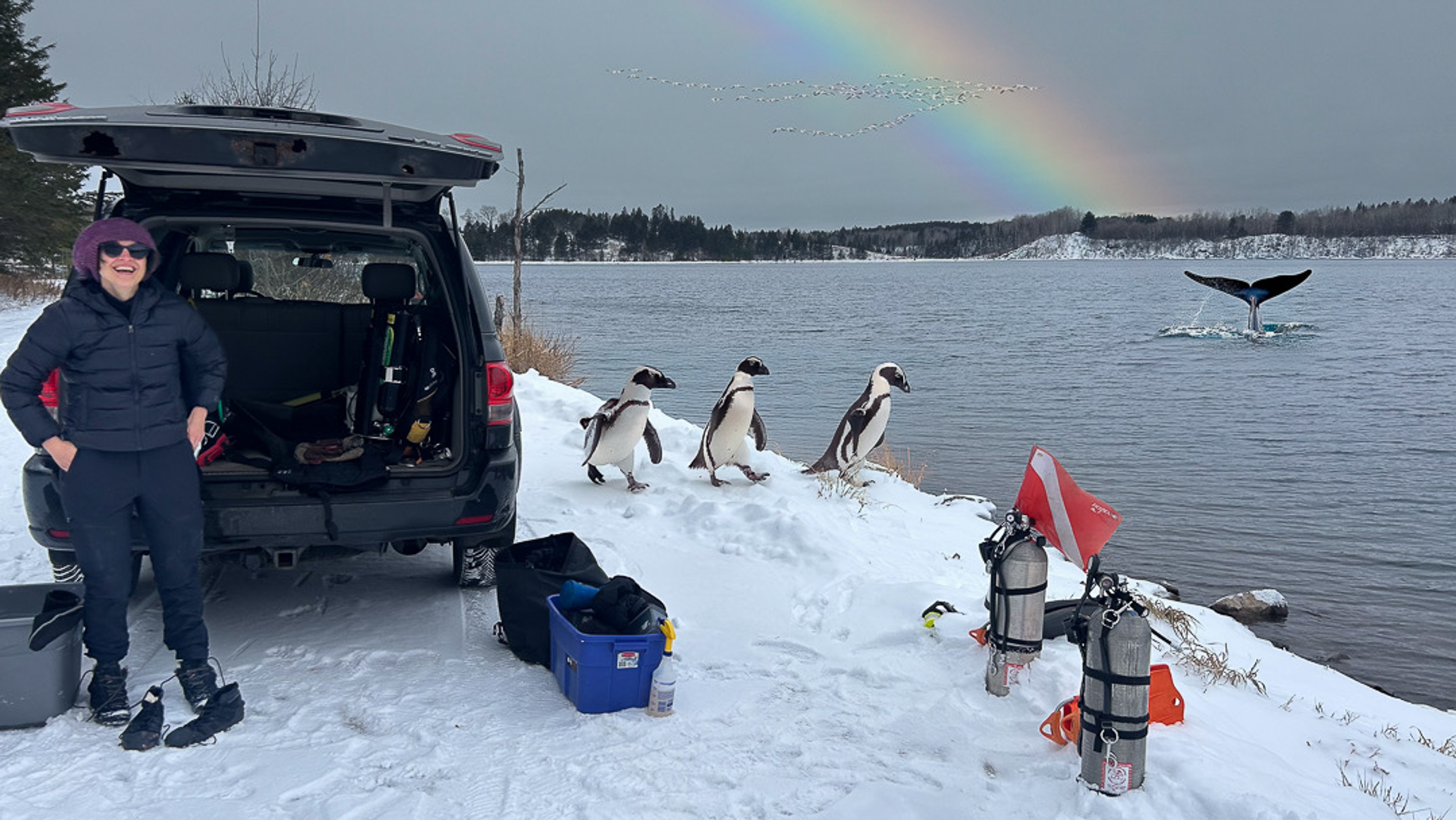
Ater the dive club posted sunny Mexico reefs, we replied with a heavily photoshopped St. James Pit ~ where penguins loiter, orcas cruise, rainbows appear, and we heroically decline a perfectly sensible dive.
Calling a dive is harder than people think. You don’t want to disappoint your buddy. You don’t want to waste the drive, the prep, the effort. But good divers aren’t defined by what they push through—they’re defined by what they’re willing to walk away from. Knowing when to stop is a skill, and often a quiet one.
A week later, we tried again—this time at Burlington Beach. The air was still in the teens, but in drysuits and properly layered, Lake Superior felt no different than it ever does. Cold, yes, but familiar. We kept the dive shallow, poking around the bay for an hour or so, never going much deeper than twenty-five feet.
We found golf balls. Again. Burlington Bay appears to function as some kind of submerged driving range, though no one has yet admitted responsibility. Alongside them was an impressive collection of junk: tires, beer cans, towels, and—most memorably—a stuffed teddy bear with a fish hook embedded in it. It was funny in that dark, underwater way, and also disappointing. Lake Superior is usually pristine, which made the mess feel more conspicuous. We may need to organize a cleanup dive next summer. Something productive. Something that feels vaguely virtuous.
The water was in the upper 30s. Completely normal. The air temperature when we surfaced, however, was not. Drysuits stiffened immediately, turning into something between corrugated cardboard and medieval armor. I nearly dragged Heather across the parking lot trying to peel her suit off her leg. We laughed, mostly because that felt better than acknowledging what we’d signed up for.
Another dive around this time—at a Breakwall—was uneventful, enjoyable but largely forgettable except for the arrival of the American Spirit, a 1,004-foot ore boat easing into Two Harbors while we were suiting up. I took a bit of video and only later did I notice that they’d mounted a Christmas tree on one of the loading booms. A ten-foot tree, nearly swallowed by a thousand feet of steel. Subtlety has never been a strong maritime value.
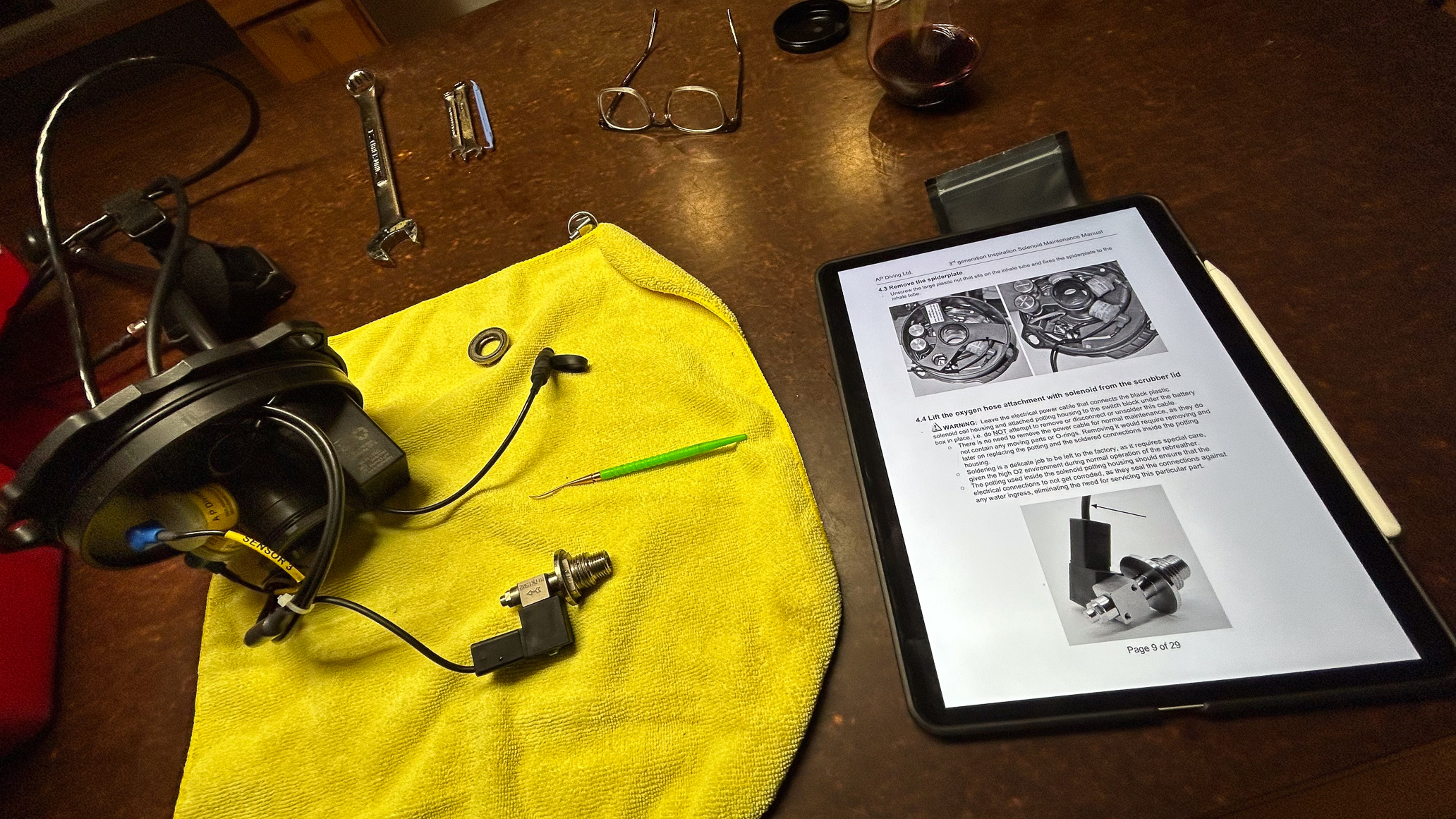
Between dives, I had a small but satisfying win at the workbench. The oxygen solenoid on my rebreather uses a fine steel mesh filter to keep debris out of the system. Mine had vanished. Silent Diving eventually shipped the replacement kit—half a dozen O-rings and the mesh itself. Solenoid servicing is officially recommended annually by AP Diving and officially involves sending the unit away for months.
I found a maintenance sheet, read the warning that strongly encouraged professional instruction, and decided to proceed anyway. It took about forty-five minutes and was surprisingly straightforward. Probably a legal warning more than anything. At least that’s what I’m choosing to believe.
Servicing life-support equipment with brass picks, a crescent wrench, and red wine—because nothing says “precision engineering” like hope and a glass of the house red.
I haven’t been diving at the aquarium as regularly lately. Tuesdays—historically my day—have been claimed for the next three months by a guy named Steve, who dives with his wife, which is objectively wholesome but still feels like a personal affront. I did manage a dive this week, though, and in talking with Jorie, signed Heather and myself up for an ice diving course next month.
Ice diving involves cutting a hole in the ice, running tether lines, and maintaining a calm demeanor while knowing your only exit is a carefully measured geometric shape some distance away. It’s not something I’d planned to pursue. We already dive water only a few degrees above freezing most of the year, and I have no intention of recreational chainsaw ownership. But Heather wants to do it, and I want the photos. Hopefully Jorie lets me bring a camera.
In non-diving news, I recorded a piano piece—Hans Zimmer’s Inception. Repetitive, forgiving, and manageable given how little I’ve been playing lately. It still needs polish, but I was happy with the sound. GarageBand remains a mysterious and humbling piece of software.
There’s a lot going on. I’m grateful to still be diving. That weekly sense of adventure is essential for keeping winter from feeling endless. Grace comes home tomorrow for Christmas, Isabel next week. There are things to look forward to.
It’s only mid-December, and tomorrow’s forecast calls for a –40°F wind chill.
Winter, it seems, is just getting warmed up.