The Picture in My Head
We have now made four dives looking for an ancient fish that almost nobody sees.
It takes a certain tolerance for cold water, poor visibility, and the peculiar sensory deprivation of spending hours in the barren world beneath Lake Superior. There is almost no plant life, fish are occasional at best, and the bottom stretches away in a landscape of rock and sand that can feel remarkably sterile. You can spend an entire dive seeing almost nothing alive. The fish are somewhere down there. Probably. We just have to keep showing up.
All four dives were at Gooseberry Falls in recent weeks, looking for lake sturgeon. The first produced nothing. The second involved a trail of shrimp and 90 minutes in 39-degree water, which is a long time to discover that fish do not necessarily respect a carefully prepared menu. On the third dive, Heather saw a sturgeon in the distance. I saw the cloud of silt it stirred up while rooting along the bottom for food. Technically, I had seen evidence of a sturgeon, although this was not emotionally or photographically satisfying.
In 1903, the Belle P. Cross was torn apart by a Lake Superior storm near Gooseberry. The boilers, engine and machinery were salvaged. More than a century later, her enormous rudder is all that remains.
The first time we actually saw them was last fall. We weren’t looking for them and certainly weren’t expecting them. Neither of us knew anyone who had seen a sturgeon underwater, despite knowing divers who had been doing this for decades. Then one appeared, and I nearly jumped out of my drysuit.
Lake sturgeon are strange survivors. New research suggests some can live well beyond 200 years, with a few approaching 300. There may be fish swimming in Lake Superior right now that were already alive when the Declaration of Independence was signed. Alive before electricity, automobiles, airplanes, television and the internet. A single sturgeon could have watched humans go from traveling by horseback to working out how to get around on the surface of Mars. Sturgeon, meanwhile, have been around for roughly 150 million years and have apparently seen no need for major revisions. They still look pretty much the way they did when dinosaurs were having their moment.
Yesterday, we went back to Gooseberry again.
No shrimp this time. We simply went where we thought the sturgeon might be and spent some time looking. The water had somehow warmed almost 15 degrees since our previous attempt, into the low 50s. After 39-degree water, it felt tropical.
About half an hour into the dive, I saw one.
Lake Superior, 55 feet down, 53° water. A species that can live past 200 years arrives to music that is entirely too dramatic. But feels totally appropriate.
It was about 55 feet down and moving toward me. Heather was 20 or 30 feet to my right, so I started slashing my dive light back and forth in what I hoped was a clear signal to come over and not the international underwater symbol for “I am out of air.”
The sturgeon kept coming.
My camera is clipped behind my right hip, tucked against the rebreather. It has two attachment points because losing it underwater would be like dropping your wallet somewhere along a mile-long trail, except there is no trail, it’s dark, there are no footprints, and you have no particularly useful way of retracing your steps.
When something interesting appears, I have to unclip it, pull it around, remove the lens cap and start recording. In practice, the camera is always easiest to retrieve when there is nothing worth photographing. The moment something interesting appears, the clips seem to multiply, the lanyards find somewhere to wrap themselves and I suddenly have the dexterity of a man wearing boxing gloves. By the time I have the camera in front of me, whatever I was hoping to photograph has usually managed to disappear.
The sturgeon was approaching while I did all of this.
It came within about six feet of me just as I was getting the camera ready. I skipped the video lights. There wasn’t time, and I didn’t want to blast a large, prehistoric fish in the face with two very bright lamps. I started recording.
The sturgeon then settled into its routine, rooting along the bottom and paying very little attention to me. I swam alongside it for perhaps 30 feet. A small boulder happened to sit between us, and the beginning of the video catches the sturgeon emerging from behind it. For a few seconds, it looks almost like I planned the shot.
I did not.
The fish eventually disappeared into the distance. I floated there for a couple of minutes, quietly amazed that we had actually found one and unwilling to leave just yet.
The footage is good. It is also not nearly as good as the footage that exists in my head.
The first few seconds are pretty nice. After that, the contrast falls off and the sturgeon gets smaller and darker as it swims away. I should have had the lights on. I should have started recording sooner and been in a better position. Ideally, I would have anticipated the appearance of a 200-year-old fish and had the camera ready.
This is the problem with wildlife photography. The actual experience can be spectacular, and the resulting photograph can still leave you thinking about what you should have done differently.
Heather and I are in the water a couple of times a week, regardless of the weather. Sometimes we go to Lake Superior and spend an hour looking at wet rocks and maybe a fish. Sometimes we drive to a mine pit and discover that a piece of equipment has decided to test the limits of our patience.
Tioga provided a good example.
On our first dive, one of Heather’s oxygen sensors was reading low. The other three agreed, so she monitored it ~ the rebreather equivalent of ignoring a check-engine light because the car still starts. Then her mouthpiece wasn’t quite tight enough. The rebreather began flooding, the mouthpiece worked loose, and our dive plans changed rather quickly.
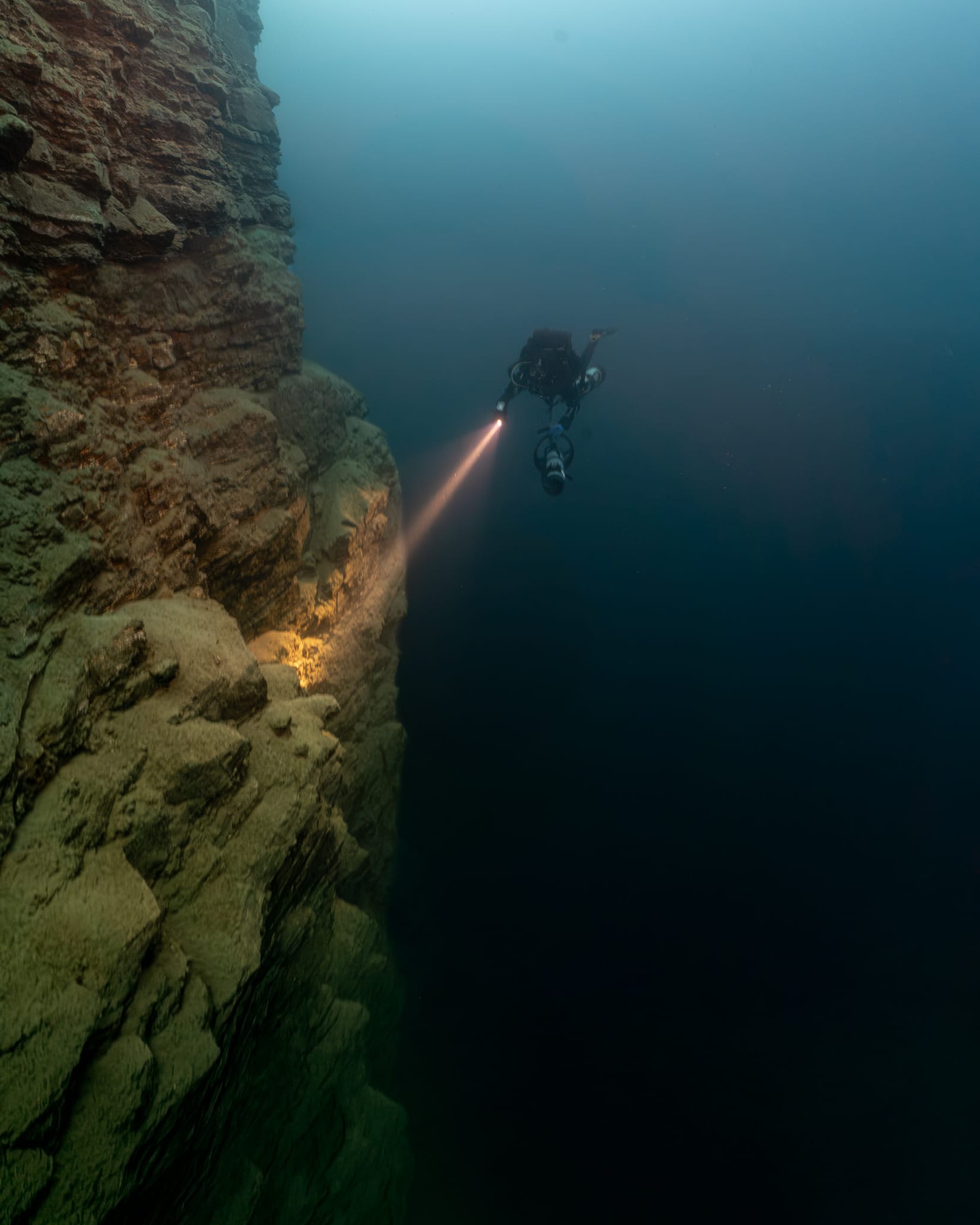
Heather descending the wall at Tioga. A single frame never worked, so I shot four and stitched them. It's the closest I've come to showing how it feels to float beside it.
Moments later, I was following her past 120 feet. Thankfully, her gas consumption rivals that of a fruit fly.
My contribution was to lose my dive light.
I was photographing fish and never noticed it had come loose from my hand mount. Heather did. She retrieved it and handed it back to me. Underwater photography produces a remarkably effective tunnel vision. The fish is in the viewfinder. Everything else becomes somebody else’s problem.
We went back the following week.
This time everything worked, which was already an improvement. The plan was to finally explore the line we’d swum past on so many previous visits. It is tied off at about 55 feet, right at the lip of Tioga’s nearly vertical wall, and runs steeply over the edge into the depths of the pit. There is a rumor that it leads to an old mining train car or engine. Nobody seems to know exactly what’s down there, or even who put the line in, but somebody went to the trouble of running a guideline down a 225-foot mine pit. It makes you wonder what they found.
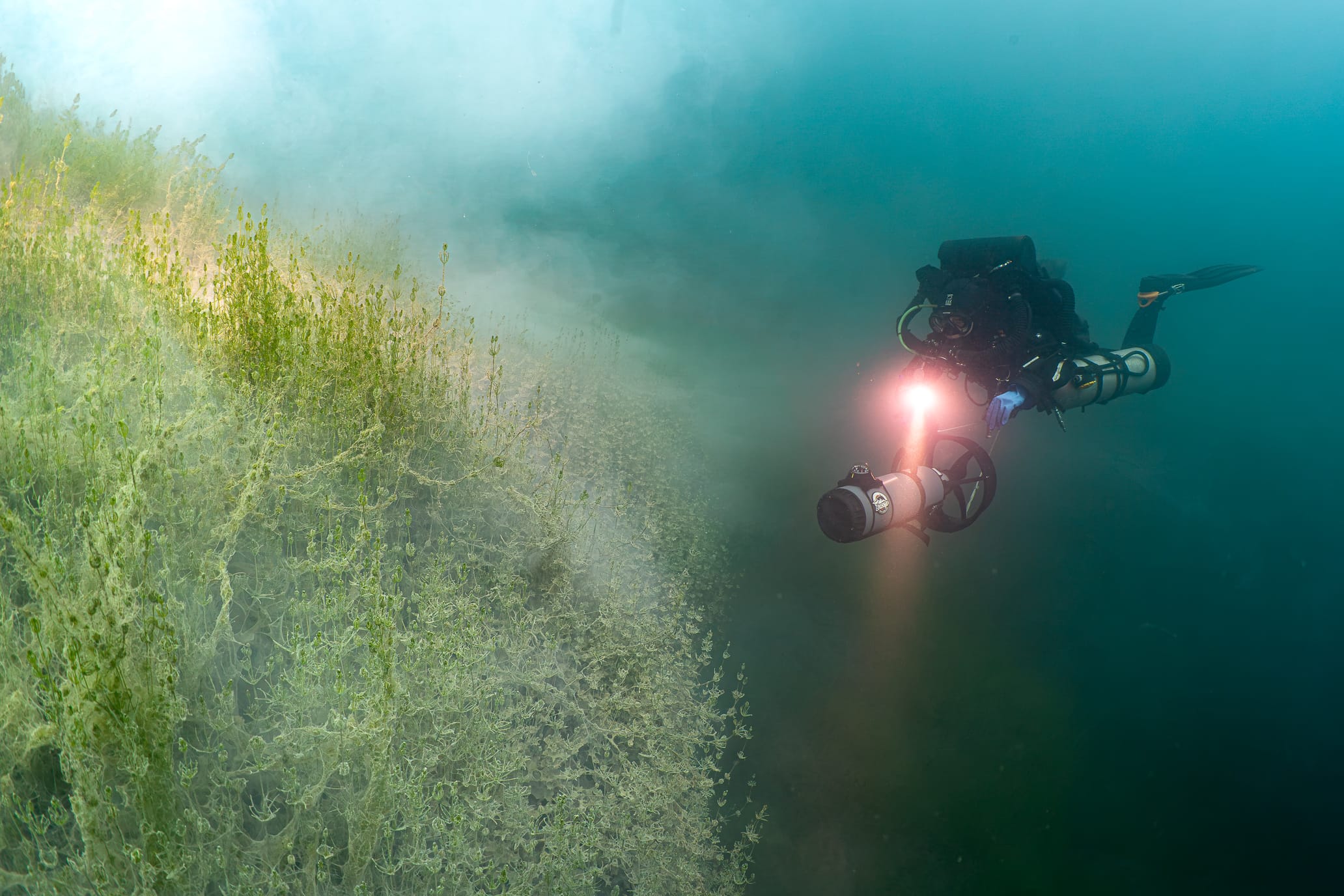
Heather swims alongside a strange white cloud that dusted the aquatic plants with pale, cobweb-like deposits. I have theories. None of them are good ones.
Heather had talked about following the line for a while, so this time we decided to finally see where it went. Her plan was to take it to 170 feet and see if she could get a glimpse of whatever might be down there. I would stay shallower and wait, perhaps work on my back kick, and probably photograph some fish.
Heather disappeared down the wall, following the line into the darker water below. I watched her slip out of sight and waited, wondering whether she was about to find a train car, a piece of mining equipment, or approximately 120 feet of absolutely nothing.
At 170 feet, she turned around. The line was still going, disappearing into the dark with no train, no equipment and no obvious end. Whatever is down there was going to remain a mystery for another day.
Heather likes that sort of thing. I prefer sunny water, fish and photographs. It is not an obvious partnership, but it has worked reasonably well so far. We just have slightly different ideas about what constitutes “deep.”
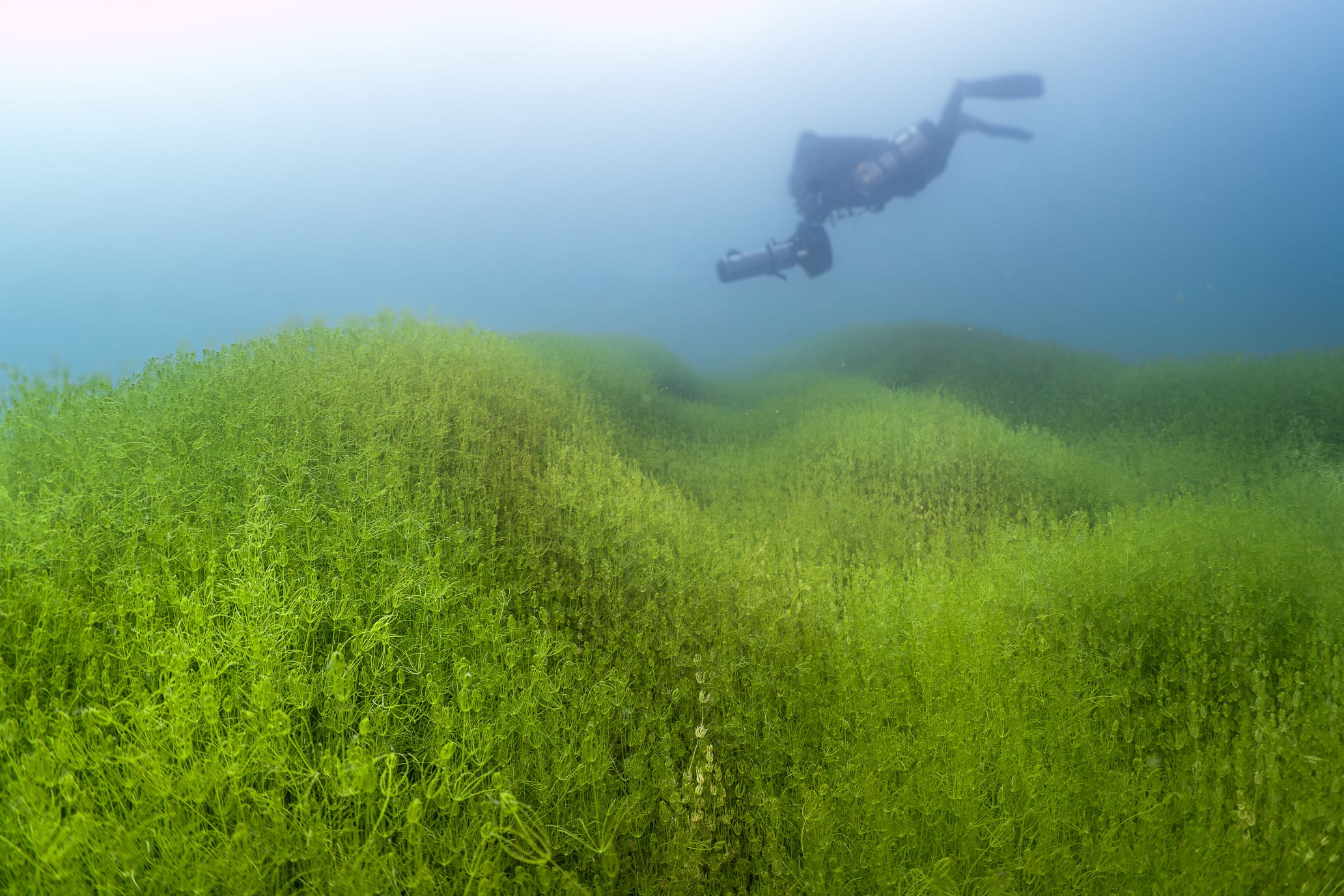
Giants Ridge is known for golf. Tioga has the rolling greens, and Heather playing through overhead. What it didn't have, is the usual dusting of lost golf balls.
For someone accustomed to diving in the ocean, our enthusiasm for repeatedly entering a lake to look at wet rocks might seem slightly unhinged. There are no coral reefs. No sea turtles. Most dives are not encounters with anything particularly remarkable. We get cold, we look around, and eventually we go home.
Then, once in a while, a 200-year-old fish swims out from behind a rock.
And for a few minutes, the lake gives you something so improbable and wonderful that you forget you’re cold, you’re underwater, and you’ve needed to pee for the last half hour.
I will probably keep looking at the video from yesterday and thinking about how I could have made it better. That’s part of the deal. The picture in my head is always going to be better than the one on the memory card.
Which is probably good.
It gives me a reason to go back.