
NORTHish
For the last few weeks I’d been chasing a red herring ~ a problem entirely of my own making, pursued with mounting confidence, unnecessary expense, and the kind of obsessive tunnel vision usually reserved for conspiracy theorists and first-time Ironman athletes.
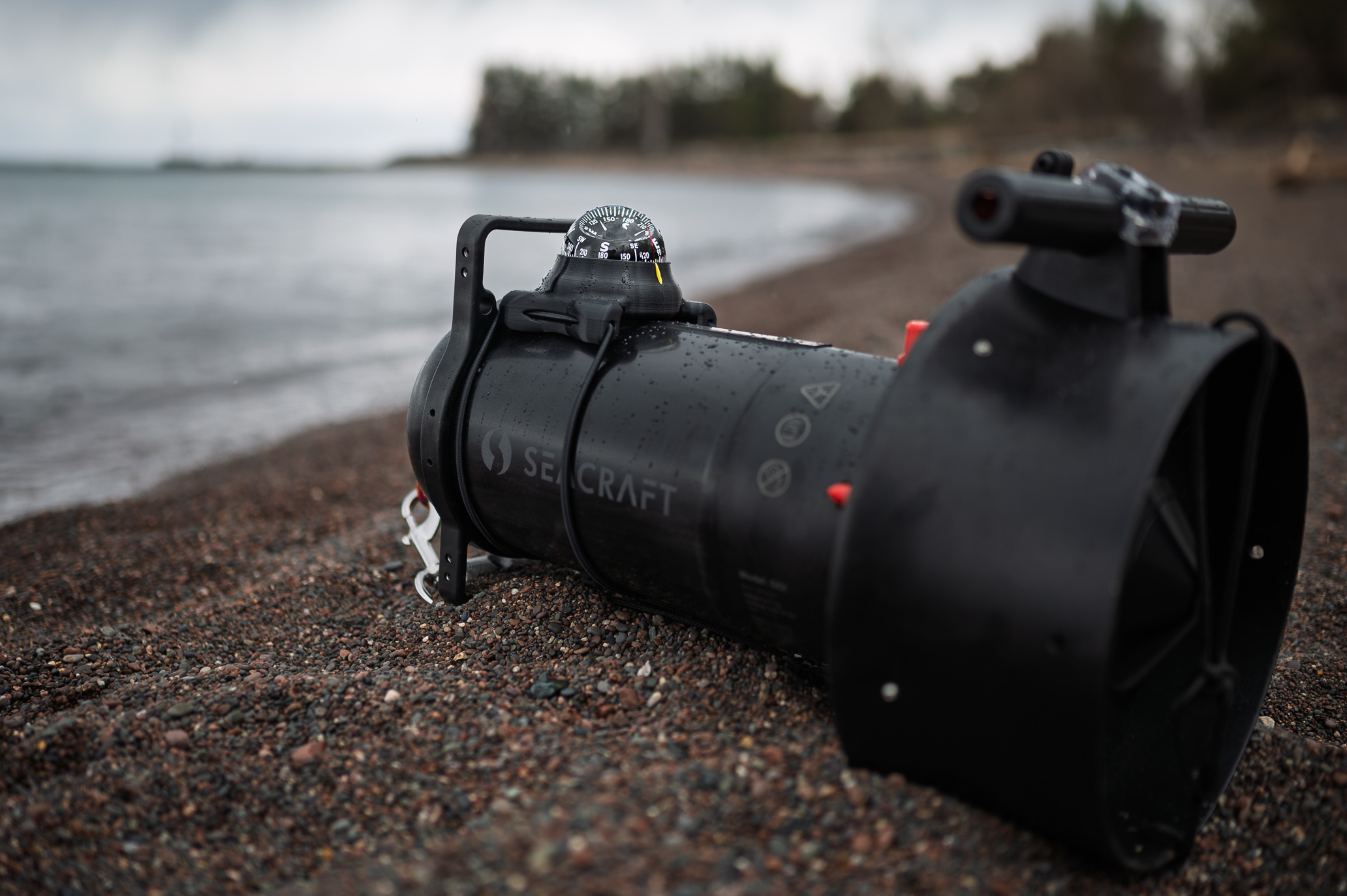
It started with my Seacraft GO!, an underwater scooter ~ or DPV if you’d prefer the acronym divers use to sound more serious than “underwater scooter” allows. The GO! is compact, absurdly fun, and fast enough to completely change the geometry of shore diving. Distances that once required grim determination and a high tolerance for suffering now pass by in what I can only describe as an underwater Sunday drive. This is wonderful right up until you realize it also lets you become very lost very quickly.
A compass is therefore not optional equipment. The problem is that compasses and electric motors coexist about as well as raccoons and campground coolers. Motors generate magnetic interference, which can send a compass needle wandering off in whatever direction it finds personally compelling. Divers solve it by mounting the compass as far forward and away from the scooter’s motor as possible. Unfortunately, the Seacraft GO! is compact enough that “far forward” amounts to roughly the length of a TV remote, which is not the kind of distance magnetic fields find intimidating.
I tried two compasses I already owned. Both wandered forty, sometimes fifty degrees off north. I then found someone on a DPV Facebook group who had mounted a Silva kayak compass to the same model scooter and declared there was “no measurable interference after extensive testing,” which is forum-speak for I checked this in my garage for three minutes and now consider myself a navigational authority.
I ordered one. It arrived. It behaved exactly like every other compass.
This should have been a clue.
It was not.
What followed was the technical rabbit hole phase ~ a dangerous period in any enthusiast’s life. It’s where reasonable people pause and reconsider, while the rest of us disappear into obscure forums populated by people with usernames like WreckHunter72 and ProfileDiverX. I eventually ordered a compass with a built-in deviation compensator featuring tiny adjustable magnets and microscopic brass screws. Calibrating it took forty-five minutes and the emotional steadiness of a bomb disposal technician. The screws were so sensitive that blinking aggressively near them appeared to shift magnetic north by six degrees. I got it close ~ not totally accurate, but north~ish, and then realized it was so sensitive that blinking aggressively near it appeared to shift magnetic north by six degrees.
Back it went.
Deeper into the internet.
Eventually I found myself reading about mu-metal ~ a nickel-iron alloy used in scientific instruments to shield against magnetic fields. This sounded promising. A letter-sized sheet cost roughly a hundred dollars, which is how I ended up on eBay purchasing what was, in practical terms, a used piece of magical tinfoil from a stranger on the internet. I completed this transaction without once pausing to reflect on the life choices that had delivered me here.
It arrived a week later.
It did absolutely nothing.
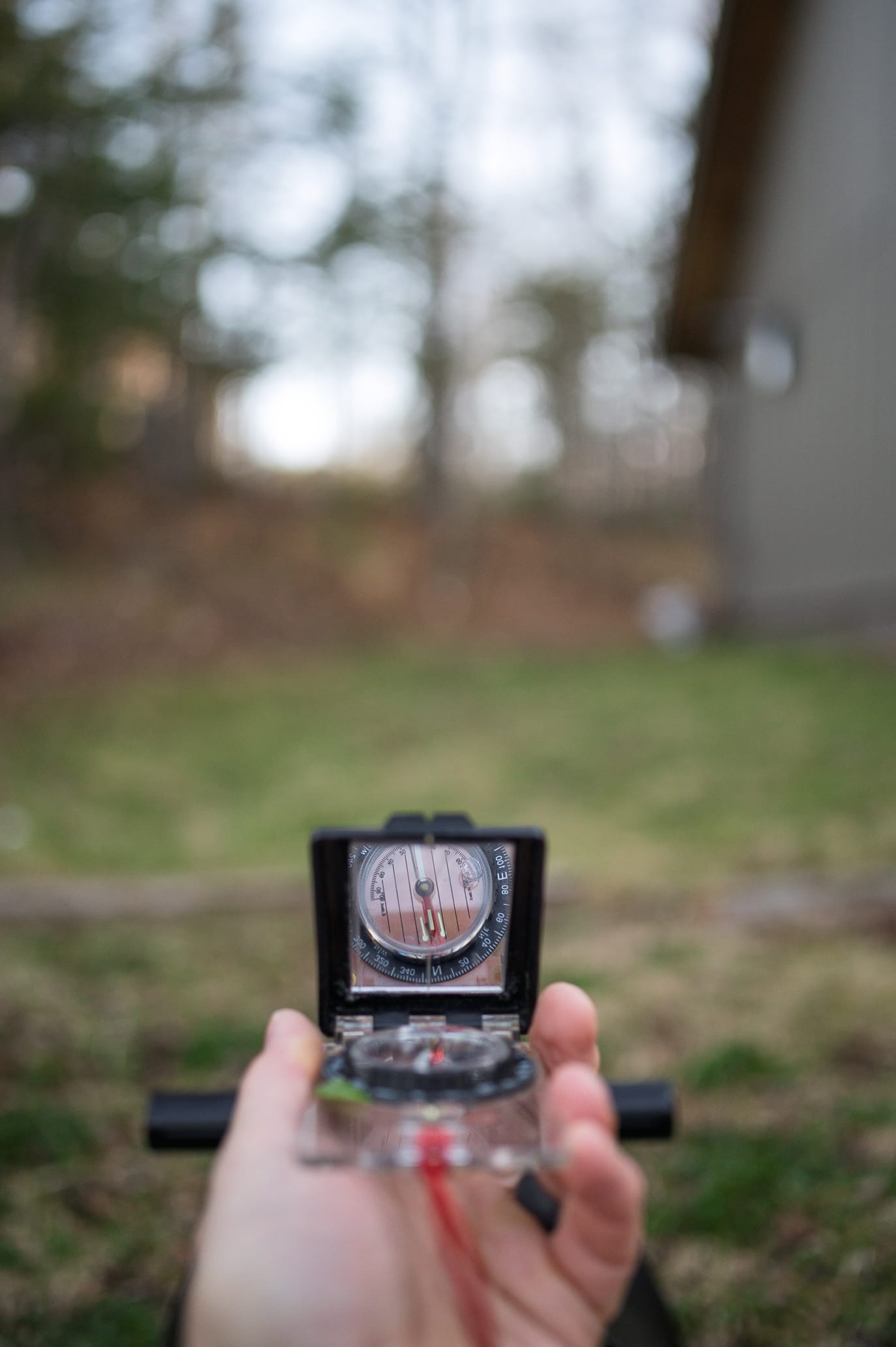
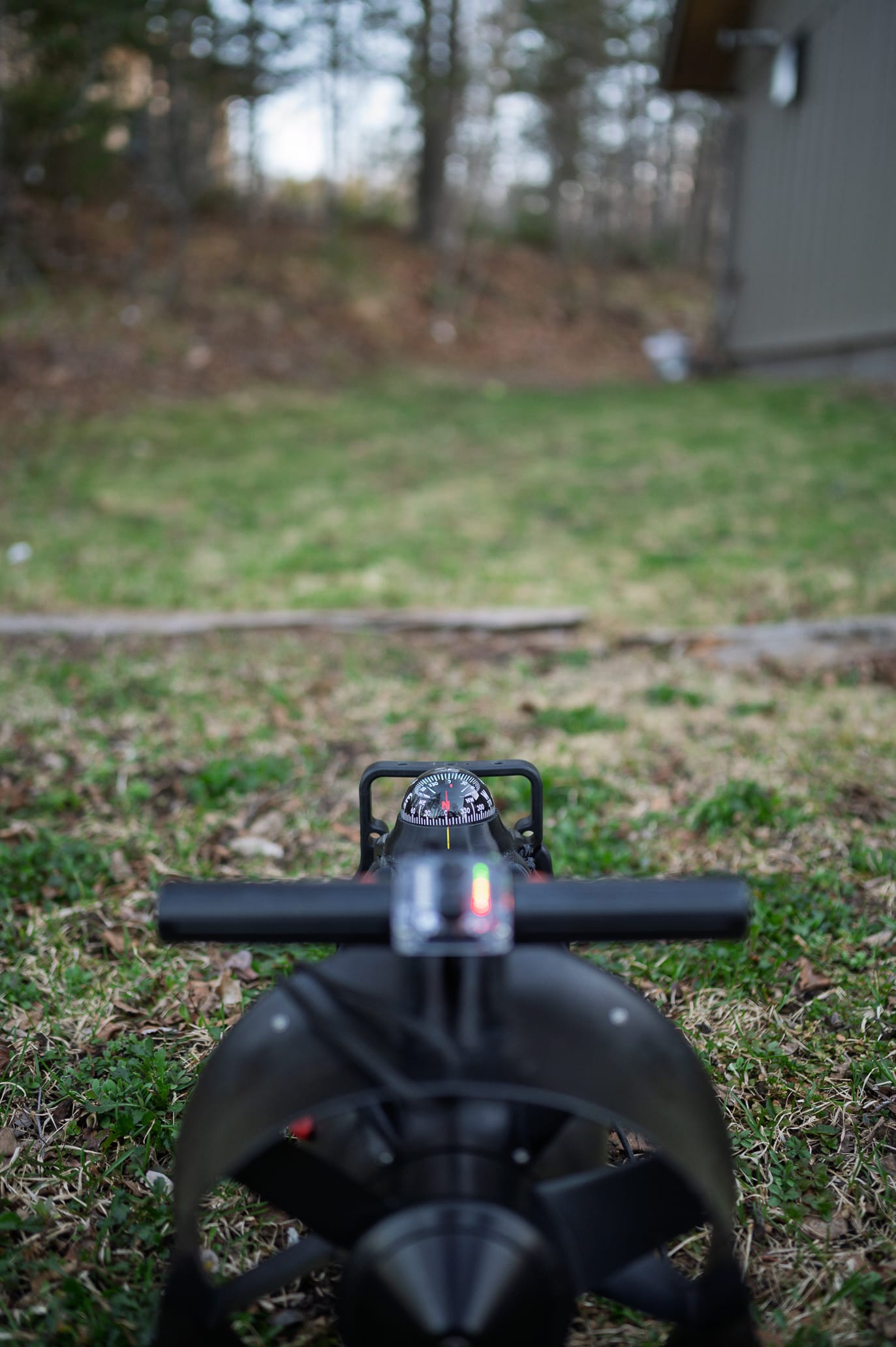
Then, through a sequence of events I no longer fully understand, I carried the scooter outside ~ away from my workbench ~ and the compass worked perfectly. Dead-on north. Stable. Accurate. Completely normal.
The problem was not the scooter.
The problem was that I had spent nearly three weeks calibrating compasses on a wooden workbench directly above a table saw and drill press and all their associated electric motors and magnetic fields.
So. Multiple compasses. Hours of research. Special shielding foil from a stranger online. All because I failed to notice the industrial equipment directly beneath my nose.
Due north. Three weeks of research, four compasses, one sheet of magical tinfoil ~ solved by walking outside.
With the compass finally sorted, there was only one reasonable next step: take it somewhere it could get me into trouble.
Which is how Heather and I ended up attempting a shore dive to the wreck of the Niagara near Knife Island.
The Niagara was a 130-foot wooden steam tug built in the 1870s, her job towing enormous log rafts across Lake Superior ~ which feels impossibly ambitious when you’re standing on the shoreline trying to decide whether conditions look “pleasant” or merely “less homicidal than usual.” In 1904 she ran aground near Knife Island in heavy weather and broke apart in the surf. Some accounts suggest compass irregularities near the island may have contributed to the wreck.
Given our plans for the afternoon, this felt less like history and more like foreshadowing.
From a boat, finding the wreck is straightforward. You plug in coordinates and drop over the side. From shore, however, the wreck sits roughly half a mile out in fifty to ninety feet of water, and on this day we had perhaps twenty feet of visibility. Finding a broken wooden wreck under those conditions is a bit like standing in a football-field-sized parking lot trying to locate a specific Subaru while wearing a blindfold and traveling by bicycle.
We geared up, hauled everything to the shoreline, and headed for the water.
About ten steps from water’s edge, I realized I’d forgotten my scooter in the car.
This would prove to be the first entry in what became a surprisingly comprehensive catalog of mistakes.
I retrieved the scooter. Returned. Then realized I’d also forgotten the dive flag we intended to tow because of boat traffic from the nearby marina. At this point irritation had overtaken responsibility, so I decided not to go back for it.
Excellent decision-making all around.
We did our checks, took a compass bearing toward the wreck, and scootered out toward Knife Island. I watched the compass carefully. Then, as we approached the island, the needle slowly drifted ~ ten degrees, twenty, thirty. My heading hadn’t changed. The bottom was mostly sand. Yet the compass wandered sideways for several minutes before mysteriously correcting itself. Somewhere beneath Lake Superior, apparently, the earth’s magnetic field was having its own off day.
Near the island we surfaced to confirm our bearings. Since we’d forgotten the dive flag, we’d agreed to deploy a DSMB before surfacing. Heather began searching her pockets. A minute later she was still excavating equipment with the calm, focused expression of someone looking for lost car keys in a winter coat.
I deployed mine instead, which went adequately considering I perform this maneuver just infrequently enough to remain only technically proficient.
We surfaced about a hundred feet off course, which felt pretty respectable given the navigational conditions.
As we discussed our plans to continue toward the wreck and I attempted to re-stow my DSMB, the bolt snap on my spool unclipped and the whole thing plummeted toward the bottom.
Another unforced error.
I retrieved it. Lost Heather briefly. Surfaced again. Regrouped. By now the dive had developed the energy of a low-budget maritime comedy.
We descended along the south side of the island. Ten feet. Twenty. I reached for my diluent valve to add gas to the rebreather and discovered nothing happened. As you descend, gas in the breathing loop compresses, and if you don’t add more, the loop slowly runs out of breathable volume ~ a process that happens considerably faster when a scooter is pulling you deeper. I found that the quick-disconnect on my MAV (manual addition valve) had come loose somewhere during my DSMB fumbling.
“Quick-disconnect” sounds wonderfully convenient until you’re trying to reconnect one with thick dry gloves in thirty-three-degree water. Delicate work in heavy gloves with numb fingers is a bit like repairing a wristwatch while wearing oven mitts. Technically possible. Not something anyone would recommend.
My desire for oxygen eventually exceeded my desire to troubleshoot gracefully. I flipped to open circuit and took a few breaths. Heather glanced over immediately ~ the sudden roar of open-circuit bubbles underwater is a sound CCR divers associate with things going poorly. I gave the OK sign. She held her position. A few breaths later I reconnected the MAV and we continued our search for the Niagara.
We rounded the island and descended deeper. Fifty feet. Sixty. Nothing. I motioned to Heather: press on or turn? She shrugged with the serene neutrality of someone who had fully made peace with the fact that this dive was now governed largely by luck and momentum.
We continued.
And then ~ there it was.
Wooden ribs. Scattered decking. Structure spread across the lake bottom in a shape resembling less a shipwreck and more an underwater carpentry project abandoned midway through construction.
After everything that had already gone wrong, it may as well have been the Titanic. We both pumped our fists. Against all reasonable odds ~ forgotten equipment, dropped gear, wandering compass, a disconnected breathing system, and a general level of organizational chaos ~ we had actually found it.
That felt genuinely magnificent.
We scootered along the wreck, following the remains deeper until the final section dissolved into ninety feet of cold dark water. We turned and headed back toward shore. Both properly cold now, we put the scooters in high gear.
After a minute or so I looked back.
No Heather.
I surfaced. Looked around. No Heather.
I wasn’t especially worried ~ navigation back to shore is straightforward enough that heading west and failing to find Minnesota would require genuine effort. We’re also both comfortable solo diving. So I dropped back down, scootered to shore, hauled out, and waited.
Likely moments after I dropped back down, Heather had surfaced looking for me ~ her hands so cold her fingers kept sliding off the trigger, costing her enough time that we lost each other in the blue. From the water, the beach looked different enough that she couldn’t immediately place where we’d entered, so she took a compass heading toward shore. It landed her about a hundred yards from our entry point. I waited on shore for a few minutes before spotting her emerge down the beach. Annoyed, but fine.
Which felt, in retrospect, entirely on-brand for the day.
We laughed. High-fived. Stood on the rocky shoreline quietly astonished that despite everything ~ the forgotten gear, the dropped spool, the disconnected rebreather, the magnetic anomalies, the general comedic chaos ~ we had navigated half a mile offshore in Lake Superior and found a wreck.
—
I turn fifty-five next month. Recently I passed on a trip to Bonaire ~ the sort of warm, clear-water diving that makes for beautiful Instagram posts and very little to figure out. A guide drops you on a reef. A shop fills your tanks. The difficult parts have already been handled before you arrive.
I love Caribbean dive vacations. I understand the pull more every year.
But what I keep coming back to is the cold dark water of northern Minnesota ~ drysuits, rebreathers, no shop, no guide, no laminated dive map. Just two people standing on a rocky shoreline trying to decide whether disappearing into Lake Superior seems like a reasonable use of an afternoon.
There’s something about the barriers to diving around here that makes the experience feel bigger ~ because, you earned it.
What Heather and I do out here is self-directed. We pick the sites, plan the dives, sort out the problems, and make our own mistakes on our own schedule. Today’s catalog included forgotten gear, a dropped spool, a disconnected breathing system, and a compass that spent three weeks fooling me in my own garage.
Nobody was there to fix any of it.
We just figured it out, kept going, and found the wreck anyway.
That feeling ~ the particular satisfaction of sorting things out as you go, in cold water, without a safety net ~ is one I genuinely hope I never lose. As I get older, I find myself thinking more about the importance of everyday adventure. About keeping something in your life that still asks something of you. Something that occasionally frustrates you. Something that requires effort before it gives anything back.
And maybe that’s part of why Lake Superior means so much to me now.
It’s twenty minutes from home. Cold. Dark. Frequently inconvenient. You have to haul the gear, solve the problems, and accept that some days the compass is wrong because you accidentally calibrated it over a table saw.
But every now and then, despite all of that, you find the wreck.
And lately, that feels like enough.
Love this. Also, I didn’t realize what a small miracle it was that you were able to find this wreck & all the scary hassle that happened to get there… gives me goosebumps just thinking about it haha.