
The Things We Decide Are Reasonable
Spring is arriving, though you’d be forgiven for thinking it had taken a wrong turn somewhere south of Duluth and decided to stay there. Up here, the warming happens with all the urgency of a committee meeting ~ technically in motion, but not in any way you’d describe as efficient.
Still, the seasons are shifting. The scooter has been out nearly every week since it arrived, and I find myself thinking less about the dives I’ve been doing and more about the ones coming ~ not in a wistful, someday kind of way, more in the way you think about a flight you’ve already booked. Longer dives. Farther dives. Better visibility. Warmer water. The long lazy cruises through the fish-filled shallows of the Cuyuna mine pits, where speed becomes the point and the walls go on long enough to actually reward following them. It’s coming. I can barely stand to wait.
Which makes it slightly strange that I spent most of the winter filming the opposite.
Lately, I’ve been thinking about a film I started and never finished. It had a title ~ Through the Cold, Into the Calm ~ which felt appropriately cinematic, or at least it did to the director, who was also the cinematographer, the diver, the sound department, and the editor, working with a budget that consisted primarily of a camera housing and a willingness to be cold on purpose.
The idea was simple: capture winter diving on Lake Superior as it actually exists for us. Not the once-and-done spectacle of cutting a hole in the ice and dangling tethered to the surface like a cautious balloon, but the quieter, more persistent version ~ the one where we’re diving Lake Superior through all but the coldest weeks, the water colder than the frozen lake I dove in February, yet somehow still liquid, snow piling up on shore, and you still find joy in it anyway. Week after week. Not out of stubbornness, exactly. More because it becomes the thing that makes winter not just tolerable, but genuinely good.
I didn’t set out to discover that. Last winter was our first full season of weekly diving through the cold, and I went in expecting it to be a minor ordeal ~ necessary for the footage and photos, mildly miserable, something to endure. Instead, I found myself looking forward to it. The prep. The drive up the shore. The particular silence under thirty-three-degree water when the rest of the world has gone gray and closed in. Northern Minnesota winters are long in a way that accumulates ~ not dramatic, just relentless. Weeks of low light, cold and the particular cabin-fever that sets in around late January when summer feels like a rumor. Having something to plan for changes the shape of the winter. Every week there’s a dive on the horizon. Every week the lake delivers something ~ a lowly sculpin, agates tucked into the sand, inexplicable congregations of golf balls off Burlington. It shouldn’t be as entertaining as it is. And yet.
This year I was actually looking forward to it before it started. That felt like progress.
I even shot the opening scenes of the film. But there was one shot I still needed ~ the shot. Me, sitting on the bumper of my car, drysuit crusted with ice, looking cold, tired, and perhaps mildly regretful. A long beat. Then, slowly, I look up. Something shifts. A smile. Cut to the underwater world: calm, weightless, luminous.
It’s a good shot. I’d watch that film.
Unfortunately, without the ability to summon winter on demand or hire a crew willing to stand around while I freeze for artistic purposes, the project remains unfinished. Somewhere over the winter the intensity I started with cooled ~ which is a peculiar thing to say about a film set in February. Part of it is that the impulse to document and share started feeling less like expression and more like content ~ the kind that gets scrolled past, appreciated briefly, and filed away without a second thought. I deleted my Instagram posts a few months ago and stepped back from most of it. The film is still in the folder. Maybe it stays there.
For now.
On Monday, someone posted that the Cuyuna mine pits were finally ice-free. This was welcome news. Ever since the scooter arrived, I’d been quietly imagining all the places it might take me ~ sheer walls, submerged forests, the kind of terrain that rewards speed and curiosity. So we drove to Crosby.
The Rally Center was deserted. A vast parking lot built for hundreds of mountain bikers, currently occupied by exactly zero. The trails were closed, still soft from the thaw, leaving us with the unusual luxury of having the entire place to ourselves.
The visibility, however, was anything but luxurious.
Spring turnover had arrived, and with it the physics lesson every diver in a northern lake eventually learns whether they want to or not. Water is at its densest at around thirty-nine degrees. As the surface warms toward that temperature after winter, the whole lake begins to mix ~ top to bottom ~ a slow invisible stirring of everything that had spent months settling quietly out of sight. The result is water that turns murky and quietly problematic ~ the kind of visibility that swallows landmarks and complicates navigation. It has a way of turning your dive buddy into someone you’re concentrating hard on not misplacing, a concern that only compounds as you descend past twenty feet and the light begins to thin. Not dark exactly, just steadily dimmer—the sun somewhere above, thoroughly absorbed by the murk—until the wall you came to see exists mostly as a suggestion.
Still, it was thirty-nine to forty degrees, which felt almost celebratory after a winter in Superior’s low thirties. “Warm” is relative, and by this point in the season I am a person whose warm threshold has been recalibrated to a degree that I prefer flip-flops for all four seasons.
Heather had also suggested I move my heated vest one layer closer to my skin for this dive ~ under one of my two wool layers instead of over them. It was, she assured me, a good idea. And in fairness, it worked. I was noticeably warmer. What she had not mentioned ~ possibly because it had not yet happened to her ~ was that the heating elements would leave what appeared to be grill marks across my abdomen and back. Not painful, just slightly seared.
Warmer? Absolutely. Slightly overdone? Also yes. In my defense, I was simply following expert advice.
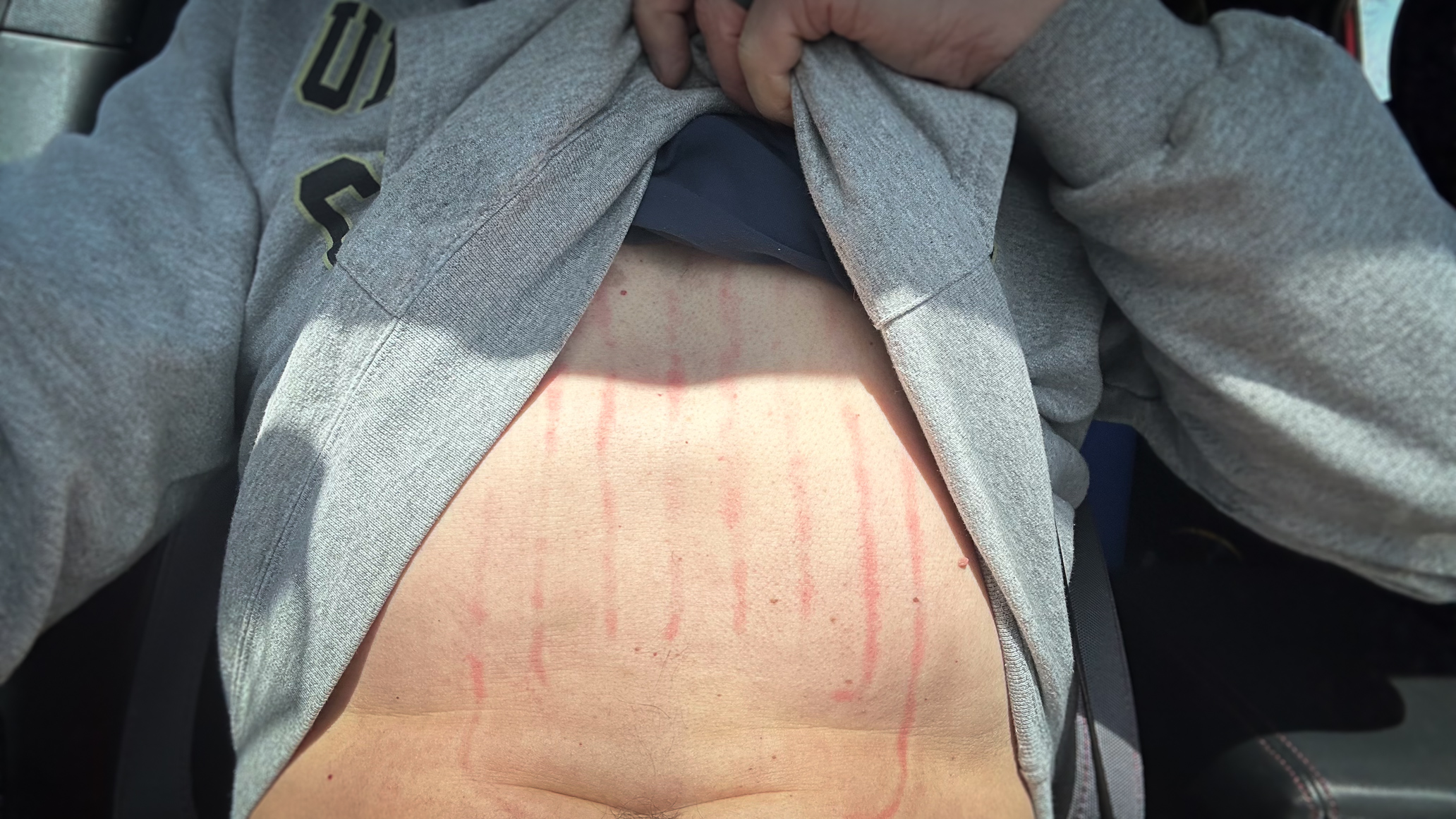
Post-dive, when we compared notes, she was sporting an identical set of sear marks. We both laughed. I filed this under lessons learned and chose not to examine too closely whose idea it had been.
We descended along the walls of the Huntington-Feigh mine, weaving through submerged trees, the scooter covering in seconds what would have taken minutes on fins—the kind of speed that makes your former swimming self look about as efficient as paddling a canoe with a soup spoon. At a hundred feet the wall ~ which by all accounts is rather spectacular ~ was present mostly as an idea. The murk had filtered out everything useful, leaving just enough ambient light to confirm we were adjacent to something impressive without being able to see it. A strong argument for coming back in August.
On the way back up, I spotted a northern pike in the shallows, holding the absolute stillness of an ambush predator that had apparently decided remaining motionless was an adequate disguise, regardless of the fact that I was six feet away and watching.
I approached. It turned. I double-clicked into what Seacraft calls, with admirable optimism, “catch up mode” ~ the scooter’s highest gear, three miles per hour, six times faster than I swim. Against a northern pike with several hundred million years of hydrodynamic refinement, this turns out to be deeply optimistic
The motor wound up. For a brief, glorious moment I was no longer a slow, awkward mammal with fins, but something approaching competent in the water. I gave chase, grinning like an idiot, closing the distance just enough to feel victorious before the pike flicked its tail once ~ efficiently, dismissively ~ and vanished.
Fifty feet of pursuit. Entirely pointless.
Completely delightful.
By Thursday we had decided to return to Ore-Be-Gone in Gilbert. Satellite images suggested open water ~ not definitively, but with enough confidence to justify the drive.
Heather had read those images carefully. She had been, in fact, quite confident.
What we found was a lake very much still in winter. Solid ice, stretching in every direction, except for an opening near the beach roughly the size of a two car garage.
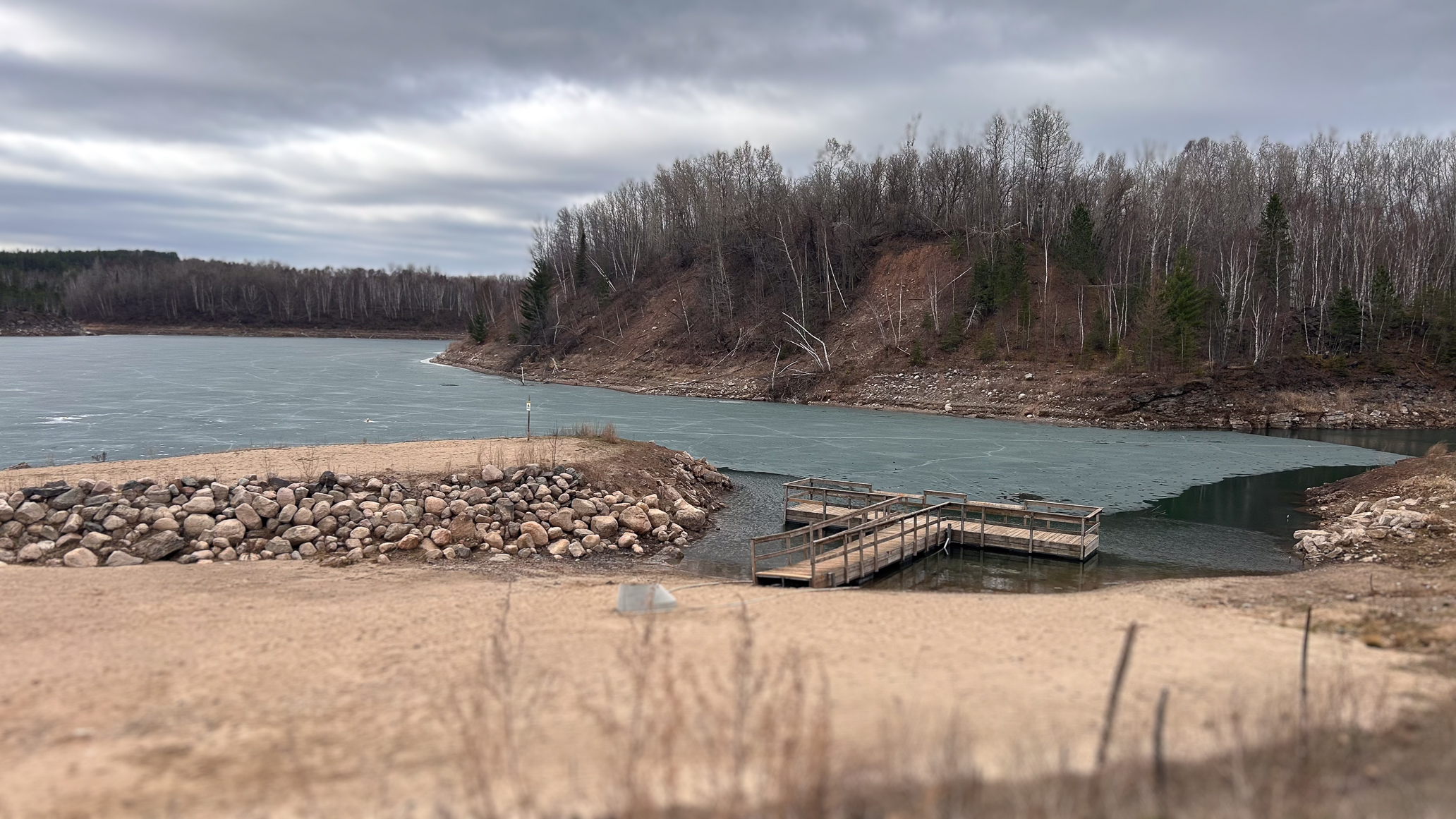
A very large lake. A very small hole. And just enough open water to convince two divers this was a perfectly reasonable plan.
Two trumpeter swans glided in and landed squarely in the center of the lake. Not near the opening. Not near the shore. In the absolute geometric middle of a solid sheet of ice ~ a landing that at least one of them clearly had not anticipated.
There was a pause.
Then the debate began ~ loud, trumpeting, all neck craning and wing flaring ~ seemingly centered entirely on whose idea this had been.
We laughed, which was perhaps because we were standing on the same frozen lake having arrived at the same frozen conclusion. The satellite images had been consulted. Conclusions had been drawn. And yet here we stood, on the edge of a lake that had clearly opted out of our plans.
Eventually they left, the disagreement apparently unresolved.
We remained.
The opening in the ice was small but usable. Which meant the dive would not be a normal open-water dive. It would be something closer to cave diving ~ overhead environment, single exit, no direct ascent to the surface. The sort of situation that causes sensible people to pack up and go home.
Heather began unloading reels.
She is, it should be noted, a cave diver. Also, by her own admission, someone occasionally willing to stand near the edge of best practice and lean forward slightly to see what happens.
Before I had assembled a fully formed objection, she was already discussing line placement.
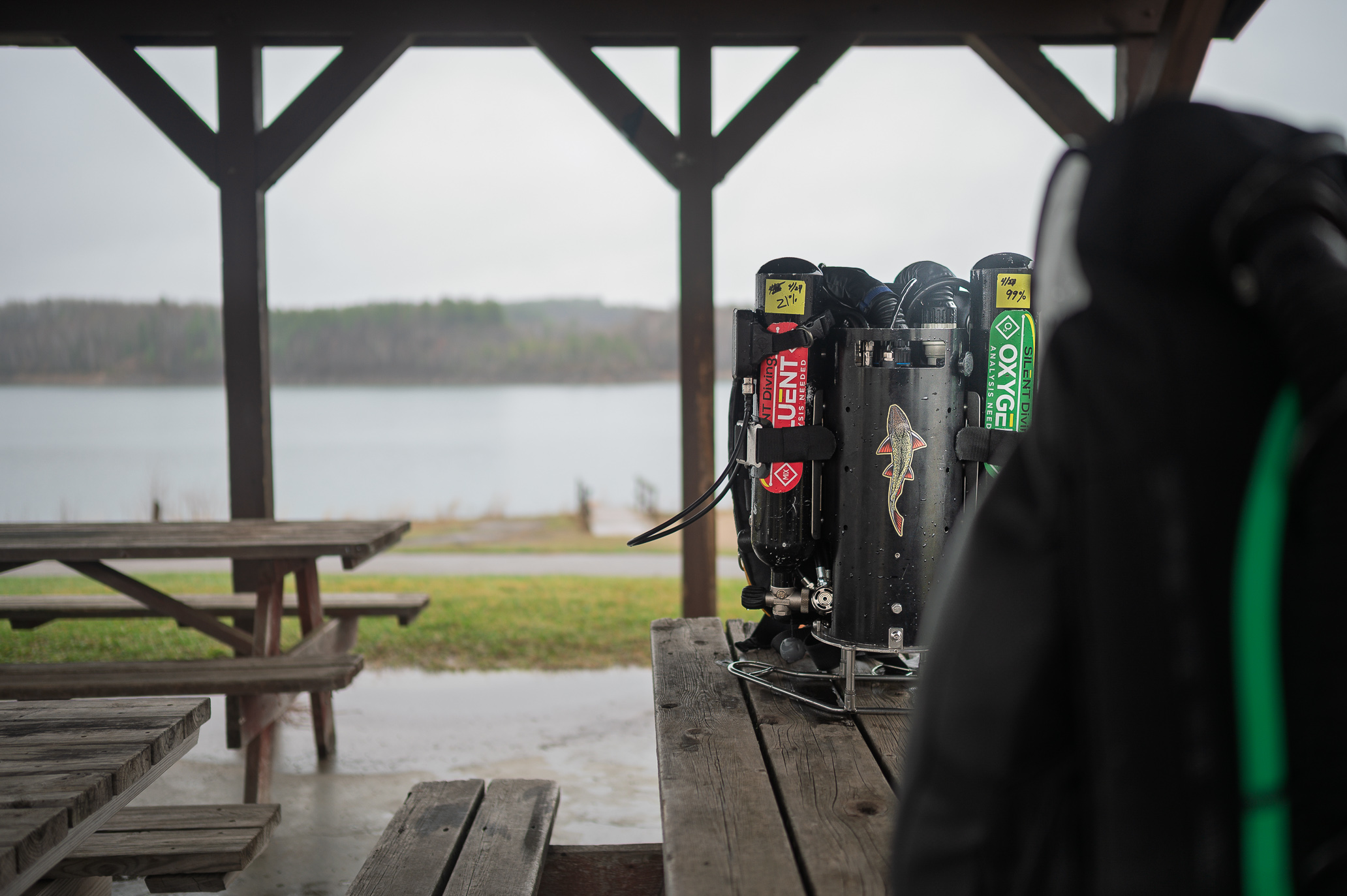
So we talked it through. We’d run a continuous guideline from the entry to the speeder ~ a small rail vehicle once used to shuttle miners to and from the pit face, now sitting quietly on the bottom in about twenty feet of water. From there, fixed lines already led down to the airplane, a single-engine Army trainer placed on the bottom years ago by the local dive club, resting at around forty feet. We had redundant gas. Rebreathers. Bailout. Lights. Familiarity with the site bordering on excessive ~ well beyond what most recreational divers would arrive with in terms of safety gear and backup.
The gear is serious. The planning was thorough. The exit was a garage-sized opening in a frozen lake. Two of these things inspired confidence.
The primary risk wasn’t gas or navigation ~ it was losing the exit. Ice moves. But the opening was tucked behind a point of land, sheltered from the main sheet.
Unlikely to shift, we agreed.
Not impossible. Unlikely.
At some point in this conversation I said: “You realize what we’re doing here ~ we’re normalizing risk.”
Normalization of deviance. It’s a documented phenomenon ~ the process by which behaviors that would initially raise concern slowly become acceptable because nothing bad has happened yet. Small risks, tolerated once, become invisible. The language shifts from “this is unusual” to “this is how we do it.” It appeared in the investigation following the Challenger disaster. It appears in aviation incident reports. It appears, with some regularity, in diving accident analyses.
We acknowledged this.
We laughed about it.
And then, having thoroughly identified the problem, we went diving anyway.
It was, I have to admit, a delightful dive.
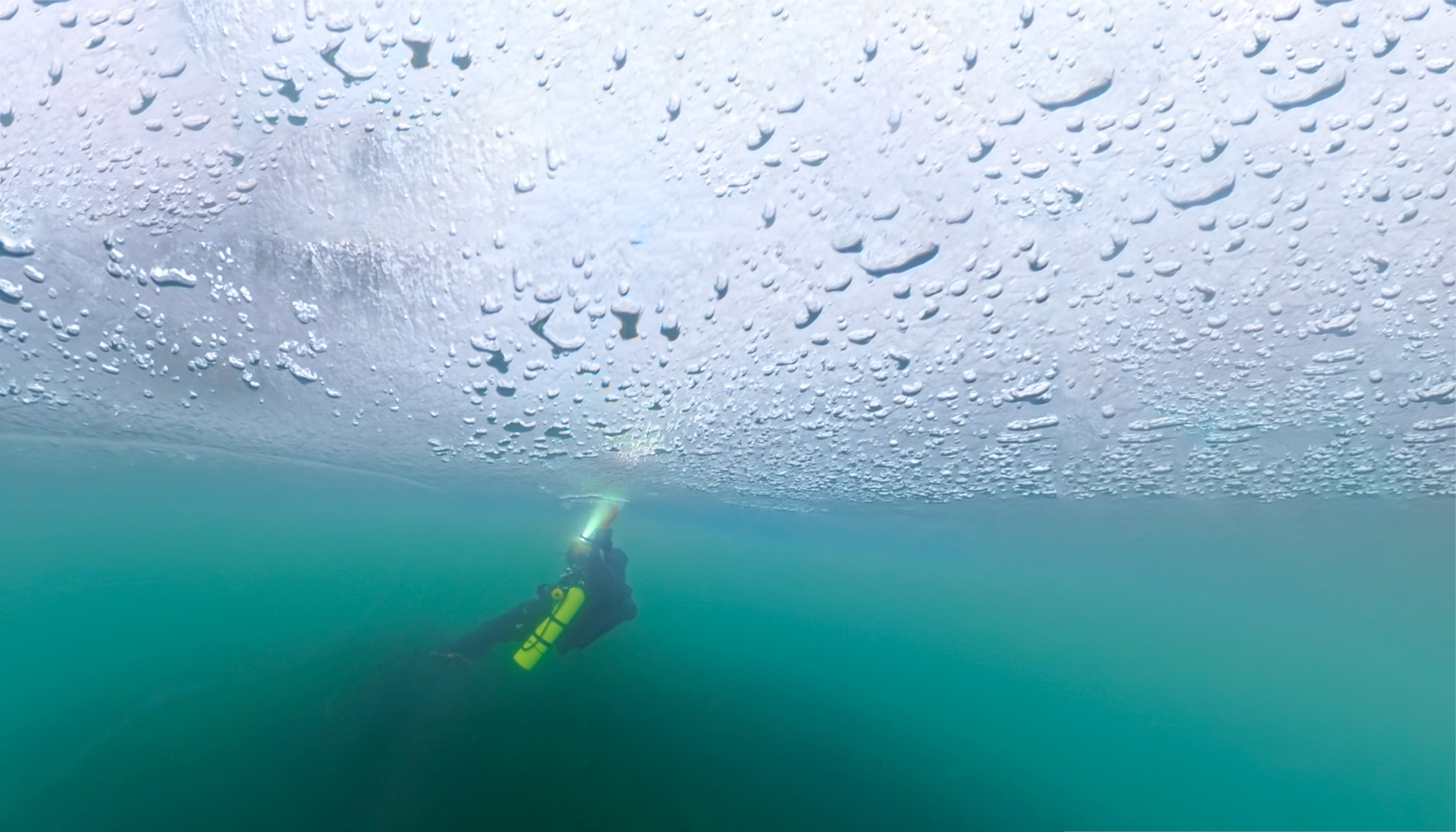
There is something about being under ice that sits outside ordinary experience. The light comes through diffused and luminous ~ not dim exactly, but softened beyond anything above water, a glow that seems to come from everywhere at once. The weightlessness deepens, as if the light itself is doing some of the lifting. Everything slows in a way that feels less like physics and more like the first few seconds of a dream.
We followed the line to the speeder, then down to the airplane. Checked the trim mirror we’d installed on a previous visit, now wearing a respectable coat of algae. Cleaned it off. Spotted crayfish in numbers that seemed very odd ~ a bit stunned by the cold, their movement slowed to a crawl, easy enough to catch. At one point we hovered just beneath the ice, looking up at the pale shifting patterns above, the light soft and strange.
It felt remarkably calm for a dive that had begun with a risk-management discussion and a waterfowl dispute.
Afterward, I found myself working back through it.
We had a line. Redundancy. Experience. A plan.
We also had a relatively tiny hole in a neighborhood-sized sheet of ice.
Both things are true. And I’m not sure where the line sits between “well-managed risk” and “well-justified after the fact.” Those two things can look identical from the inside.
Still, it was a good dive. The kind that lingers a bit longer than most.
Monday is forecast to be cold and rainy, which feels like a fitting continuation of things. We’ve talked about heading back to Gilbert ~ if only for the picnic shelter’s ability to keep the rain off while we suit up. There’s not much point in climbing into a drysuit if everything underneath is already soaked.
The ice, I’m fairly confident, hasn’t gone anywhere in the last few days. Which means the conversation we already had, about the exit, about the overhead, about what we might be quietly doing to our own thresholds ~ will need to happen again.
We’ll have it.
And then, in all likelihood, Heather will begin unloading reels.