
An Audience of More Than One
The projector always needed a few seconds to wake up. First came the low mechanical hum, then the fan, and finally the familiar click as the first slide dropped into place. That sound meant something good was about to happen.
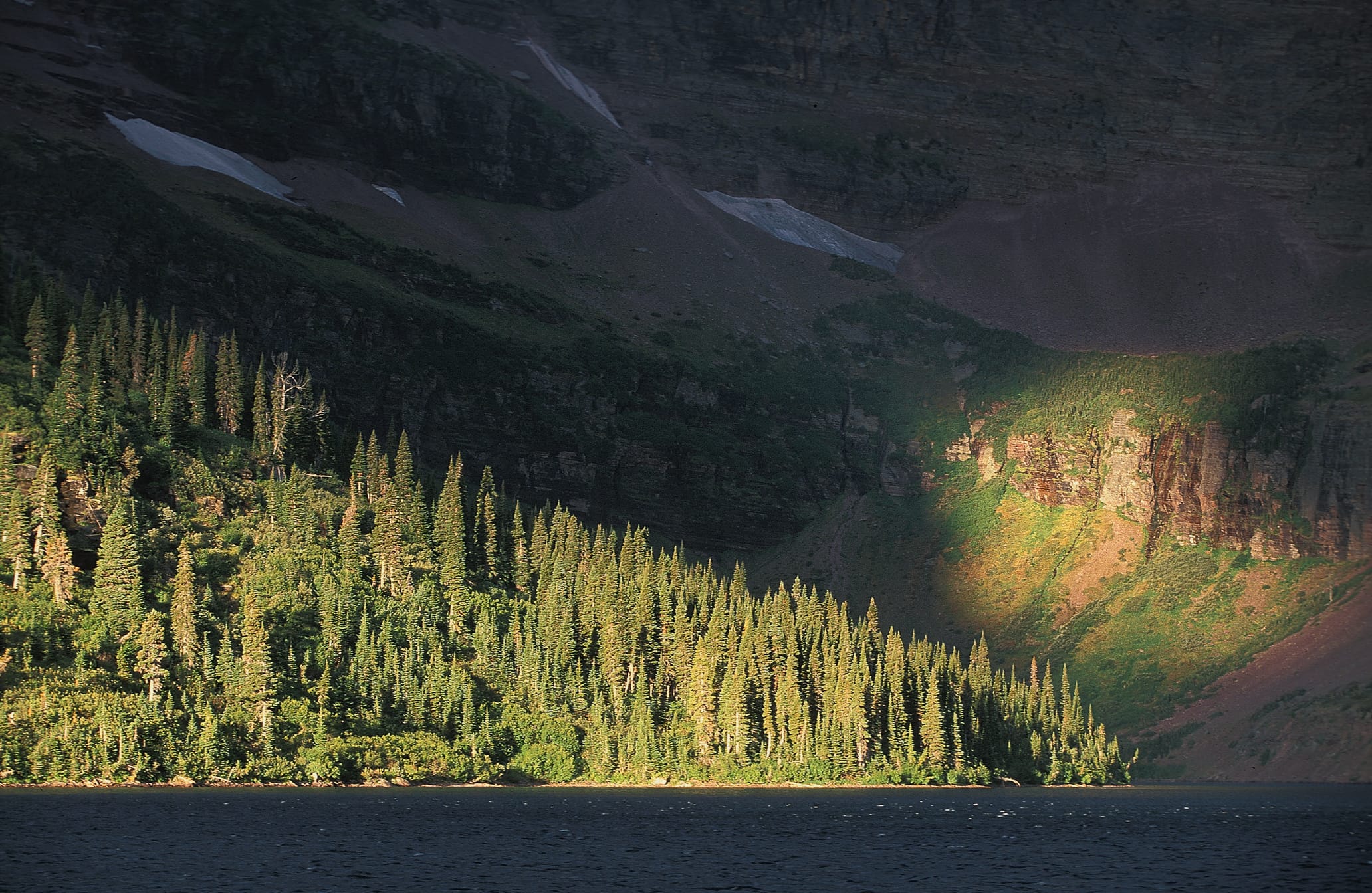
My friend Sparky would already be there, carousel trays stacked on the coffee table, each of us quietly convinced we’d edited our own slides a little better than the other guy. We’d dim the lights, point the projector at the screen in the basement, and for the next hour or so, Arizona, Florida, Yellowstone, or Teddy Roosevelt’s Badlands would appear larger than life. Fuji Velvia film had a habit of making the world look a little better than I remembered it. Reds leaned toward impossible. The sky always seemed to discover one more shade of blue.
The photographs mattered.
So did the people sitting in the room.
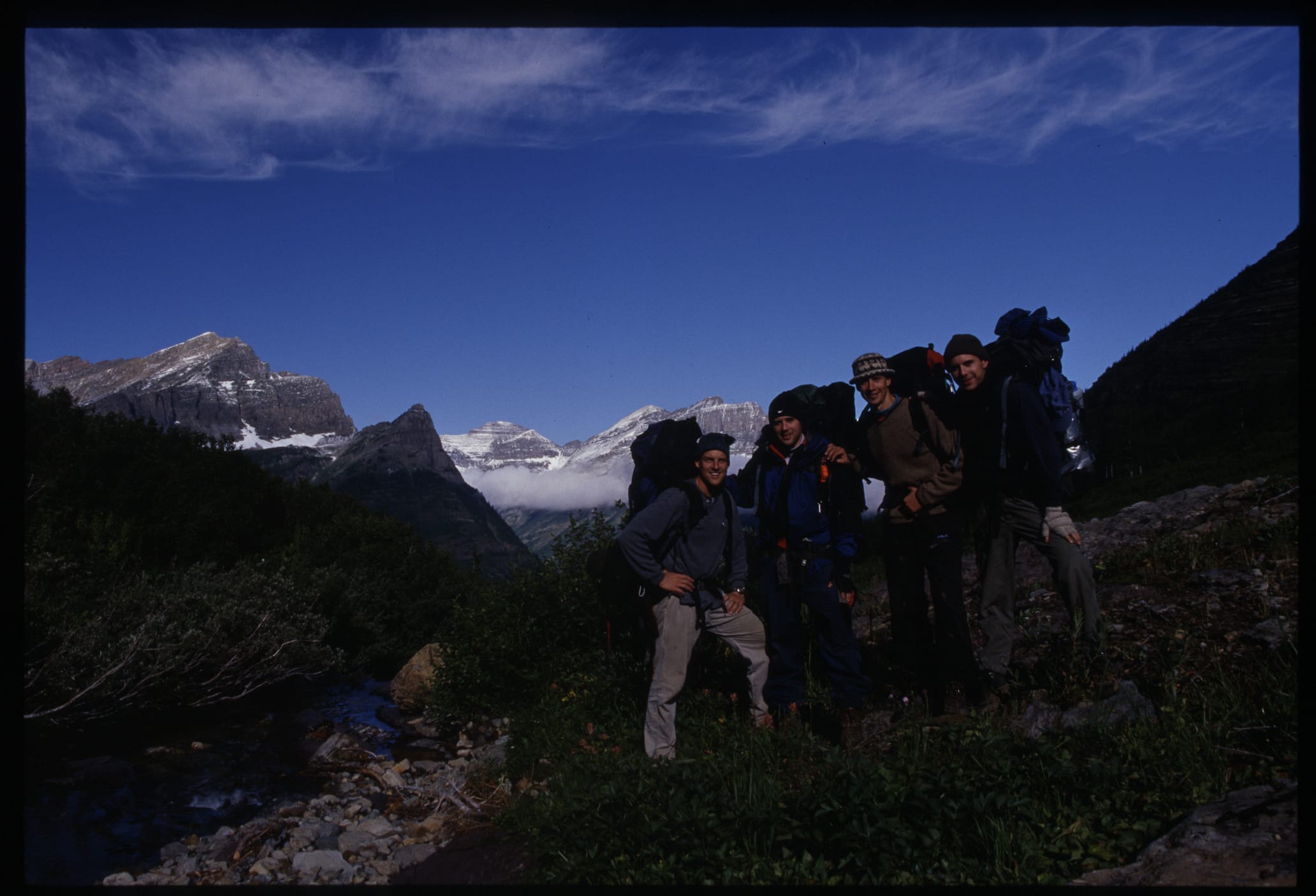
Twenty-year-old me packed a tripod, a bag of slide film, and an unreasonable amount of confidence into Glacier National Park. The mountains came out perfectly exposed. My friends... not so much.
Those evenings weren’t presentations so much as conversations that happened to have pictures attached. We’d stop on a slide because someone recognized a trail, or remembered a campsite, or wanted to argue about whether that was actually a moose or just a suspiciously moose-shaped rock. Stories wandered off in directions the photographs never intended. Before long we were talking less about the trip we’d just taken than the one we hoped to take next.
I don’t miss slide film.
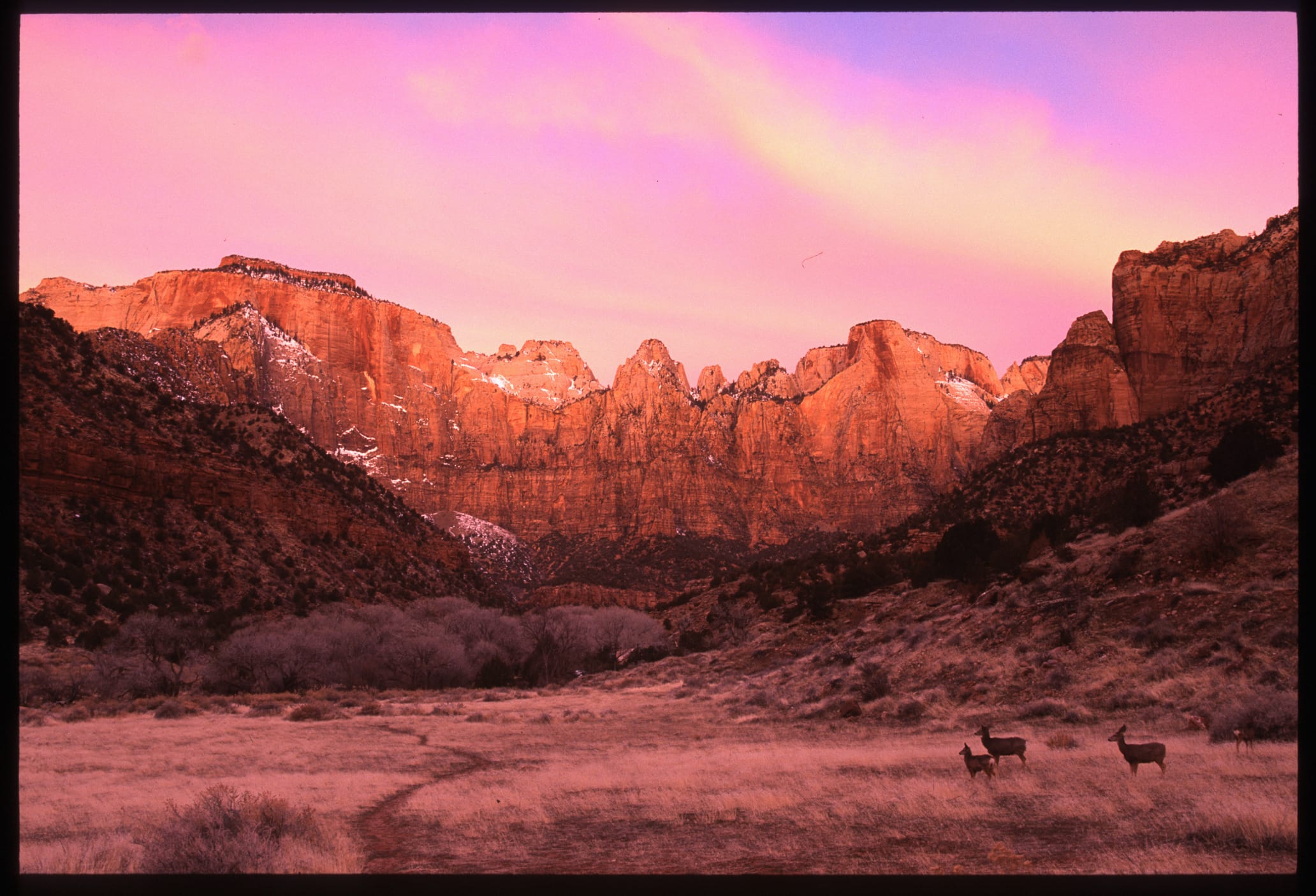
Fuji Velvia never believed in subtlety. You crossed your fingers, guessed the exposure, and waited a week to learn whether you’d made art… or just another expensive lesson.
Every roll carried thirty-six decisions, each one costing enough money to make you hesitate before pressing the shutter. I kept notebooks full of exposure settings, hoping that when the slides came back I’d finally understand why one frame worked and the next one didn’t. It was slow, occasionally frustrating, and spectacularly unforgiving of a beginner’s guesswork.
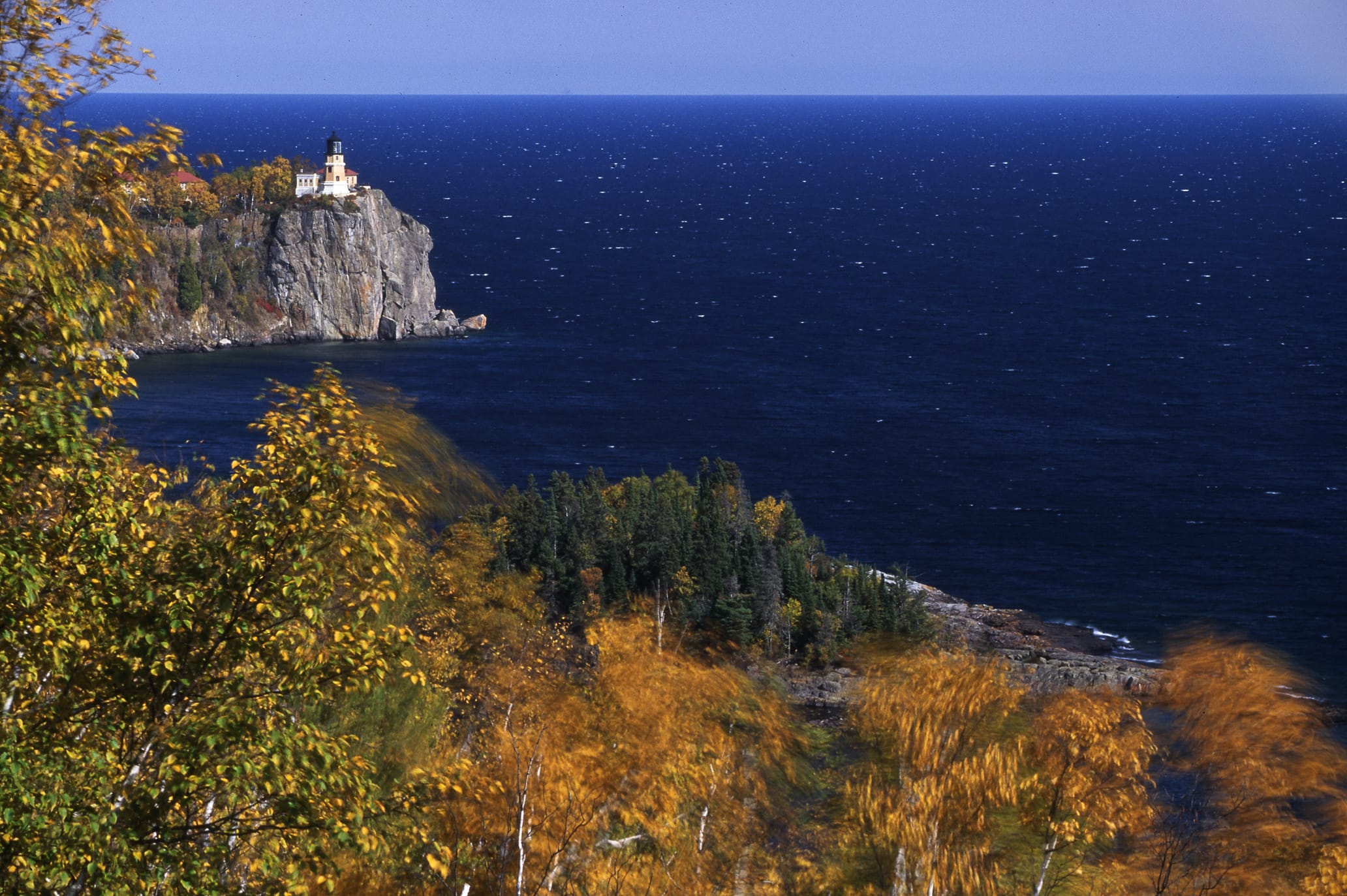
Back when “motion blur” wasn’t a Lightroom slider, you had to risk an entire frame. I dragged the shutter, hoped the wind cooperated, and waited a week to see if I’d been clever or just shaky.
Digital photography fixed almost all of that. These days I can spend an afternoon photographing fish under Lake Superior without doing shutter-cost math in my head, blow through frame after frame chasing the same shot, and still come home with more images from a single dive than I used to shoot in an entire year of film.
It’s better. And, if I’m honest, it’s become my main excuse for leaving the house ~ an admission that took longer to arrive at than it probably should have.
People often assume I dive because I love being underwater, and the camera tags along for the ride. It’s closer to the opposite. I dive because I love the photograph. Take away the camera and my drysuit hangs in the closet gathering dust, while I go chase pictures of something else entirely.
Somewhere during the workday, usually while doing something fairly mindless, I’ll find myself sketching a photograph in my head. Maybe it’s sunlight spilling across the deck of the Madeira. Maybe it’s a pike tucked into a bed of milfoil, waiting for breakfast to swim by. Maybe it’s a Pileated Woodpecker backlit against the deceptively warm glow of a frozen February morning.
The image exists before the shutter clicks.
That imagined photograph quietly becomes the reason to load scuba gear into the truck on a Monday morning, or drive the North Shore before sunrise, or spend an afternoon sitting perfectly still in a bird blind waiting for something that may never happen.
Photography, I’ve realized, is the gasoline for the engine of adventure.
I’ve tried explaining that to people before, but it always sounds backwards. Shouldn’t the adventure come first? Isn’t it supposed to be about traveling, hiking, diving, and documenting the adventure afterward?
For me it rarely is.
The photograph creates the adventure. The world has other ideas about whether it shows up.
There’s one image I’ve been trying to make for the better part of two years. At Tioga, a sheer rock wall disappears into astonishingly clear water, dropping far beyond the reach of my dive lights. Every photograph comes home looking exactly like what it is — a rock wall, underwater. Accurate enough. Completely incapable of conveying what it feels like to drift beside something so immense that you lose the surface above and the bottom below at the same time.
I suspect I’ll spend the next several years trying anyway.
When you’re diving, you’re genuinely less reachable than an astronaut orbiting the moon. No phone. No wifi. No texts. No endless stream of tiny interruptions reminding you the rest of the world still exists. You drift along in a pocket of air, inside an underwater world that’s less familiar to most people than the actual dark side of the moon.
It can be a beautiful place. A place that nearly everyone living on a lake in the Midwest has never actually seen. They’ve fished it, waterskied over it, cursed the weeds fouling their propellers, and walked docks that stare straight down into it for forty summers running ~ all without once looking at what’s underneath.
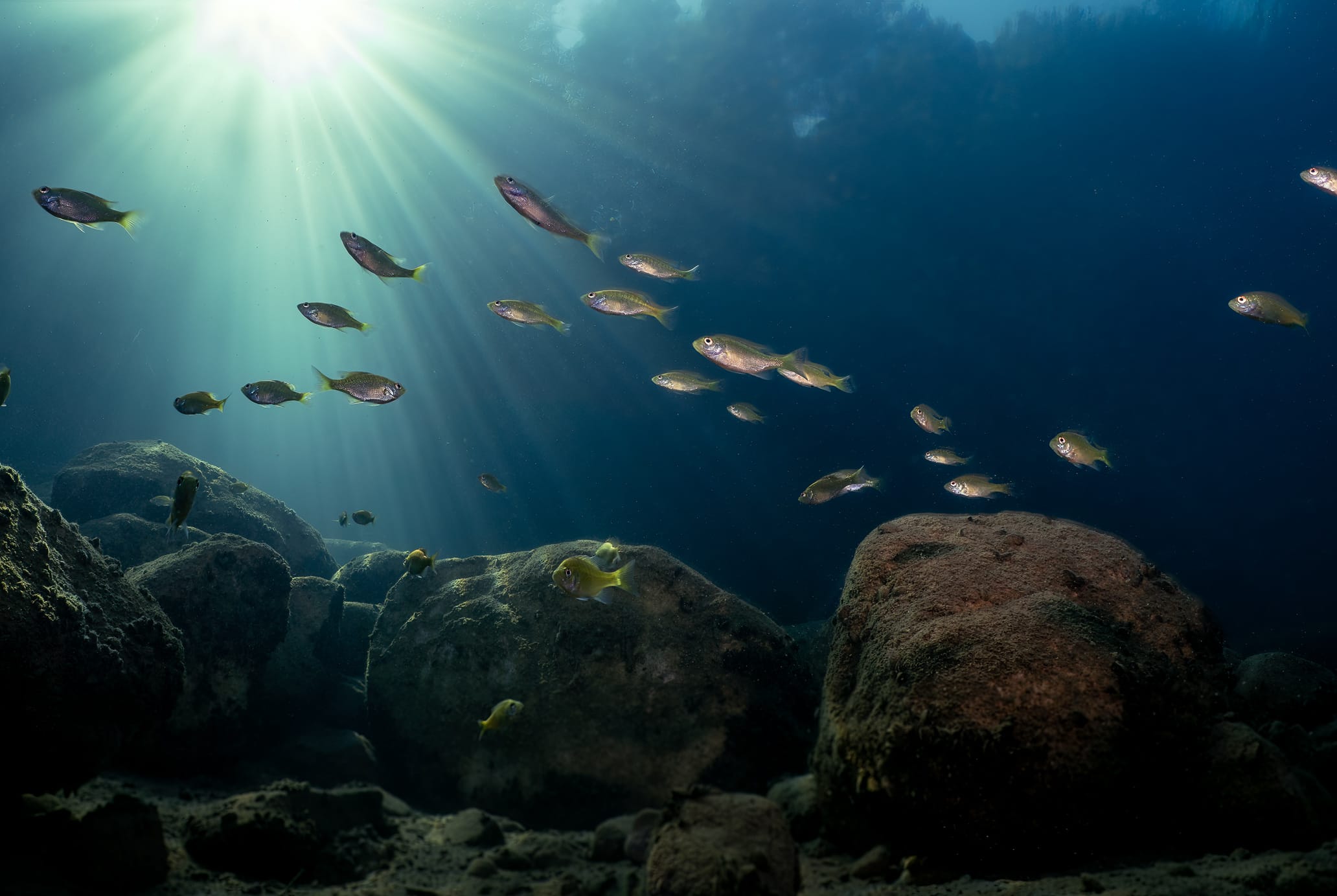
Digital photography has spoiled me. I can see the histogram, tweak the exposure, and shoot 200 frames without a second thought. Slide film would have charged me a second mortgage.
There’s an aquatic plant called large-leaf pondweed, or Potamogeton amplifolius if you’re trying to impress a botanist. Nothing about that name suggests how striking a stand of it can be underwater. Tall reddish stems reach toward the surface, supporting broad, translucent leaves that shimmer as sunlight flickers through them. Most people call them weeds. Seen from underneath, they stop being weeds and start being forests.
All that solitary chasing ~ the imagined shot, the wall at Tioga, the swaying stand of Potamogeton amplifolius ~ would be a strange way to spend a life if the images never left my hard drive. I feel like they need to be shared. It’s another world down there, strange and beautiful, so far removed from most people’s daily reality that it deserves an audience of more than one.
For years I assumed that was what social media was for.
A place to share photographs.
Instead, somewhere along the way, it quietly became a place to consume them.
A couple of years ago I deleted every photograph from Instagram.
It wasn’t a dramatic protest. More like finally throwing away leftovers that had been sitting in the refrigerator a little too long. Afterwards I built this website instead and, in what remains one of the stranger decisions I’ve made, proceeded to tell almost no one it existed.
At the moment I have exactly one subscriber.
My oldest daughter.
I often joke that I deleted Instagram so I could build a blog nobody reads.
Like most jokes, there’s probably more truth hiding in it than I’d like to admit. Which is its own contradiction I haven’t fully resolved: I wanted an audience badly enough to keep writing, but not badly enough to tell anyone where to find it.
Eventually I wandered back to Instagram because, despite everything, sharing photographs is still part of the creative process for me.
Here’s the slightly embarrassing confession.
About two minutes after posting something, I’ll check to see whether anyone’s liked it. Then I’ll promise myself I won’t look again until tomorrow. About forty minutes later I’ll check again. Not a flattering habit for a grown man with a mortgage and a job that involves actual medical judgment, but there it is.
Self-awareness, it turns out, isn’t the same thing as self-control.
It isn’t only compulsion, though. A while back I messaged a diver I follow ~ mostly GoPro video, and unusually good GoPro video, which is its own rare thing ~ asking about the mine pits near Crosby, where he dives most. What came back was a handful of specifics that led me, a few weeks later, to the best underwater loon footage I’ve ever managed: clear water, good light, the bird circling close enough for eye contact more than once. All of it traceable to a stranger’s reply on Instagram. We still trade messages now and then, mostly me asking where to dive next.
For a while I thought what bothered me was the algorithm. It wasn’t.
Then I thought it was watching ordinary phone videos gather thousands of likes while photographs I’d spent decades learning to make drifted quietly into obscurity.
That wasn’t it either.
What finally dawned on me was much simpler.
I’d spent years learning how to make photographs people could wander around inside.
Instagram had quietly become a place where nobody wandered. A place where photographs became the billboards of the internet, and people sped past at interstate speed, never really looking at any of them.
Years ago I stood in Tom Mangelsen’s gallery in Jackson Hole, staring at one enormous photograph for what must have been ten minutes. It showed elk crossing a river before sunrise, the Grand Tetons glowing softly in the distance. The elk themselves were tiny. On a phone they’d barely register.
Standing in front of a print nearly five feet across was something else entirely.
Your eyes wandered through it.
From the mountains, to the river, to the mist, then finally down to the elk, almost as an afterthought. The photograph rewarded patience. Twenty-five years later, I still remember standing in front of it.
I sometimes wonder what someone in their twenties would see if they stood there today.
I suspect they’d still be impressed.
But I also wonder whether they’d recognize what went into making that image. The years spent learning light. The patience. The rolls of film that never worked. The mornings when the elk never showed up. Modern cameras perform small miracles every day. They make extraordinary photographs seem almost inevitable.
Film never let you believe that.
Maybe that’s why I still miss prints.
Not because they’re old.
Because they ask something different of us.
A phone asks us to decide whether a photograph deserves our attention.
A print assumes it already has it.
It asks us to slow down.
To explore.
To notice.
To stay just a little longer.
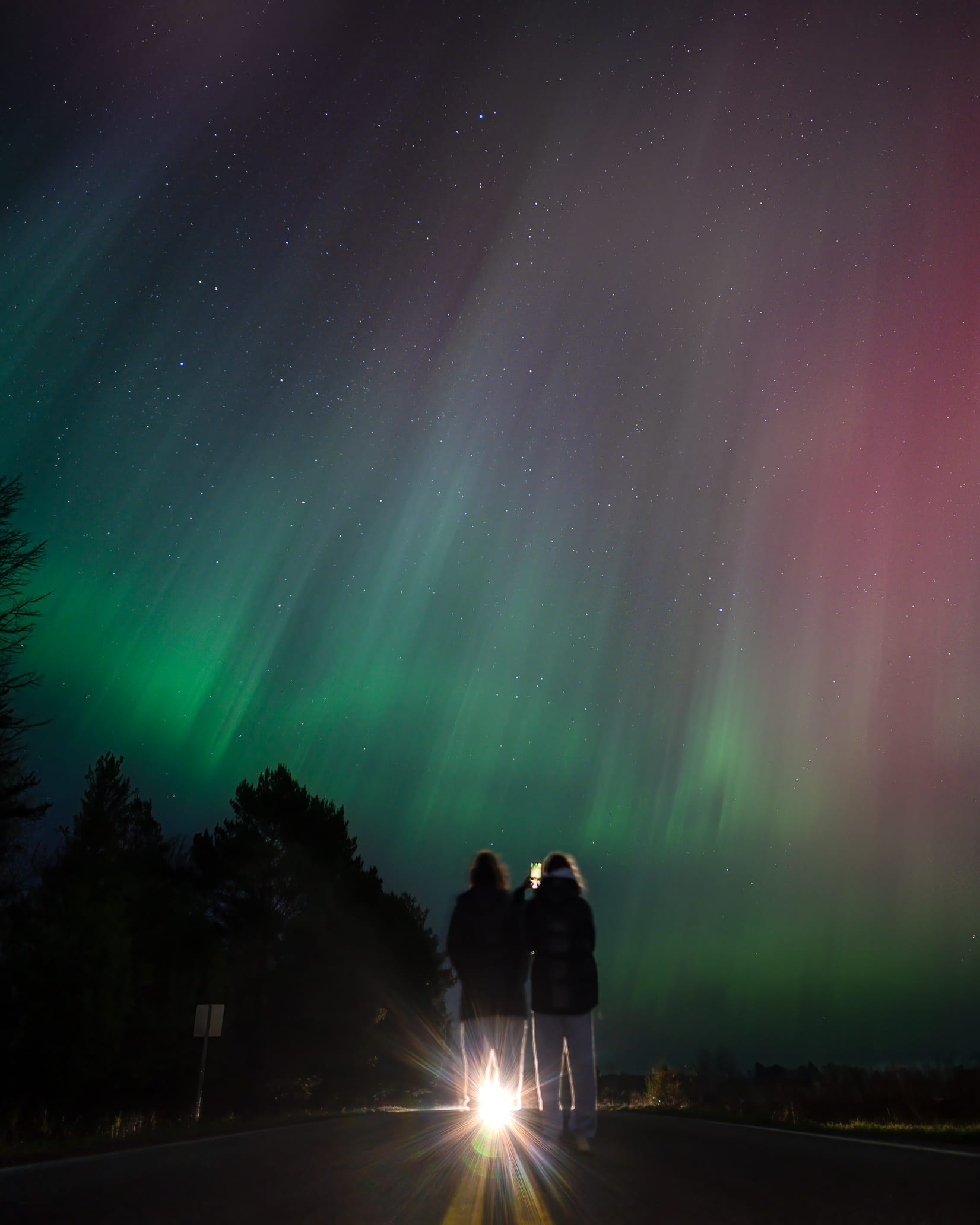
ISO 3200. On slide film, "fast" topped out at 400, and I mostly shot 50 anyway. A sky like this would have come back as a black rectangle and a receipt for processing.
A few years ago, a biologist from Michigan stumbled across some of my underwater photographs and asked whether he could use them in presentations about aquatic plants. I happily said yes. Instead of paying me, he mailed me a field guide that I still use regularly. We’ve exchanged messages ever since.
One photograph.
One real conversation.
Maybe that’s all social media ever needed to be.
This was slide film. No histogram. No recovery slider. No generous dynamic range. Just a few quiet minutes when the sun decided to cooperate.
Lately I’ve found myself thinking less about Instagram and more about that large-format printer — the one that used to turn out gorgeous 17×22 prints ~ that died in a lightning strike a few years back. I never quite got around to replacing it. I’ve got close to a hundred prints scattered around this house ~ some framed, most stapled directly to the garage wall, like I’m running an extremely low-budget gallery. I miss making big prints. I miss photographs that ask people to stop instead of scroll.
I’ve even started imagining something that feels suspiciously like those old slide shows.
Not a presentation.
Just friends dropping by for a drink. A stack of large prints spread across the table or leaning against the wall. No speeches. No projector. No notifications. Just enough time for someone to pause at one photograph and quietly ask,
“Where was this?”
Maybe, eventually, it’ll be the Tioga wall ~ the shot I still haven’t managed to get right ~ printed big enough that someone has to walk its length to take in all of it.
I honestly don’t know whether people still have the patience for that.
I’d like to think they do.
And if they don’t…
Well…
The bulb’s probably burned out by now anyway.
The projector’s still in the closet, bulb and all, just in case I’m wrong about that.