Plague, Probably Not: Notes from Theodore Roosevelt National Park
Ten days after leaving North Dakota, I am still itching.
Several patches of small red, blistering bumps, with the stubborn enthusiasm of something that has no plans to leave. I assumed spiders. Sparky, a man with a successful YouTube channel and no medical training, favored a different theory, which he reached by typing my symptoms into Google along with “North Dakota Badlands” and “prairie dog town.”
The second result was PLAGUE.
I’ll get to the plague. First, the trip.
Sparky and I make a nearly annual photographic pilgrimage west. For more than a decade that meant Yellowstone, until the crowds turned wildlife photography into a parking problem with bears. So we’ve moved to Theodore Roosevelt National Park in the North Dakota Badlands, the only national park in the country named for a single person. Quiet, in national park terms, means you can find a bison without also finding four tour busses.
It was a short trip. We drove out Sunday and got home Wednesday night, with one afternoon set aside for the newly opened Theodore Roosevelt Presidential Library. It opened in July, cost $450 million, and sits in the landscape so naturally, under a grass-covered roof, that it seems to have grown there, like sagebrush with a very ambitious architect.
Inside are countless pieces of Roosevelt’s history and a good deal of technology. At one exhibit, a lifelike Teddy stands behind a lectern with a microphone for visitors who want to ask him anything. He answers in an AI-generated version of his own voice, hands moving with the rhythm of his words, fielding questions on most any topic you can imagine.
“President Roosevelt, what’s your favorite bird?” Sparky asked.
Teddy declined to choose. He spoke instead about the wonders of the natural world and said he could never pick a favorite. It was a diplomatic answer from a man who ran a natural history museum out of his bedroom as a boy.
The labels have shifted under Roosevelt since his time. He was a reform-minded Republican who pushed for conservation, labor protections, and limits on corporate power. When his party’s conservative wing blocked him in 1912, he ran as a Progressive and adopted a bull moose as mascot. Political parties have had a century to rearrange the furniture.
The library carries a bit of that tension on its own front step. It’s privately funded, a $450 million gift to the memory of the conservation president, and its biggest booster was Doug Burgum, the former North Dakota governor who now runs the Interior Department. Interior is the agency that oversees the National Park Service, which means the man who helped build the library also helps set the budget for the park outside its windows. At the opening, conservation groups pointed to that overlap. Valerie Naylor, a former superintendent of Theodore Roosevelt National Park, said the park used to have about 31 permanent employees and now has 23, and she blamed federal cuts and a push for energy development on public land. Interior answered that Burgum honors Roosevelt through “active stewardship,” and that locking up public land isn’t conservation, it’s neglect.
I can’t tell you who’s right, and neither can the avatar, who only takes questions about birds. But it does seem fitting that a man who spent his life arguing about how to look after the land now gets to be argued about, in front of a $450 million building, by people who all insist they’re on his side.
The library is well worth an afternoon. The rest of our time went to the park, looking for photographs.
One of our regular strategies is to settle into a prairie dog town well off the road in the late afternoon, tuck ourselves under camo netting, and wait. We sit there for a few hours, until the light gets too dim to shoot. Sparky and I set up a few hundred yards apart and keep in touch by walkie-talkie. There is no cell service in parts of the park, which makes the walkie-talkie feel less like nostalgia and more like planning.
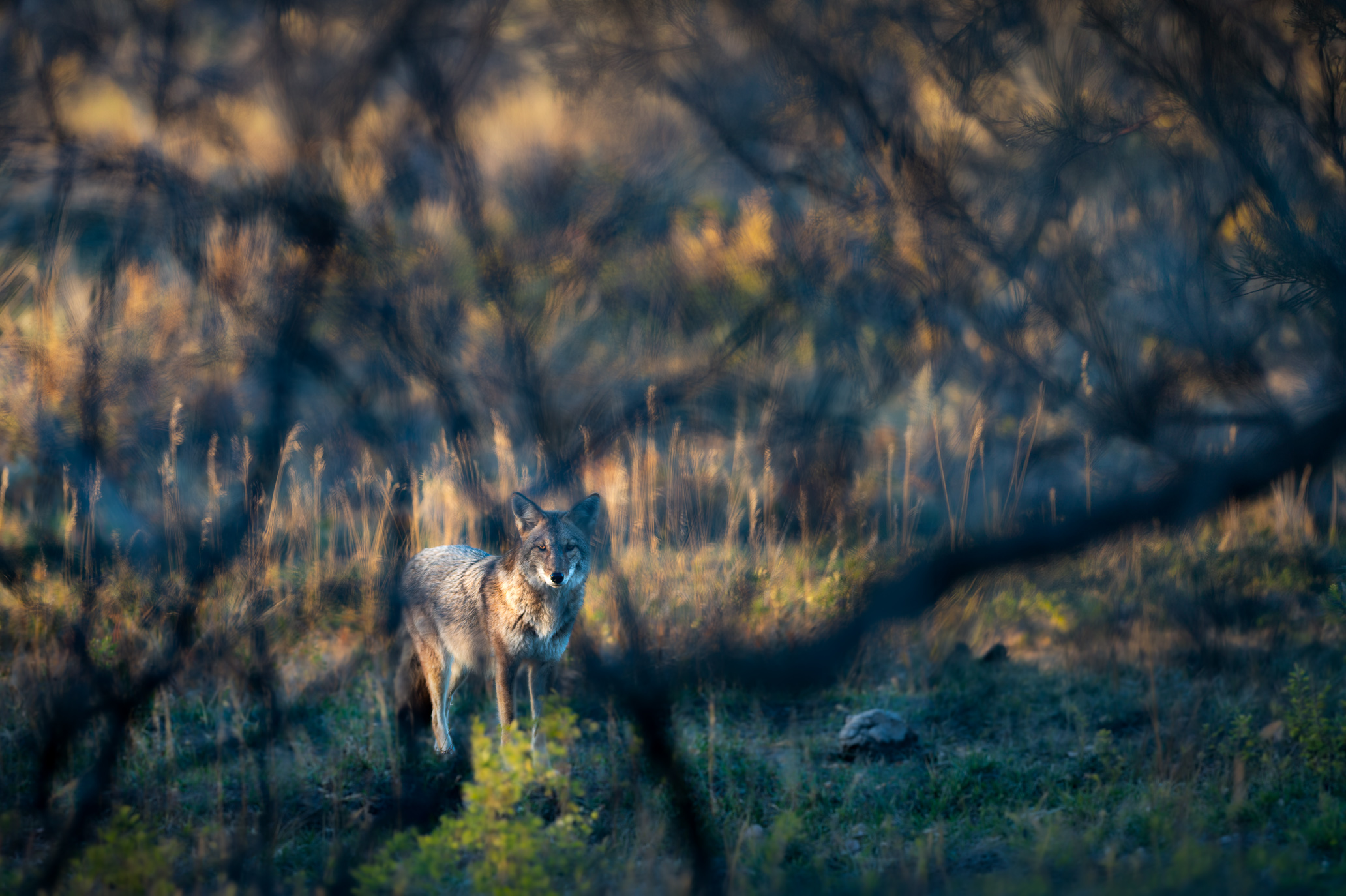
I love that quiet. You sit, you watch, you consider where the coyote might enter the valley, and eventually your mind wanders off somewhere else entirely. Then a hint of movement flickers at the edge of your vision and your brain snaps back to photography. Even when the photographs are rubbish, the waiting is always worthwhile. It’s a small window into a wild world you don’t usually see. Most of us could use more time sitting still and paying attention.
Prairie dog towns are cute to some people. I see a crowded, overrun suburb with no zoning board. Sparky combs the colony for the fattest, cutest dog he can photograph. The towns do attract other wildlife, which is why we pitch our blinds and wait.
What I didn’t know until this year is that prairie dogs are part of the plague story.
Here’s the plain version. Plague is caused by a bacterium, Yersinia pestis, which lives in rodents and travels in their fleas. A flea bites a rodent, then bites you, and now you have a problem. The same organism swept through Europe in the fourteenth century as the Black Death and killed millions, a reputation that is hard to live down. In the American West it never entirely left, though it settled into a smaller operation. The CDC counts about seven human cases a year, mostly in northern New Mexico, Arizona, and Colorado, and modern antibiotics handle it well when it’s caught early.
Prairie dogs get the worst of the arrangement. Plague is a relative newcomer to North America, arriving around 1900, and prairie dogs never developed any defenses against it. In an infected colony the death rate approaches 100 percent. In 1986 plague wiped out a 45-acre prairie dog town in this very park, and officials closed part of a trail. So the cheerful little neighborhood we were photographing is, strictly speaking, a community living with a rumor of catastrophe.
Which brings me back to my itch.
A few days after I got home, I developed several small, itchy red bumps. Sparky said he had none. He said he had Googled mine. And now I was staring at a screen wondering whether the fleas that conquered medieval Europe had come to Medora for a rematch. Had I contracted the Black Death from a rodent in a field? Was my next blog post going to be “Prairie Dog Town: A Postmortem”? Would someone else have to write it?
The odds were reassuringly long. Plague tends to announce itself with fever and swollen glands, neither of which I have. What I have is an itch, the classic symptom of a man who sat for hours in a prairie dog town and was bitten by something. Still, I had briefly managed to turn a photography trip into a nineteenth-century medical drama. I’m happy to report I’m not dead yet.
This trip was also different because Sparky shoots both stills and video, and I’ve always taken stills. This year I decided to try video too. I shoot video underwater, but never on land, where cameras apparently expect you to know what you’re doing. My cameras are not especially good at video autofocus, and I don’t own a proper video tripod head for smooth camera movement. I still came home with enough clips to assemble what I think is an enjoyable short travel video.
Then I sent it to my family. Grace immediately declared it unwatchable because of a high-pitched tone running through most of it.
She has mentioned this before. I have never tracked it down, mostly because I can’t hear it. My audiologist would not be surprised. My hearing is shockingly poor for a 55-year-old, which is a sentence I apparently get to say now.
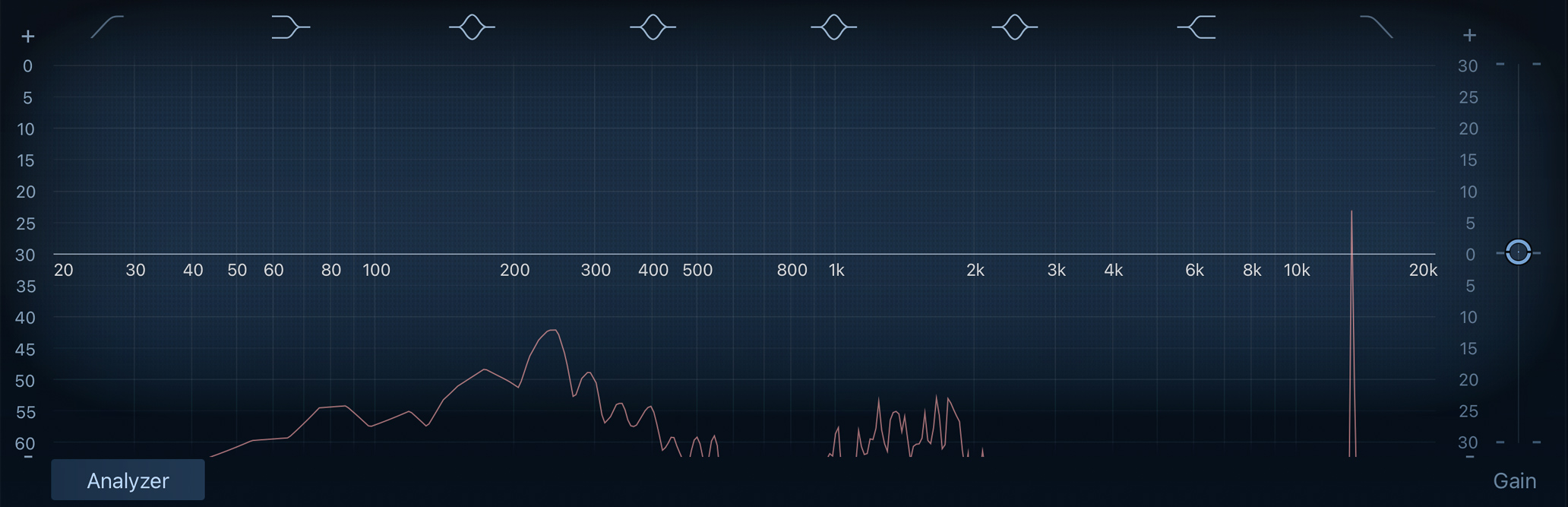
After some investigation, the culprit turned out to be a shotgun microphone I’d bought on eBay. It produced a narrow, loud spike at 13,300 hertz, well beyond my hearing and apparently quite clear to Grace and Isabel. I’d essentially purchased a microphone whose finest work is performed for an audience that doesn’t include me. Heather, my perfect-pitch dive buddy, identified the note as G-sharp, which was exactly right. I managed to build a couple of equalizer filters that removed nearly all of it. I think.
I do enjoy making videos, and I suspect I’ll come back to them more often than I come back to still photos. Part of the reason is the music. Pairing a few moving images with the right piece gives a memory an emotional shape. The music carries you back into it: the long light in the Badlands, the waiting under the netting, the small flicker of movement that makes you look up.
Still photos hold a moment beautifully. Video with music lets the moment keep going.
I’ll probably keep doing both. As with most of my hobbies, I expect to become halfway decent at each and expert at neither.
In the meantime, I’ll be back under the netting soon enough, watching the edge of the frame. Something will flicker. I’ll look up.
And I will try very hard not to scratch.