
Above the Clouds
There’s an aerial photograph of Embarrass Mine Pit from the 1970s that I can’t stop thinking about. The eastern shore in that photo doesn’t look like a lake at all ~ it looks like the earth was sliced clean with a knife and left to fill with water. A sheer wall, straight down, no slope, no shore.
We’d never been over there.
The 1970s aerial photo that started it all ~ a massive, sheer wall cut straight into the earth on Embarrass's east side.
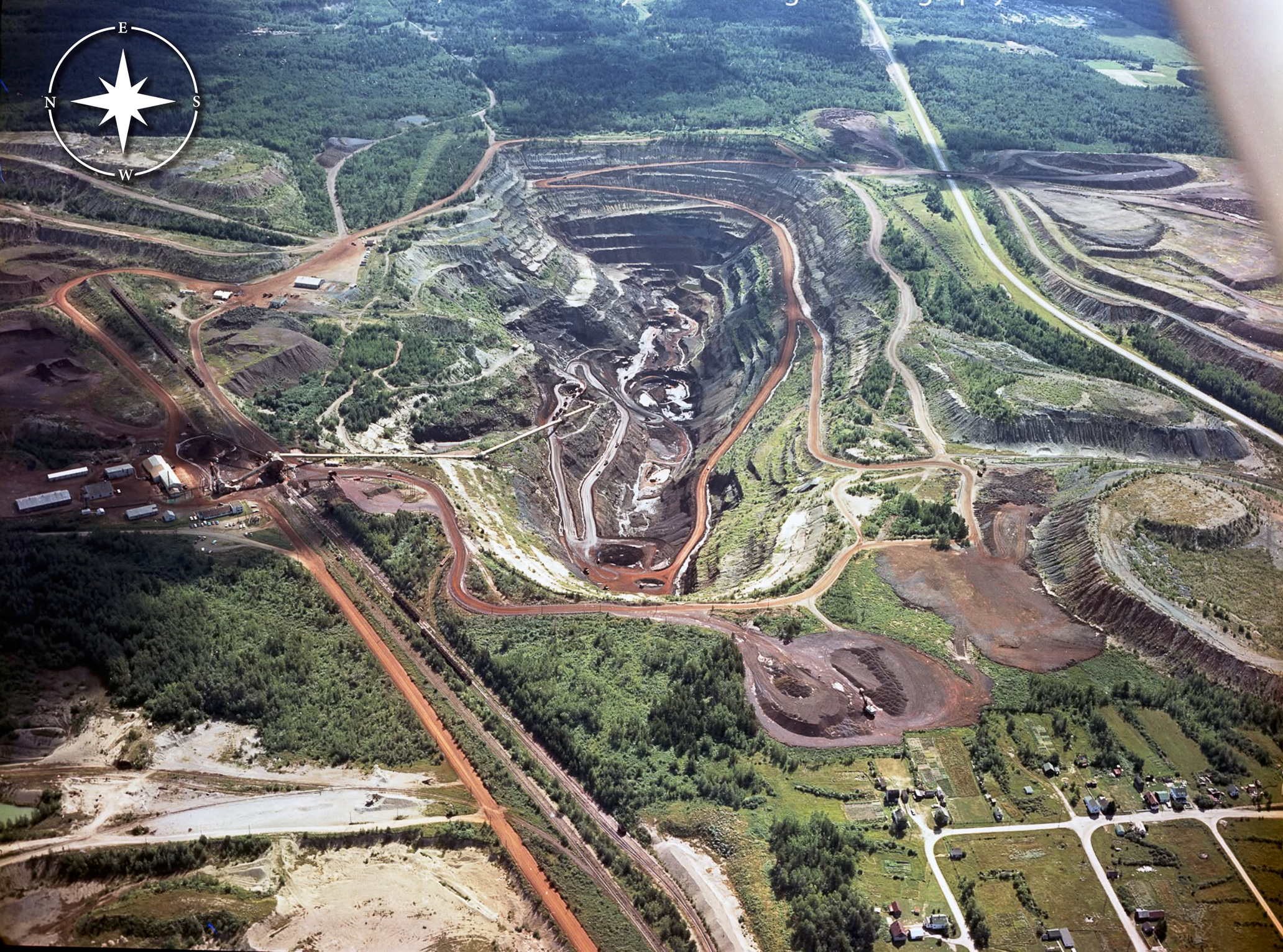
Embarrass sits near Biwabik, one of those small Iron Range lakes that started life as a mine and ended up as some of the better diving in northern Minnesota ~ which is how most of the good diving around here happens. A hole gets dug, the pumps get turned off, and eventually nature hands you a 156-acre lake with startling clarity and a bottom that drops to roughly 465 feet. The submerged shoreline still carries pieces of what used to be there ~ collapsed buildings, concrete foundations, the occasional structure rising straight out of the water .
I’ve dived the western side of Embarrass a number of times. Visibility usually runs around 30 to 50 feet, sometimes better, in water so emerald blue it can feel more Caribbean than northern Minnesota. Divers have run permanent lines to the more interesting features over there, which makes the western side comfortable, almost familiar.
The eastern wall, though ~ that was still just a photograph.
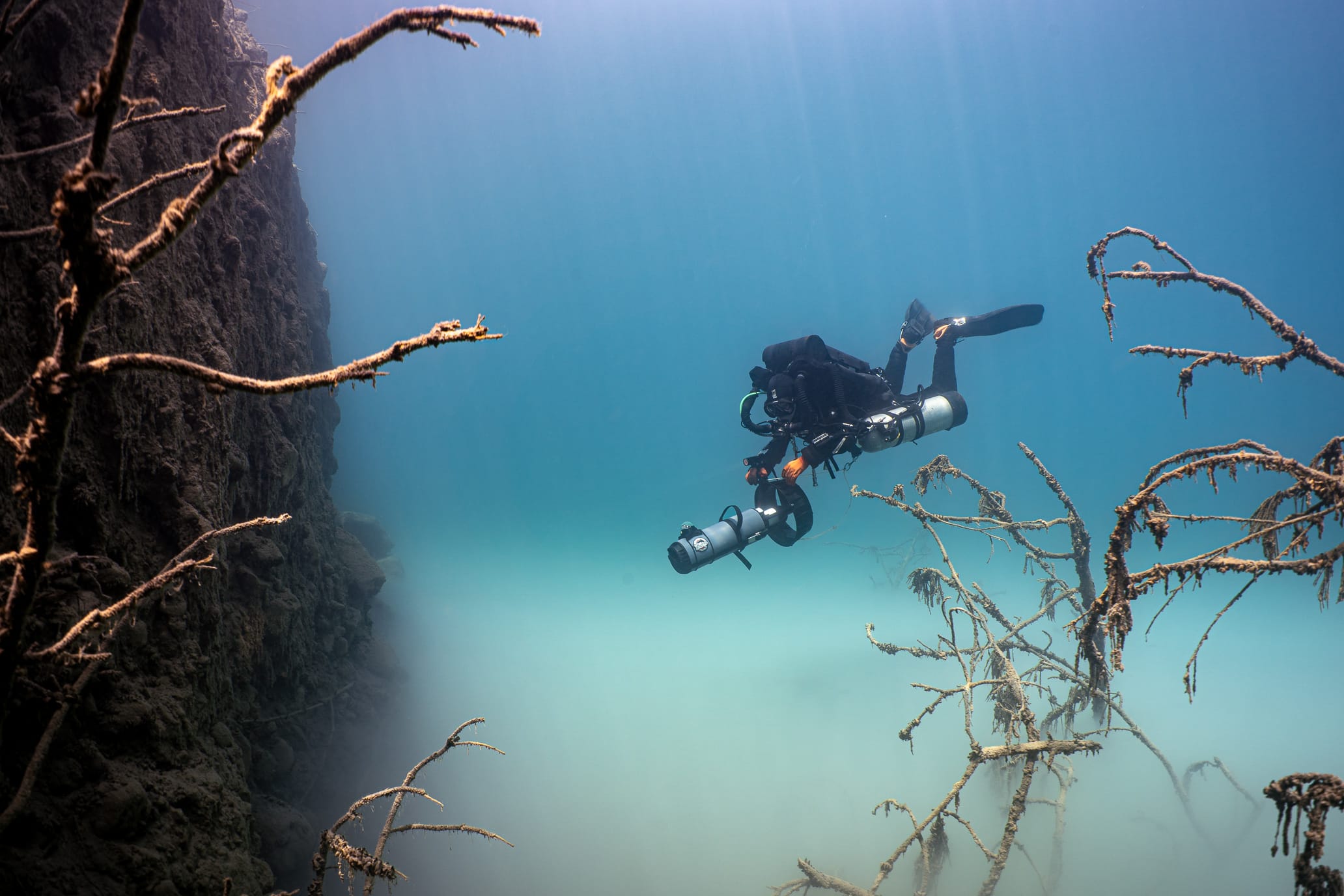
So that became the plan for June 27: work our way around the east side and see how dramatic that wall actually was underwater. Wall diving in genuinely clear water does something strange to your sense of space. The bottom disappears below you, the wall disappears above you, and for a while you’re not so much swimming through a mine pit as floating in the space between two worlds.
Getting there took a little care. On the north side of the lake sits a municipal water intake ~ a squat concrete structure behind a fence, decorated with enough warning signage to make its point from a distance. From across the water, all I could make out was WARNING. As we motored closer on the scooters, the rest resolved: STAY BACK 150 FEET. We gave it a wide margin, closer to 200, and looped around it on the surface before dropping.
Once we were down, the water was everything I’d hoped. We worked our way along the bottom toward the east wall, eventually passing 150 feet and spending about twenty minutes below the 100-foot mark. The wall itself turned out to be more of a steep grade than the sheer face in the photograph. Decades underwater had softened whatever the mining equipment had left behind, and although the wall grew steadily steeper as we followed it, it never quite became the underwater cliff I had imagined from that old photograph.
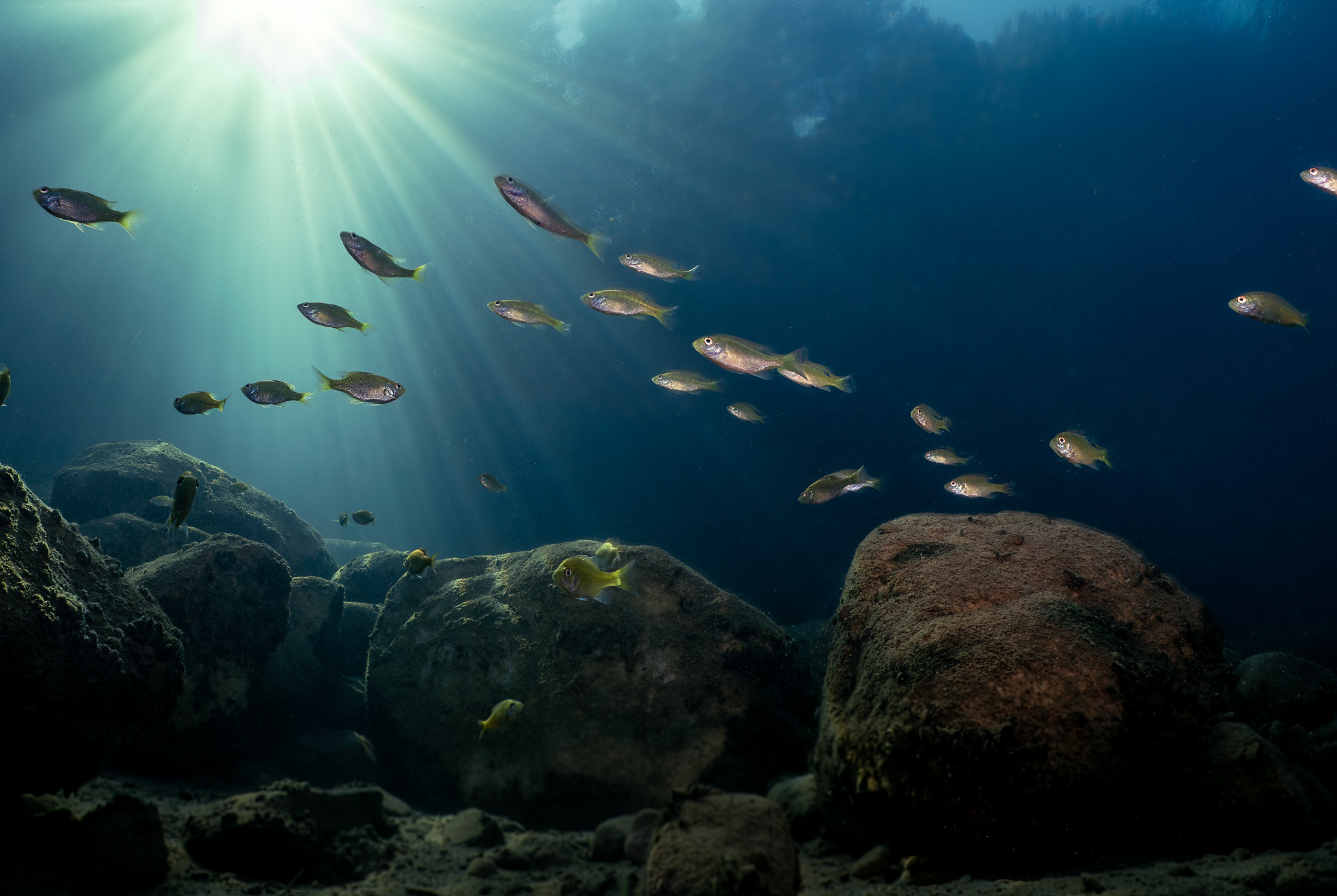
Posted this one to the Minnesota Scuba Facebook group. Someone responded, “wall hanger.”
At this point there was a bit of decompression to do so Heather motioned to level up.
Around 70 feet the wall turned more vertical, and the visibility began to slip. Gradually, at first. Then it wasn’t gradual at all.
We were scootering along the wall when I nearly ran square into a tree.
It had apparently grown along the original shoreline before the mine filled in, and now sat 70 feet underwater. At that point I could see maybe five feet ahead. Enough to see where you were going, barely. Not enough to make scooting around particularly sensible.
Heather went around it.
I went over it.
And that was the last time I saw her. On the other side of the tree, the visibility had collapsed to a foot or two.Our lost-buddy procedure is simple. Heather searches, I stay put and fire my camera strobes in different directions, because strobes are absurdly bright underwater ~ far brighter than any dive light, and visible from a genuinely long way off in “clear” water.
It’s a good plan.
Not good enough for that day.
I stayed where I was and fired the strobes. No Heather. After three minutes ~ the limit we’d agreed to beforehand ~ I started up on my own.
I wasn’t worried about Heather. We’re both comfortable diving independently, and she’s about the last person on earth I’d bet against in a bad-visibility situation. But by then I couldn’t see more than a few inches past my mask, and things got more interesting when I realized I could no longer read my dive computer.
I could see it glowing. I couldn’t read it.
Depth. Ascent rate. Deco time. All of it sitting somewhere behind a wall of white.
So I found the mine wall with one hand and used that instead. No visual reference, so the rock became my depth gauge ~ face a few inches from the stone, moving up in inches at a time.
Slowly.
Really slowly.
A few years ago, this would have unraveled me. I wouldn’t have willingly put myself 150 feet down in a mine pit in the first place, let alone blind at 70 feet with a computer I couldn’t read. Instead I was oddly, almost inconveniently calm ~ mostly ~ working my way up a rock wall by feel, waiting for the world to reappear.
The cloud came with me the whole way.
At 20 feet my computer was still an illegible glow.
Then, almost without transition, it ended. One moment I had a white wall inches from my mask. The next I could see fifty feet in every direction ~ like pulling your head out from under the blankets.
And there was Heather.
Heather hovering just above the fog layer ~ clear water on top, another world dissolving into white just beneath.
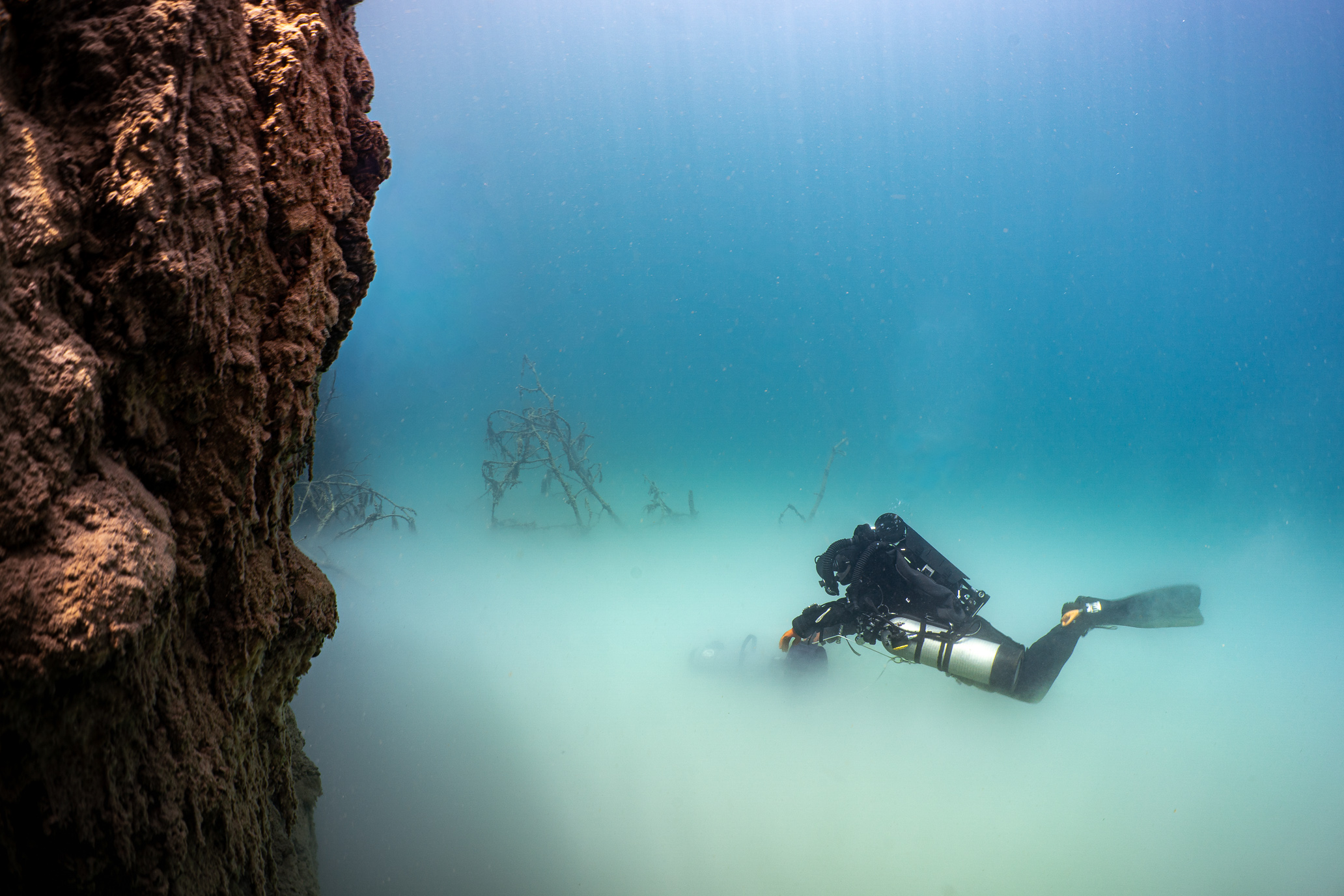
She’d already come through and was hanging in the clear water twenty feet off, waiting. We looked at each other and laughed ~ the particular, slightly unhinged laugh that shows up after something goes fine that had every right not to. Which sounds completely unhinged in the loop of a rebreather.
Then we looked down.
Heather was floating just above the cloud, her scooter dangling below her into it and vanishing completely a few feet down. In the clear water she was perfectly visible. Below her, nothing — like she was hovering over a low bank of fog from an airplane window, except the fog was twenty feet underwater and we were the ones in the sky.
I’ve heard hydrogen sulfide mentioned as an explanation for layers like this, particularly in caves. Maybe that’s what it was. Maybe not. I’ve never run into anything quite as dramatic anywhere else in the Midwest ~ a layer so fine it looked like smoke, dense enough to cut visibility to inches, with an edge so clean that a few inches was the entire difference between seeing nothing and seeing fifty feet.
We spent our decompression time up there, mostly just floating above it, taking pictures of something that looked considerably more like another planet than a flooded mine in northern Minnesota.
Eventually we worked our way along the wall and around the southern shoreline, where the cloud followed us for another hundred yards or so before it simply stopped.
Just gone, the way it had arrived.
The rest of the dive was a relaxing cruise along the southern shoreline. The light was wonderful, and I stopped to photograph a school of bluegills. I posted one of the photos later to the Minnesota Scuba Facebook group. Someone responded, “wall hanger.”
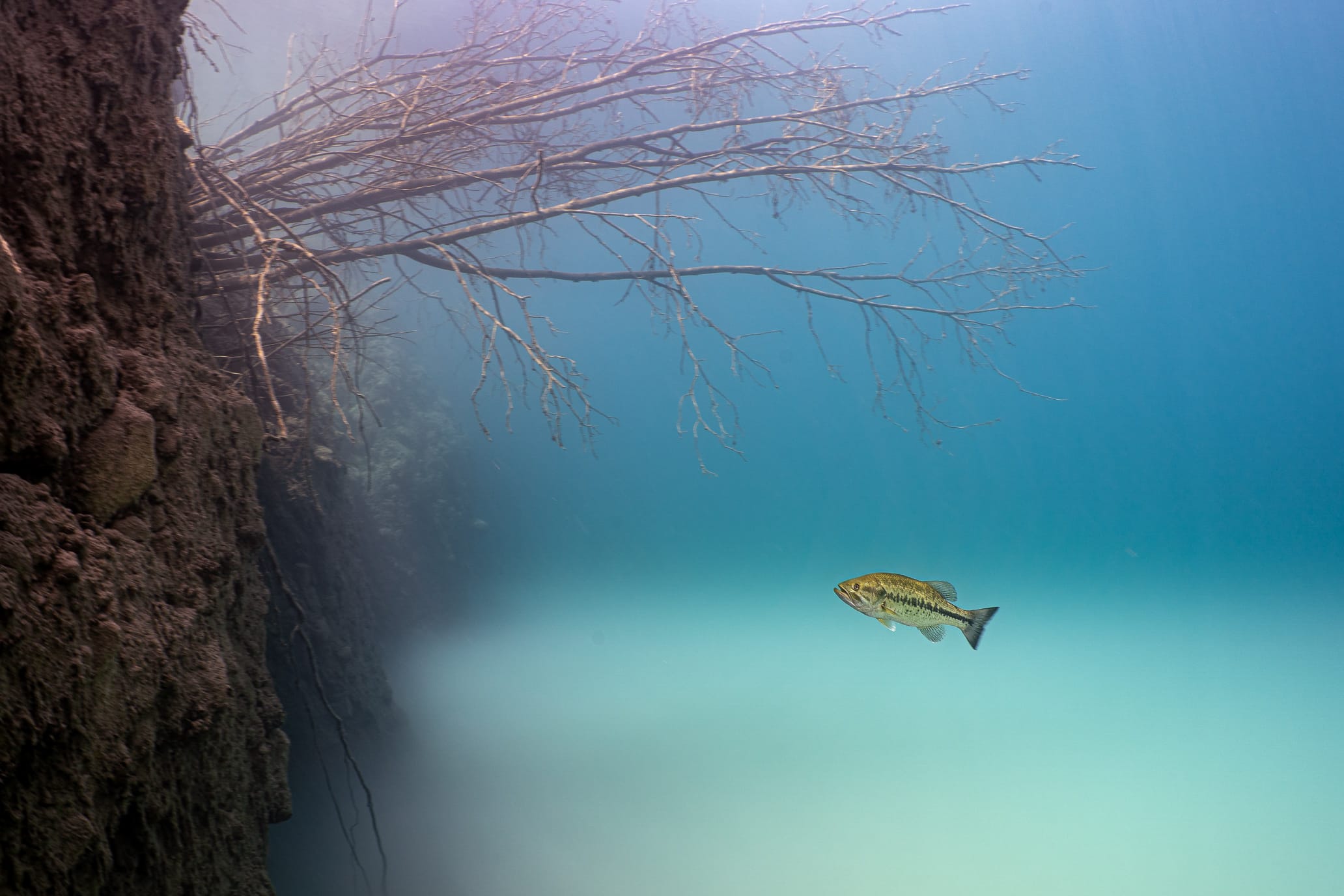
Nothing about this scene looks real, but it is. That's genuinely how strange it felt down there.
After a couple of hours we surfaced on the opposite side of the lake from the car, roughly halfway around. We decided we’d had enough. There wasn’t much point in spending another couple of hours completing a lap we had never intended to make.
So we pointed the scooters north and crossed the lake on the surface, with 465 feet of former mine beneath us.
We stayed on top.
We spread our gear out along the dock, which at this point looked less like two divers getting ready to leave and more like a small scuba shop having a sidewalk sale. Drysuits, tanks, scooters, cameras and assorted bits of dive equipment were scattered everywhere. We have apparently never learned to travel light.
Gear covering every inch of the dock ~ and then the mergansers went by, traveling light, needing none of it.
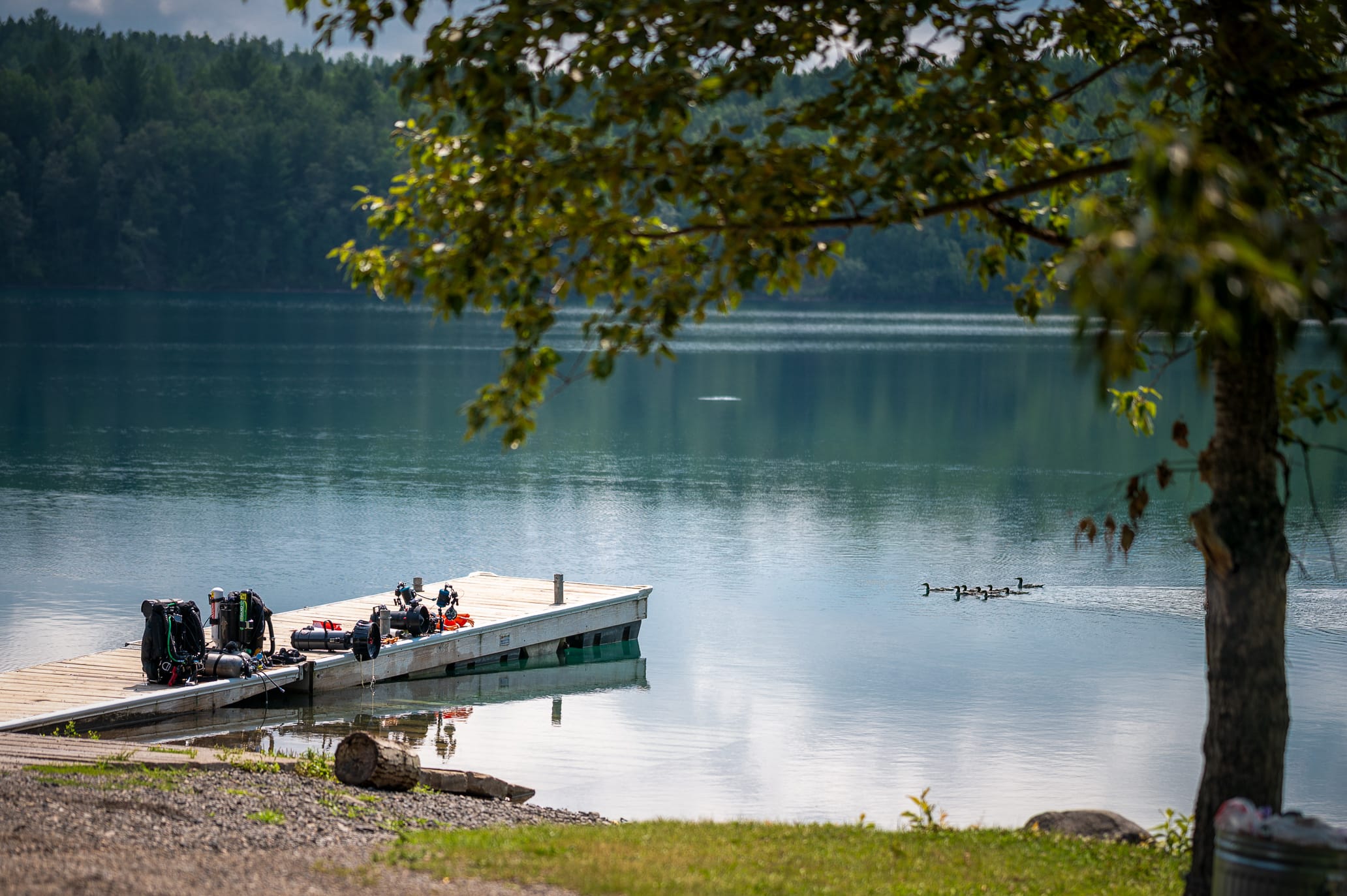
It was my deepest dive to date, but that’s not what I’ll remember.
I’ll remember that ascent. Floating in that white cloud, unable to see my computer, keeping one hand on the rock and slowly working my way upward. A few years ago, that would have rattled me badly. This time, I kept my wits about me.
Mostly, I’ll remember the cloud.
That strange, impossibly dense layer of white water with a sharp edge, where a few inches of depth separated complete blindness from fifty feet of visibility. We had spent the dive exploring an old mine pit, but for a while it felt like we had found something else entirely.
Something otherworldly.
We were floating above the clouds.